
Related videos:
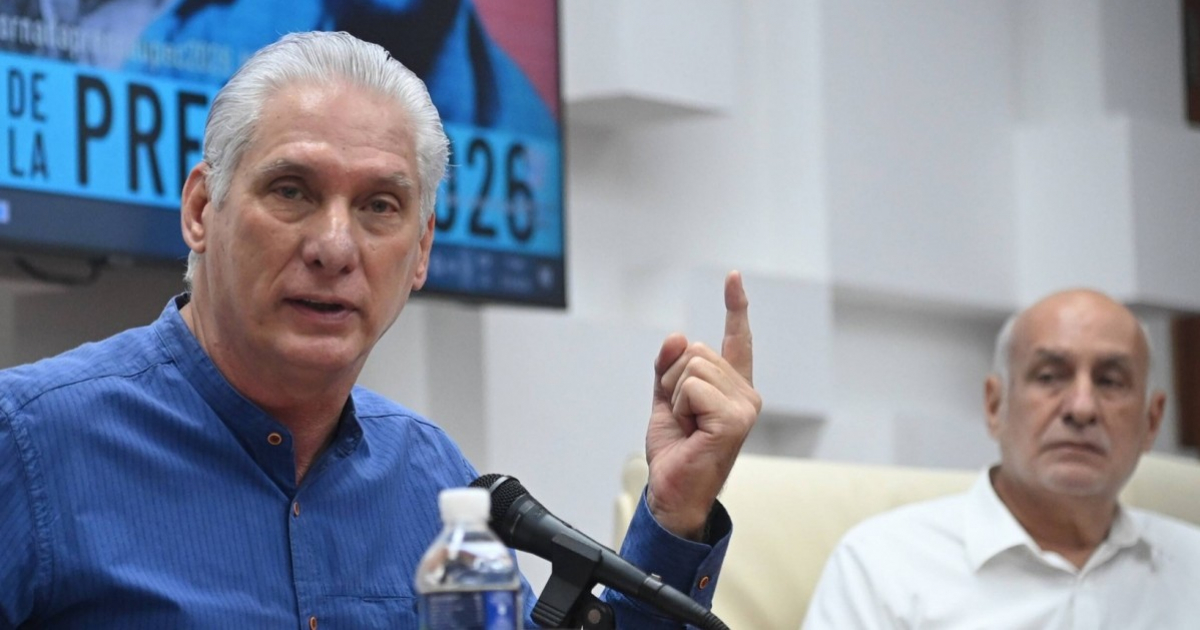
The Cuban leader Miguel Díaz-Canel once again praised the state media and reaffirmed its role within the country's political system during a meeting with representatives of official media on the occasion of Cuban Press Day.
In a message on Facebook, Díaz-Canel described the meeting as an exchange that was "frank and instructive" with media professionals who, he stated, face challenges in informing the public.
"It is an honor to share the same trench with them in the defense of truth and the vindication of Cuba," he wrote about the voices working in the state-controlled media.
A repeated speech in the face of a deep crisis
The meeting was widely covered by the state newspaper Granma, which stated that the press sector "is battling and innovating" amidst difficulties.
According to the report, the leader spoke with more than 80 representatives from print, radio, television, digital media, and agencies, as well as specialists in social networks and executives from the state communication system.
During the meeting, Díaz-Canel reiterated the narrative that the regime has been repeating for years: the official press as an "ideological trench."
He stated that state media are on the "front line" of what he described as a global confrontation against the country, which he called a "sixth-generation war," a mix -in his words- of ideological, cultural, and communicational warfare.
He urged journalists to strengthen their role in that media battle and to utilize technological tools such as social networks, digital platforms, and artificial intelligence to defend the official narrative.
He also referred to the decline of printed newspapers and suggested that paper versions should publish more reflective texts, with greater depth and literary value, while immediate information would be reserved for digital platforms.
A press aligned with power
During the meeting, the leader reiterated that the Cuban press must be "up to the standards of the revolution" and that its role is to promote popular participation, unity, and social control.
His speech once again highlights the subordinate role that official media play within communism, where the press does not act as a counterbalance or as a watchdog of the government, but rather as a means of disseminating the Party's discourse.
In Cuba, there are no legally independent media or freedom to practice journalism outside of state structures. Journalists who try to work autonomously often face harassment, surveillance, interrogations, detentions, or forced exile.
Díaz-Canel's praise for the state media contrasts with the reality of a media system that responds directly to political power and often reproduces the government's messages without question.
An evident disconnection with what is happening in the country
The leader's statements came at a particularly tense moment for the country, marked by protests and growing social unrest.
The contrast was particularly evident on Saturday, when Díaz-Canel congratulated the state media while the images of what happened the night before in Morón were still echoing.
In the municipality of Avila, hundreds of citizens took to the streets amidst blackouts, food shortages, and the general deterioration of living conditions.
The protesters banged on pots, marched with flashlights, and chanted slogans like "Freedom!" and "Homeland and Life!".
A group stood in front of the Police Unit shouting "Freedom!", with their faces uncovered, while the thugs merely watched from the doorway.
Other videos shared on social media showed how protesters entered the municipal headquarters of the Communist Party and took out furniture, documents, and political propaganda which were then set on fire in the middle of the street.
During the unrest, it was also reported that a young man was allegedly injured by police gunfire, although the authorities have not officially confirmed this event.
While all this was happening, the state media provided a very different version of events.
The provincial newspaper Invasor described the events as mere "vandalistic acts" carried out by a group manipulated from outside and assured that calm reigned in the city.
The official coverage ignored the causes of social discontent and reduced the protest to an isolated incident, in line with the regime's usual narrative.
Interrupted internet and arrests
Following the outbreak of the demonstrations, residents and activists reported an Internet service outage in Morón that hindered the circulation of images and testimonies in real time.
Independent organizations also reported detentions in the context of the protests.
The legal organization Cubalex has reported at least 14 arrests linked to the wave of protests that took place in March, which began on the 8th of this month following the collapse of the Antonio Guiteras thermoelectric plant.
The energy crisis has further exacerbated the shortage of food, fuel, and basic goods, fueling social unrest.
The press that power celebrates
In the midst of this scenario, Díaz-Canel's discourse on the "trench of truth" and the role of the state media is disconnected from the reality faced by millions of Cubans.
While the ruler praises the media that echo his political narrative, a growing segment of the population is turning to social media and independent outlets to find out what is really happening in the country.
International organizations have also harshly questioned the situation of journalism on the Island.
The organization Reporters Without Borders ranked Cuba 165th out of 180 countries in its 2025 World Press Freedom Index, marking one of the worst results on the continent.
The official Díaz-Canel was included in 2021 in the list of "press predators" compiled by that organization following the repression of the protests on July 11 of that year.
Despite this, the ruler continues to present the state media system as a model of independence and commitment to the truth, a narrative that increasingly contrasts with the perception of many citizens who see these media outlets as an extension of the regime's propaganda apparatus.
Filed under: