
Related videos:
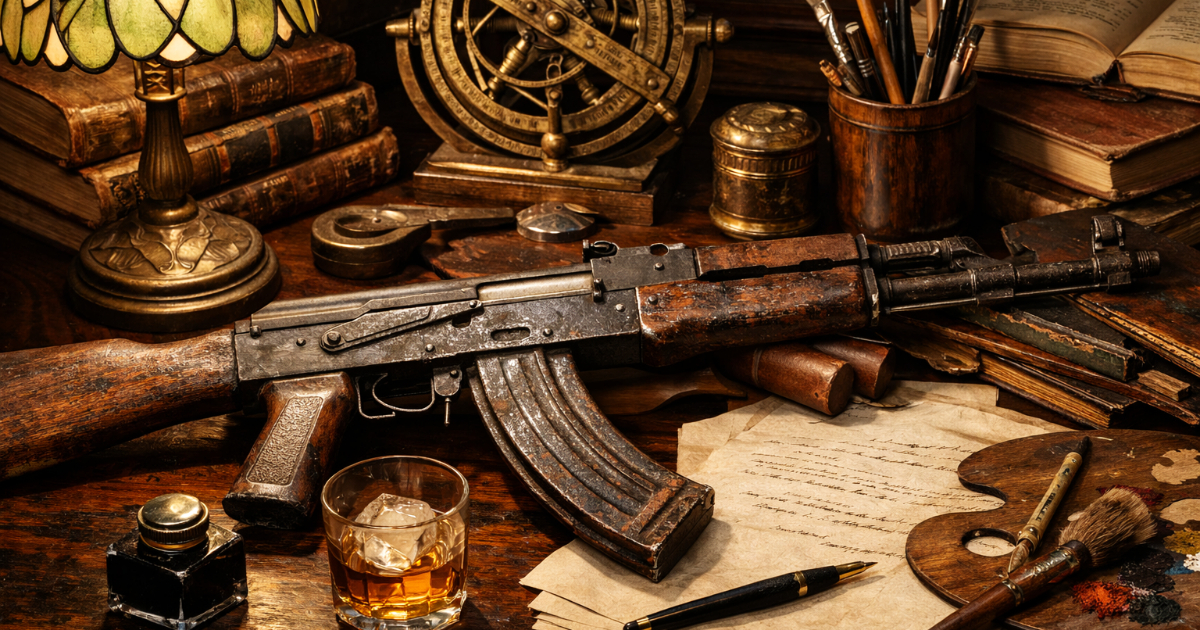
The phrase leaves little room for ambiguity: “I demand my AKM, if they launch it. And let me emphasize, I’m saying this very seriously.”
At the age of 79, Silvio Rodríguez once again positioned himself — at least symbolically — in the trench of armed defense of Cuba against a potential intervention by the United States.
It was not an isolated outburst. It was, in fact, a fairly accurate synthesis of a position that has been held for decades: internal criticism, yes; a break with power, no.
But that declaration, when read in light of his own words over the past years, reveals a contradiction that is hard to ignore. What does it truly mean to defend the “sovereignty” of a country where the citizen has no effective political rights? Who is really being defended?
In theory, sovereignty resides in the people. Not in the State, not in the government, not in a political elite, nor in a historical process frozen in time. However, in the official Cuban discourse —and Silvio is not exempt from this— sovereignty has shifted: it is no longer the power of the citizens, but rather the preservation of the system that governs them.
Thus, defending sovereignty ultimately translates to defending power in practice. There lies the core of the problem.
Silvio has acknowledged, with varying degrees of clarity, that there are serious errors in Cuba: disproportionate sentences, political repression, fear, mass emigration, material deterioration, and a system that has become a “burden.”
He has even said that the people could end up confronting the government. These are not minor statements. But when it comes time to take an absolute stance, his compass always points in the same direction: close ranks against the “external enemy”.
And it is there that the contradiction becomes more evident.
Because there has not been heard a demand for fundamental rights of Cubans with the same force—neither symbolic nor real. There is no "I demand the freedom of political prisoners", or a "I demand free elections". Instead, there is an "I demand my AKM."
The contrast is uncomfortable.
Why this willingness to confront when the conflict is external, and this caution when the problem is internal? The answer is not just personal; it is structural.
For decades, the revolutionary discourse has established an almost automatic equivalence: homeland, state, government, and "revolution" are the same. Within that logic, questioning authority is not an act of citizenship, but a threat to the nation.
And so, the moral order is reversed.
The defense of sovereignty —understood as resistance against the United States— takes precedence over the protection of fundamental rights. First the "homeland", then the citizen. First the "epic", then freedom. The problem is that this "after" never arrives.
Contemporary international law is quite clear on this point: sovereignty is not a blank check. It is a responsibility.
A state that does not guarantee basic freedoms, that limits political participation, that represses dissent, or that condemns its population to precarious living conditions cannot indefinitely hide behind sovereignty to justify its actions.
Sovereignty without free citizens is, at best, a legal fiction; at worst, a tool of control.
From that perspective, the question is not whether Cuba should defend itself from external aggression—every country has that right—but rather what it is exactly defending itself against.
Because if the "sovereign" —the people— cannot express themselves, organize, or choose, the defense of sovereignty becomes the defense of a power that operates without that people.
The figure of Silvio Rodríguez embodies that tension like few others. He is someone who sees the cracks, who half names them, who whispers them.
But he is also someone who, when the decisive moment arrives, does not cross the line. His loyalty to the so-called "revolution"—more emotional than political at this point—still weighs more than his criticism.
That’s why their “AKM” is primarily a symbol.
Not a real war, but rather a foolish loyalty: to an idea of a country where sovereignty is defended externally, but rarely exercised internally. Where the enemy is always outside, even though repression and frustration grow within. Where the people are invoked, but are given little space to be truly sovereign.
The paradox is evident: one is willing to fight for the sovereignty of the dictatorial State, but not to confront with the same firmness the lack of sovereignty of the Cuban people.
And that, more than any statement, is the contradiction that defines not just Silvio Rodríguez, but an entire political narrative that has, for decades, confused power with homeland and loyalty with silence.
Filed under:
Opinion article: Las declaraciones y opiniones expresadas en este artículo son de exclusiva responsabilidad de su autor y no representan necesariamente el punto de vista de CiberCuba.