
Related videos:
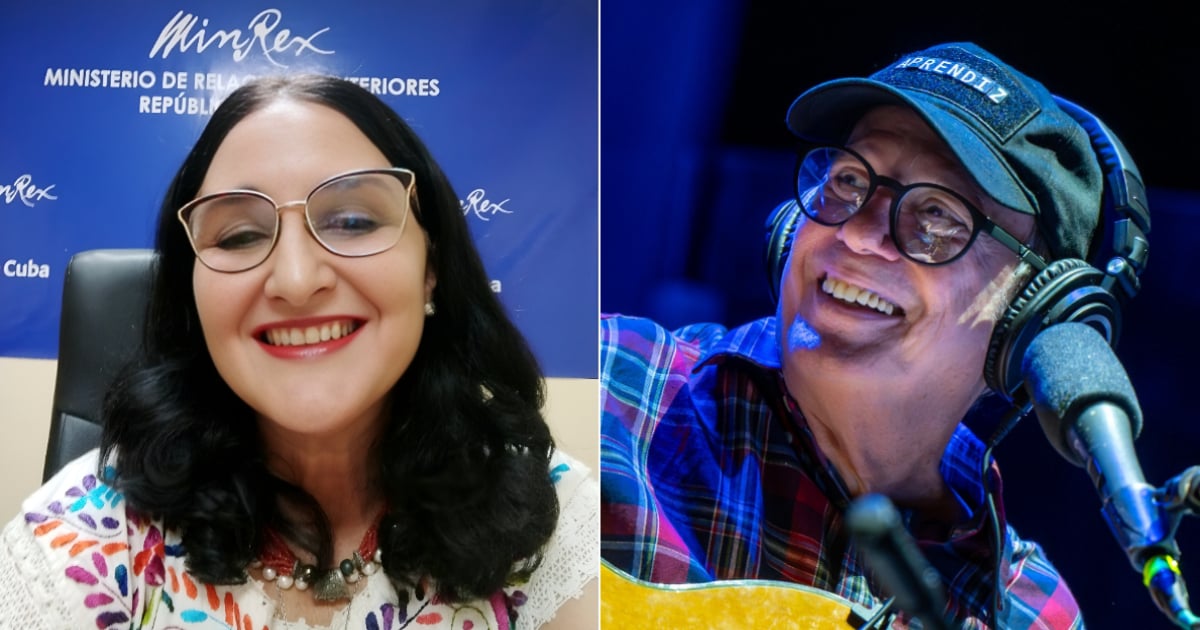
The Cuban diplomat Johana Tablada de la Torre, the Deputy Director General for the United States at the Ministry of Foreign Affairs (MINREX), has once again demonstrated her ideological fervor and her role as the emotional spokesperson for the regime.
In an extensive post on social media, the official described Silvio Rodríguez as “a great ambassador of revolutionary Cuba” and devoted entire paragraphs to praising his recent international tour as a “transformative and unforgettable event.”
The text, saturated with adjectives and a nearly religious devotion to the troubadour, clearly illustrates the symbiotic relationship between Cuban political power and its cultural apparatus.
Tablada de la Torre writes: “Silvio helps to awaken us from the anesthesia with which those who believe they own the world want to lull us to sleep.” And he elevates him to the rank of “humanist ambassador” of the so-called “revolution,” a title that, coming from a diplomat of the regime, sounds less like an artistic commendation than a political canonization.
Behind Tablada de la Torre's words lies an old mechanism: the instrumentalization of Silvio Rodríguez as a symbol for the external legitimization of Castroism.
For decades, the author of 'Ojalá' and 'El necio' has served as a symbolic bridge between the old revolutionary utopia and the current reality of the country—a reality marked by scarcity, repression, and mass migration.
While the Cuban people survive amid blackouts and endless queues, Tablada de la Torre and other official spokespersons cling to an epic narrative where privileged artists are showcased as representatives of a people who no longer recognize them.
His praise for Silvio is not innocent: it seeks to reaffirm, from nostalgia, the relevance of an exhausted political project.
The international tour of the troubadour, which went through countries such as Chile, Argentina, and Mexico, was described by Tablada as a "tour of light," an act of "cultural resistance," and "historical memory."
In his interpretation, each song by Silvio would be a reaffirmation of the revolutionary ideal. However, what the official omits is that this very ideal has long ceased to inspire the majority of Cubans, who are now busy escaping the system she defends from the comfort of her diplomatic position.
Silvio Rodríguez, for his part, embodies the contradiction of a generation that transformed conformity into coherence. While he occasionally offers timid critiques of the situation in Cuba, his loyalty to the power structure remains intact.
In recent interviews, the singer-songwriter has insisted on his adherence to the revolution, even as he admits that "not everything can be blamed on the embargo." He is, as he himself sang, a fool: an artist who prefers fidelity to the myth over commitment to the truth.
Both —Tablada de la Torre and Silvio— are distinct pieces of the same cultural legitimization machinery. She, through the diplomatically polished language of “humanist” rhetoric; he, through poetic nostalgia and the moral authority that comes from having been the voice of an era.
Together, they represent the intellectual version of the ideological apparatus of the Cuban totalitarian regime: an elite that speaks of social justice while living off the privileges of the system that oppresses the rest.
Tablada's admiration for Silvio's "revolutionary diplomacy" reveals, moreover, the regime's strategy: to present itself to the world not with tanks or party speeches, but with troubadours and metaphors.
It is the soft power of Castroism, which disguises itself as culture and sensitivity while censoring, monitoring, and punishing within the island.
It is ironic that the official praises a tour that, in her own country, would have been impossible to organize freely for other troubadours with different messages. In Cuba, music and art in general remain closely monitored: independent artists are repressed for singing, painting, or writing what they think, and stages are reserved for those who do not challenge the official narrative.
Thus, while Tablada de la Torre proclaims that Silvio is an "ambassador of revolutionary Cuba," the Cuban people continue to be the true exiles of that revolution. Neither poetry nor diplomacy can mask the failure of a system that survives only through propaganda and its old symbols.
And in that ideological theater, Silvio Rodríguez and Tablada de la Torre each act in their role as loyal intellectual henchmen of a dictatorship that has long lost its stride and its songs of heroism.
Filed under: