
Related videos:
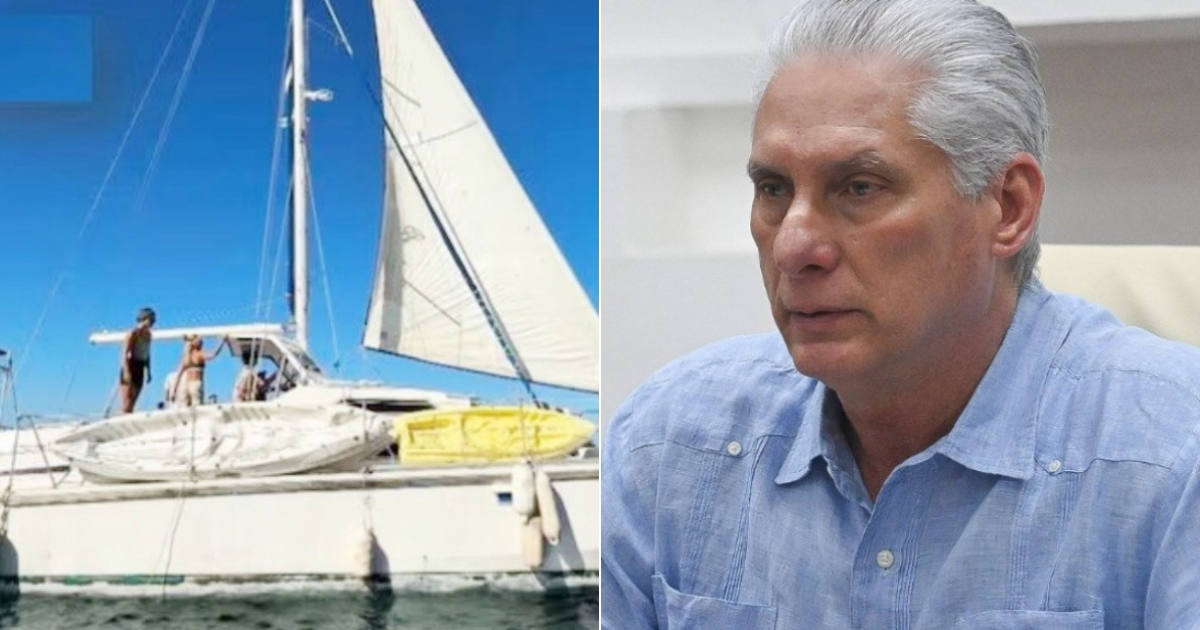
The ruler Miguel Díaz-Canel revealed on X that Cuba is participating in the search for the two sailboats that were traveling to the Island with aid and have been reported missing in the Caribbean for several days.
"We express our special concern for the two Mexican vessels that were transporting humanitarian aid to Cuba as part of the Convoy Nuestra América," he wrote.
"From our country, we do everything possible in the search and rescue of these brothers in struggle," he added.
The two vessels loaded with humanitarian aid and with nine people on board -including a three-year-old child- departed from Isla Mujeres, Quintana Roo, heading to Havana.
Their arrival was expected between March 24 and 25; however, they never arrived, and there has been no trace of them until now.
The alert was confirmed by the Mexican Navy (SEMAR), which activated an emergency operation due to the lack of communication with the sailboats.
In an official statement, the institution reported that "the Marina Plan was activated in its Search and Rescue (SAR) component, with the aim of locating two sailing vessels with 9 crew members of different nationalities."
Authorities acknowledged that, despite the time that has passed, "there has been no communication or confirmation of their arrival," which has heightened concerns about the status of the crew members.
A humanitarian journey that ended in uncertainty
The vessels were part of the "Nuestra América" convoy, an initiative by activists that transported humanitarian aid to Cuba amid the severe economic crisis the island is experiencing.
The group was transporting a total of nearly 30 tons of supplies, including food, medicine, hygiene products, and solar panels.
Although other ships in the convoy managed to reach their destination, these two sailboats fell behind after delaying their departure due to adverse weather conditions.
According to data released by the agency EFE, there were two women, six men, and a three-year-old child on board.
In the absence of news within the expected timeframe, the Mexican Navy immediately activated its response mechanisms.
The institution emphasized that the decision stems from its duty to protect lives at sea: "the corresponding protocols were activated immediately, in fulfillment of the responsibility of the Mexican state to safeguard human life at sea."
The operation includes a broad deployment of naval and air resources along the estimated route between Mexico and Cuba.
According to SEMAR, "the deployment of surface and air units has been carried out, including Persuader-type aircraft," which execute search patterns taking into account ocean currents, weather conditions, and possible course changes.
In addition, the authorities are maintaining "continuous monitoring and ongoing analysis of the available information," with the goal of adjusting the search areas and increasing the likelihood of finding what they are looking for.
The search has also activated mechanisms for international cooperation. Mexico is in contact with maritime rescue centers and authorities from several countries.
According to the statement, there is coordination with entities from Poland, France, Cuba, and the United States, "in order to strengthen cooperation and real-time information exchange."
In parallel, the Coast Guard has requested support from those navigating in the area.
The institution made "a respectful appeal to the national and international maritime community (…) to report immediately any information or sightings of the mentioned vessels."
As the search efforts progress, the case keeps families, activists, and authorities on edge in a race against time.
Filed under: