
Related videos:
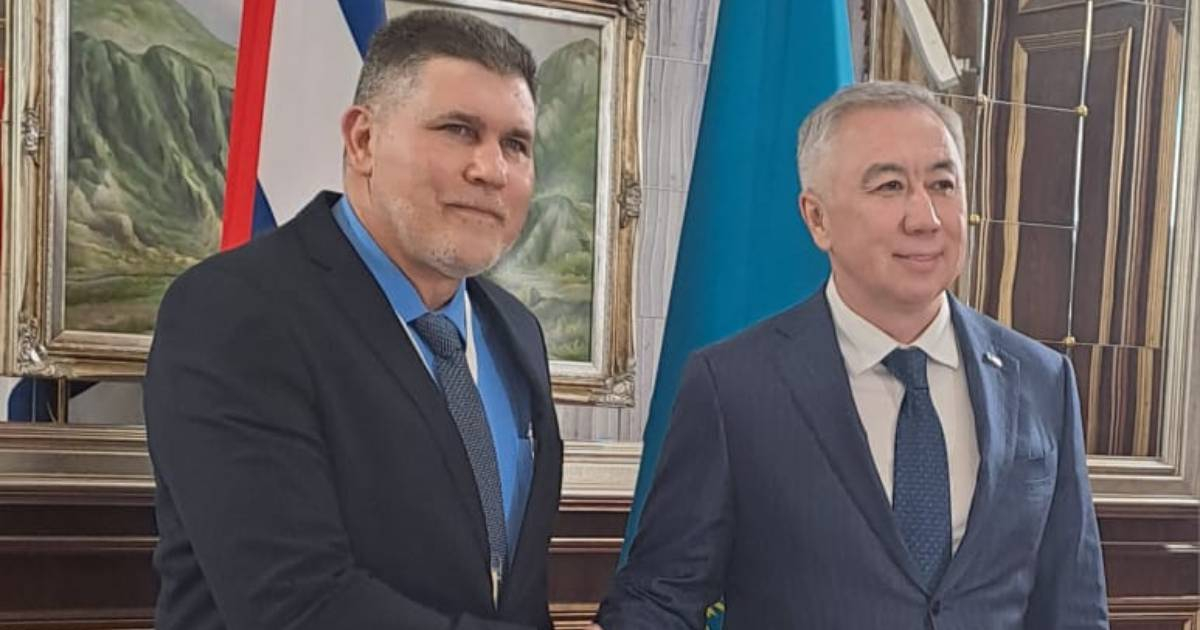
The Cuban Deputy Prime Minister Óscar Pérez-Oliva Fraga participated on Thursday and Friday in the meeting of the Eurasian Intergovernmental Council held in Shymkent, Kazakhstan, where he reiterated the regime's intention to transform Cuba into a regional productive logistics hub based on the Mariel Special Development Zone.
In his speech before heads of government and delegations from the five member countries of the Eurasian Economic Union (EAEU) —Russia, Belarus, Kazakhstan, Kyrgyzstan, and Armenia—, Pérez-Oliva urged moving from words to action: "It is necessary to enter a new stage of defining and implementing joint projects."
The official promoted areas of cooperation such as health tourism, the biopharmaceutical industry, food and energy security, the chemical industry, and digital transformation, and reported that the Mariel logistics hub project will be formally presented at the upcoming Eurasian Economic Forum.
"We must adopt a more comprehensive and strategic vision of the role Cuba can play as an extra-regional partner for the expansion of the activities and presence of the Eurasian Economic Union in our economy and in Latin America and the Caribbean," stated Pérez-Oliva.
This year, Cuba marks five years as an Observer State of the EAEU and has submitted for approval a Joint Collaboration Plan for 2026-2030, which it aims to sign in the first half of this year.
The proposal for the logistics hub is neither new nor has it produced concrete results. In June 2025, Díaz-Canel presented it at the IV Eurasian Economic Forum in Minsk. In August of the same year, Prime Minister Manuel Marrero Cruz reiterated it electronically before the Intergovernmental Council in Kyrgyzstan. In December, Marrero repeated the message from Moscow.
The Mariel Special Development Zone, built with a loan from the Brazilian bank BNDES of approximately 862 million dollars, has been operating at 40% of its capacity since its opening in 2013 and is controlled by GAESA, the military conglomerate that dominates about 40% of the Cuban economy.
The participation of Pérez-Oliva also has a political reading. The nephew of Fidel and Raúl Castro,
In his speech, the official also condemned the Executive Order signed by Trump on January 29, which imposed tariffs on countries that export oil to Cuba, labeling Washington's policy as an "illegal and arbitrary" pressure on the island.
Despite the rhetoric of sovereignty, the underlying message highlights the regime's urgency to attract investment and economic support from its Euro-Asian allies amid an energy and economic crisis that Pérez-Oliva himself acknowledged by mentioning "a difficult situation in the availability of fuels."
The Fifth Astana Forum, scheduled for May 28 and 29 under the theme "Digital Transformation and the Economy of Trust," will be the next platform where the regime will attempt to turn its repeated promises about Mariel into concrete agreements.
Filed under: