
Related videos:
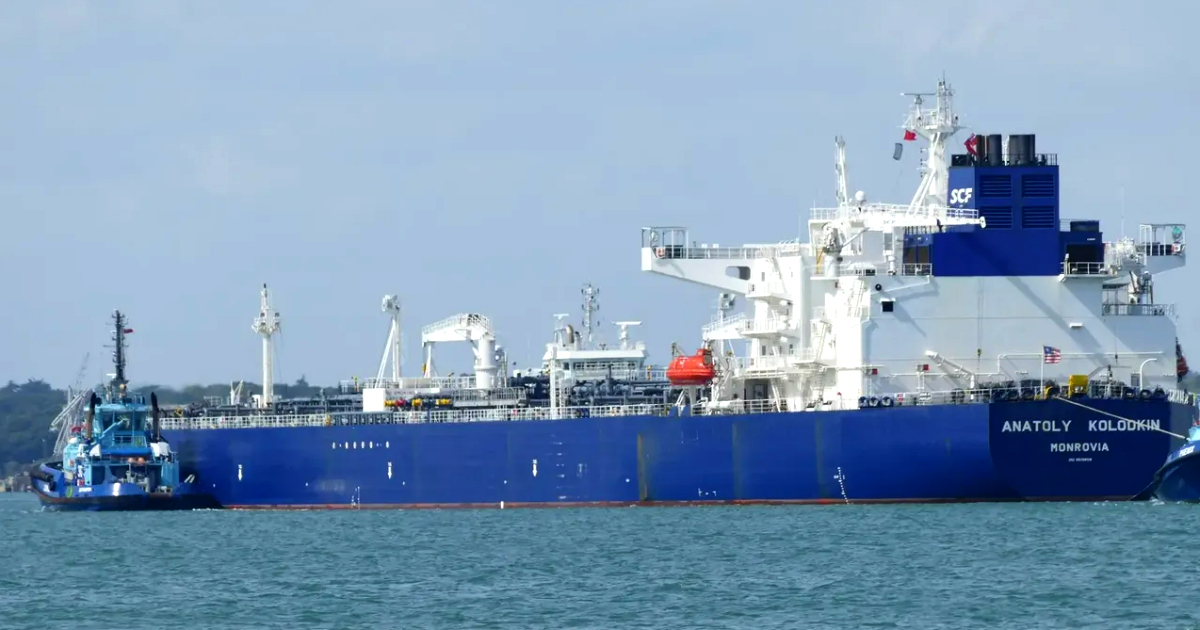
The arrival in Cuba of the Russian tanker Anatoli Kolodkin, a vessel sanctioned by the United States and connected to the so-called “ghost fleet” of Moscow, has highlighted the real limitations of the energy blockade imposed by Washington against the Cuban regime.
The episode occurs at a critical moment for the island, characterized by prolonged blackouts, fuel shortages, and a growing economic paralysis that directly affects the population, exacerbating a humanitarian energy crisis.
In that context, the arrival of a shipment of over 700,000 barrels of Russian crude oil represents a temporary relief for the energy system, but also raises questions about the effectiveness and coherence of the U.S. sanctions framework.
At first glance, the case appears contradictory. Days earlier, the Office of Foreign Assets Control (OFAC) had made it clear in its General License 134A that this temporary authorization for dealings with Russian oil does not include Cuba. Nevertheless, the ship ended up unloading on the island.
The key is to understand that the sanctions from the United States do not function as an absolute physical blockade, but rather as a system of pressure structured on multiple levels.
On one hand, the executive order signed in January 2026 by President Donald Trump established a mechanism to penalize countries that supply oil to Cuba, .
On the other hand, OFAC translates this policy into concrete rules. License 134A introduces a limited exception for closing ongoing operations with Russian oil, but explicitly excludes Cuba.
This means that entities under U.S. jurisdiction—such as banks, insurance companies, or businesses—cannot engage in transactions involving the island under that license.
However, there is a third dimension that is crucial: the practical enforcement of sanctions. The United States controls its financial system and can exert pressure on international actors, but it does not have the automatic ability to prevent all global transactions.
If a shipment is completely structured outside of that system —without the involvement of entities under U.S. jurisdiction— it may be executed.
This appears to be the case with Anatoli Kolodkin. Being a vessel that has already been sanctioned, its use fits within the logic of the so-called Russian "ghost fleet," designed to operate outside the Western system and minimize direct exposure to sanctions.
However, this pattern is not consistent. The United States has intervened in other cases against ships linked to the same network, whether through additional sanctions, pressure on insurers, interdictions, or operational restrictions, which shows that it does have tools to hinder this type of shipment.
In that context, the fact that Moscow has acknowledged that the shipment was coordinated or, at the very least, not blocked by Washington introduces a crucial nuance: more than just a simple evasion operation, the case also points to a margin of political tolerance.
The use of this type of vessel thus responds not only to strategies for evading sanctions but also to scenarios in which the United States decides to what extent it applies—or does not apply—its pressure capabilities.
In this context, the arrival of the tanker does not invalidate the legal framework of the United States, but it does reveal its practical limits.
Sanctions can restrict, raise costs, and deter, but they do not always succeed in completely preventing certain operations, especially when actors willing to take risks or operate outside the reach of the Western financial system are involved.
Moreover, the case suggests an element of political discretion. Various reports indicate that Washington chose not to escalate the situation to the point of physically blocking the shipment, amid the severe energy crisis faced by Cuba.
Sources cited by various media indicated that the decision was evaluated based on humanitarian criteria, considering the direct impact of fuel shortages on the civilian population. This nuance is crucial: it does not imply a change in the policy of pressure on the regime, but rather a specific and selective application of that pressure.
This type of decision reinforces the idea that the U.S. strategy is not applied automatically but is adjusted according to the context and the political and humanitarian costs of each scenario.
Ultimately, the episode with Anatoli Kolodkin reveals a reality that is more complex than what simplistic interpretations suggest: the energy blockade exists, but it is not airtight.
Between what is prohibited, what is possible, and what is ultimately tolerated, there is a range that defines how sanctions actually operate in practice.
Filed under: