
Related videos:
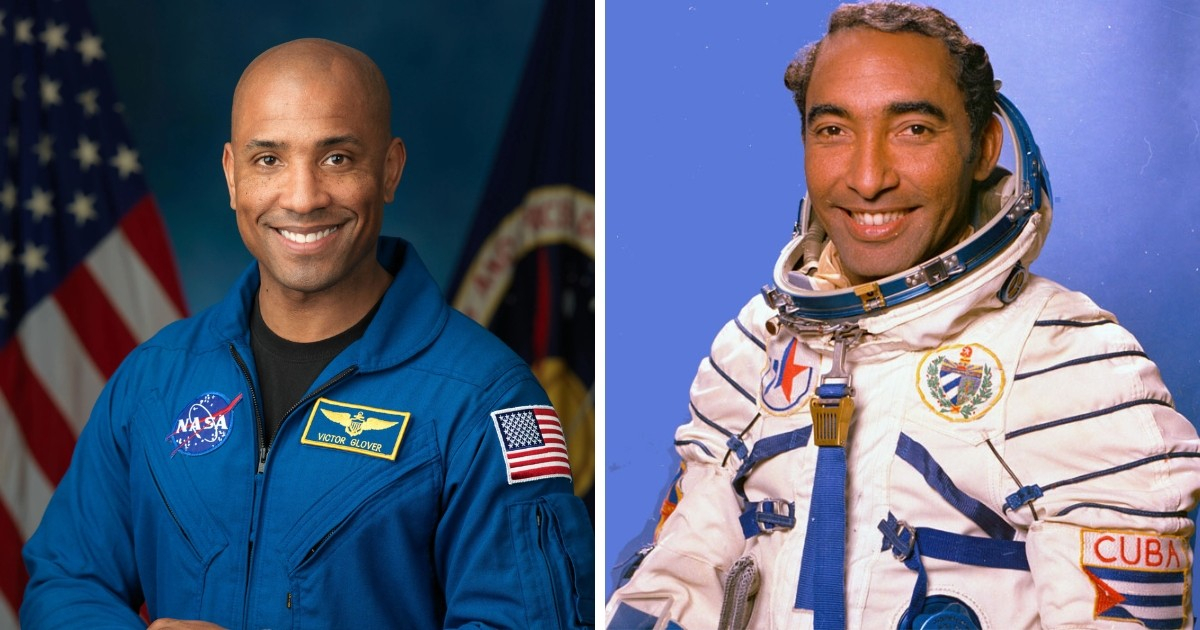
Forty-six years separate two historical milestones achieved by Afro-descendants in space exploration: the Cuban Arnaldo Tamayo Méndez, who in 1980 became the first man of African descent to travel to space, and the American Victor J. Glover, who this year becomes the first Afro-descendant to travel to the vicinity of the Moon aboard NASA's Artemis II mission.
Tamayo Méndez launched on September 18, 1980 from the Baikonur cosmodrome in Kazakhstan, aboard Soyuz 38, as part of the Soviet Intercosmos program. He was selected in March 1978 from 600 candidates and traveled as a research cosmonaut alongside Soviet commander Yuri Romanenko.
The mission lasted seven days and twenty hours, completed 124 Earth orbits while docked to the Salyut 6 station and landed on September 26, 1980.
Tamayo, born in Guantánamo on January 29, 1942, was awarded the titles of Hero of the Republic of Cuba and Hero of the Soviet Union.
The context of that flight was radically different from today: the program Intercosmos, launched by the USSR in 1967, integrated allied socialist countries into space missions for both scientific and propaganda purposes during the Cold War. Cuba joined the program in 1976, and the Central Committee of the Communist Party approved on June 26, 1980 an official propaganda campaign surrounding the mission.
The USSR controlled all technical aspects; Tamayo traveled as a symbolic figure of the socialist bloc.
Glover operates in a completely different context. NASA confirmed him as a pilot for Artemis II, the first crewed mission around the Moon since Apollo 17 in December 1972, over 50 years ago.
The mission launched on April 1 from Launch Complex 39B at Kennedy Space Center in Cape Canaveral, Florida, aboard the SLS rocket with the Orion capsule. The crew consists of commander Reid Wiseman, specialist Christina Koch — the first woman on a crewed lunar mission — and Canadian Jeremy Hansen, the first non-American on a mission of this kind.
Glover, born on April 30, 1976 in Pomona, California, had already made history in 2020-2021 as the first African American on a long-duration mission in the International Space Station, spending 168 days in orbit during Expedition 64.
On April 2nd, the translunar injection maneuver was completed, propelling the Orion capsule towards the Moon. NASA Administrator Jared Isaacman confirmed this Friday that the crew is in good condition and the spacecraft is functioning normally.
It is important to clarify the historical context: Tamayo was the first Afro-descendant in low Earth orbit; Guion Bluford was the first African American in space in 1983 aboard the Challenger, being the second Black man in orbit. Glover is now the first to travel to the vicinity of the Moon.
Artemis II will not land on the Moon, but it will orbit it, photograph its far side, and validate the Orion systems with humans on board for the first time, with the lunar flyby scheduled for April 6 and splashdown in the Pacific, near San Diego, on April 10.
Filed under: