
Related videos:
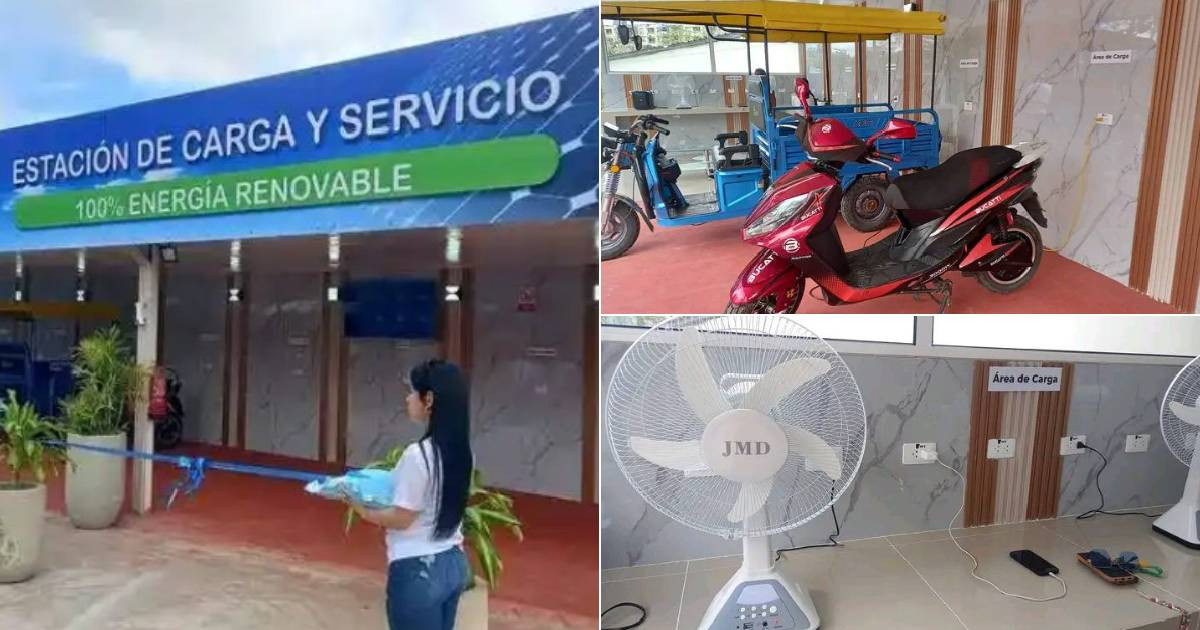
The Virginia popular council, in the city of Santa Clara, inaugurated this Saturday the first solar station in the province of Villa Clara, an energy service station that operates with solar panels, functions entirely independently of the National Electric System (SEN), and provides residents with a space to cook and charge their devices.
According to the report from the provincial station CMHW, the inauguration was led by the Local Development Project (PDL) Gomate, whose director, Julio Ernesto Gomate Morales, emphasized the speed of the construction.
"Today we inaugurate this solinera with great effort and sacrifice, in record time, as we only took nine days to build and assemble it from scratch, starting from the ground up," Gomate stated.
The term "solinera" is a Cuban neologism that combines "solar" and "gas station" to describe an energy service station based on photovoltaic technology.
The installation was carried out by Eléctrica Total, a private company based in the municipality of Ranchuelo. Its co-founder, Reinaldo Andino González, explained that they set up 30 kilowatts of power with 60 kilowatts of battery storage, using 56 solar panels that provide complete autonomy to the solar station, even during hurricanes and other emergencies that extend power outages.
The solar panel has the capacity to simultaneously accommodate six vehicles and 26 dual outlets, allowing for the connection of 52 cooking devices.
The food preparation service will be free for the entire population. The cost for transportation services such as motorbikes, tricycles, and other electric vehicles is yet to be determined, although Gomate Morales assured that it will be kept as low as possible to ensure the project's sustainability.
Zoraima Escobar Poveda, president of the Virginia local council, described the solar station as "a stronghold for the community" and emphasized that it represents a concrete opportunity to address the prolonged power outages in the area.
The initiative arises during Cuba's worst energy crisis in decades, which has led to blackouts lasting over 20 hours a day in various provinces.
In March, the SEN experienced two total blackouts, on the 16th and 22nd of that month, the seventh and eighth in just 18 months.
The crisis intensified following the suspension of Venezuelan crude oil shipments since January 2026 and the halt of Mexican oil exports under pressure from sanctions imposed by the Trump administration.
In response to that collapse, decentralized solutions have emerged such as tricycles with solar panels in Havana and outlets set up in a solar park in Isla de la Juventud.
From the neighborhood, the neighbor Miguel Ángel García Marimón evaluated the initiative with caution. "It's an important step to have a place to charge your phone or cook when there is no power, but there is still a long way to go to resolve the energy issue in the neighborhood; hopefully this is the beginning of more projects like this, because the need is great and the blackouts continue to be very bothersome."
Filed under: