
Related videos:
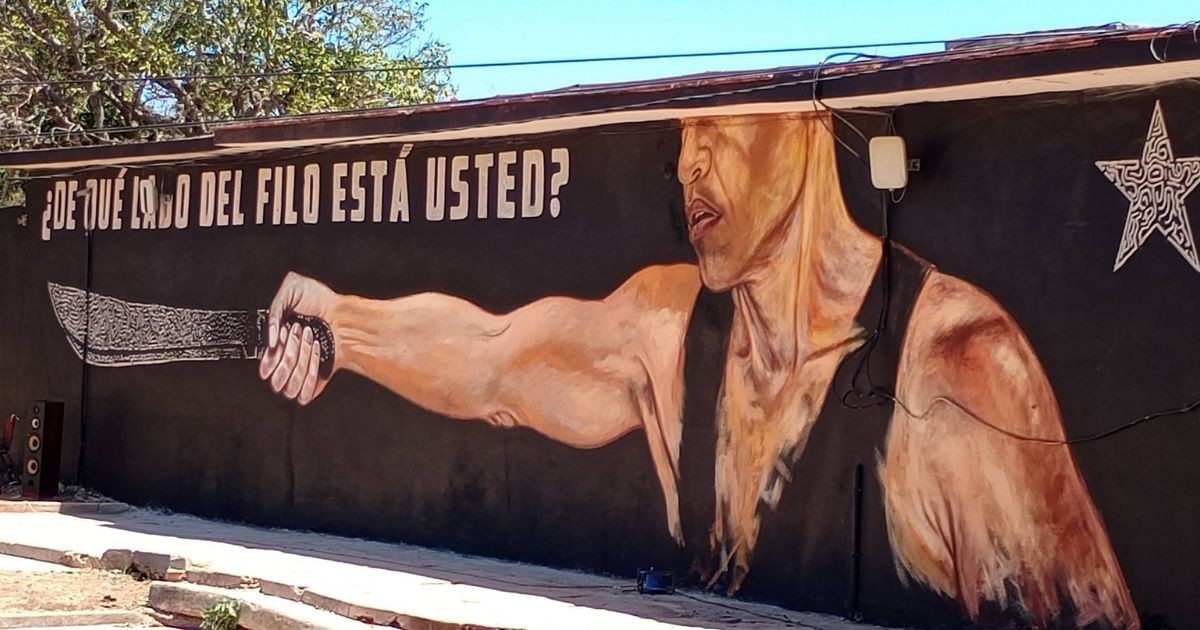
A giant mural inaugurated this Sunday at the José Raúl Capablanca Park, in the Almendares neighborhood of Playa municipality, Havana, directly challenges Cubans with a question that allows for no neutrality: "Which side of the blade are you on?"
The work is a gift from the Chilean artist Sebastián "Ratavirus", who arrived in Havana from Valparaíso, and was completed in a week of intense work alongside the Cuban artists Yurelsy Villalón George, Pablo Francisco, Félix Aguilar, and Néstor Martínez.
The mural depicts a male figure with Afro-Cuban features, of strong build, extending his arm towards the viewer with a machete in hand, set against a black background.
The symbolism is intentional: the machete references the mambises, the Creole and Afro-descendant guerrillas who fought for Cuba's independence from Spain in the wars from 1868 to 1898, machete in hand, demanding freedom, not socialism or communism.
That question also refers to a deeply entrenched logic in the official narrative: that of forcing one to take sides. A dichotomy known in Cuba as "Homeland or death," where there is no room for nuance: you are either with the system or considered an enemy.
Or will the mural be a call to fight for independence, once again?
The extended machete can also be interpreted as a symbolic dividing line, evoking the fractures within the nation itself.
It suggests a divided Cuba between those who remain on the island and those who have left, yet still remain connected to its fate.
The journalist Ania Ortega, who covered the inauguration in two publications on Facebook, emphasized this historical connection and shared her own interpretation: "It is our responsibility to care for Cuba as well. And that depends on each one of us."
The origin of the mural has a particularly significant dimension: it was a personal request from the former Uruguayan president José Mujica, who passed away in May 2025, who told the Chilean artist: "If you go to Cuba, leave something in my name."
Mujica, a historical figure of the Latin American left, had openly criticized the Cuban socialist model in his last years, stating that "that doesn't work" regarding the one-party system.
Ratavirus, which has left murals in Europe and Latin America with themes of social justice —the Grandmothers of Plaza de Mayo in Argentina, the struggles of the Palestinian people, an Allende in Santiago de Chile— did not hide his position: "I stand with the people, I am part of and come from the people", I know the Mapuche struggles."
She described Cubans as "warm, gentle, giving what they have and even what they don't have," and promised to return to the island.
The phrase from the mural immediately triggered a debate on social media.
Raul Ernesto Gutierrez García associated it with the state propaganda program "Con Filo," one of the most criticized and least viewed programs on Cuban television, created in 2021 as a media response to the protests of July 11—and with chess, due to the name of the park honoring world champion José Raúl Capablanca.
Ortega responded firmly: "You didn’t understand. You tried to associate it with that program you mentioned, but the artist DOES NOT KNOW it exists nor has any idea. The name of the park is unrelated to the topic. And the chess is in your head."
The interpretative tension reveals something deeper: in Cuba, the mere word "filo" automatically triggers an association with the regime's propaganda space, which says a lot about the influence that the official media machinery has managed to impose on the collective imagination.
But the machete in the mural does not point to the revolution of 1959: it points to the history of those who fought for freedom long before, and it asks every Cuban where they stand.
Filed under: