
Related videos:
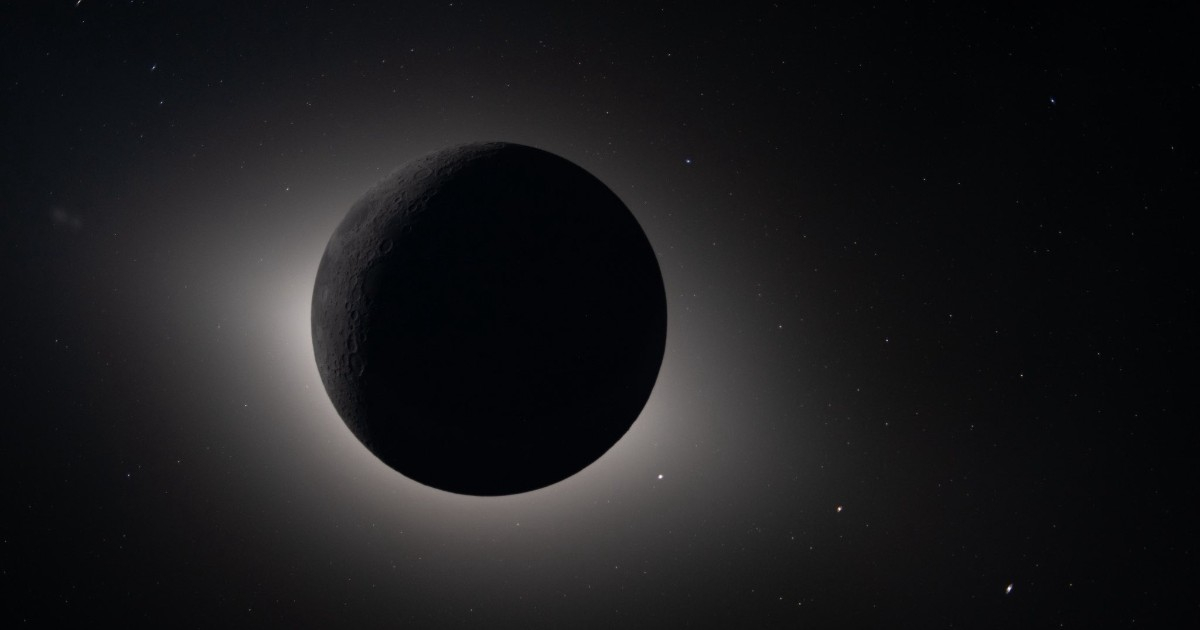
The crew of the Artemis II mission witnessed and photographed a total solar eclipse today from lunar orbit, marking one of the most extraordinary moments of the first crewed flight around the Moon in over 50 years.
The European Space Agency shared images today, describing the event as a view that very few humans have ever witnessed, with photographs credited to NASA.
The eclipse occurred between 8:35 PM and 9:32 PM EDT, with a totality lasting approximately 50 to 60 minutes during which the Moon completely blocked the solar disk.
From the perspective of the Orion spacecraft in lunar orbit, the Moon appears five times larger than the Sun, which ensured a perfect and uninterrupted totality.
The four astronauts wore special glasses to protect their eyes and observed the solar corona — the Sun's outer atmosphere, normally invisible — as a luminous white-silver halo of irregular distribution. One of the crew members described the experience as "unreal".
The eclipse occurred a day after the crew experienced another visual milestone: the "Earthset", when the Earth disappeared behind the lunar horizon at 6:45 p.m. EDT yesterday, followed by the "Earthrise" at 7:25 p.m. EDT, when the planet reappeared on the other side.
During the 40 minutes that the spacecraft crossed the dark side of the Moon without communication with Earth, the crew entered the lunar shadow and began to observe the phenomenon.
In addition to the eclipse, the astronauts reported six flashes of light produced by meteoroids impacting the lunar surface, a rarely observed phenomenon that is only visible in the unlit portion of the Moon during eclipse conditions.
The eclipse adds to a series of milestones achieved by the mission in recent days. Yesterday, Artemis II reached a record distance of 252,756 miles (406,773 km) from Earth, surpassing the Apollo 13 record that had stood since 1970 and recognized by Guinness World Records.
The crew also photographed the Orientale basin, measuring 930 kilometers in diameter, seen in its entirety by humans for the first time in history.
The mission is commanded by Reid Wiseman, with Victor Glover as the pilot —the first African American in a lunar mission—, Christina Koch as the specialist —the first woman in a crewed lunar mission— and Jeremy Hansen, the first Canadian to participate in this type of mission.
The Orion spacecraft, named "Integrity", was launched on April 1 from the Kennedy Space Center in Florida aboard the SLS rocket and is equipped with 32 cameras to document the journey.
The Artemis II landing is scheduled for April 10 at 8:17 p.m. EDT in the Pacific Ocean off the coast of Baja California, thus completing a mission of about ten days and approximately 695,081 miles traveled in total.
Filed under: