
Related videos:
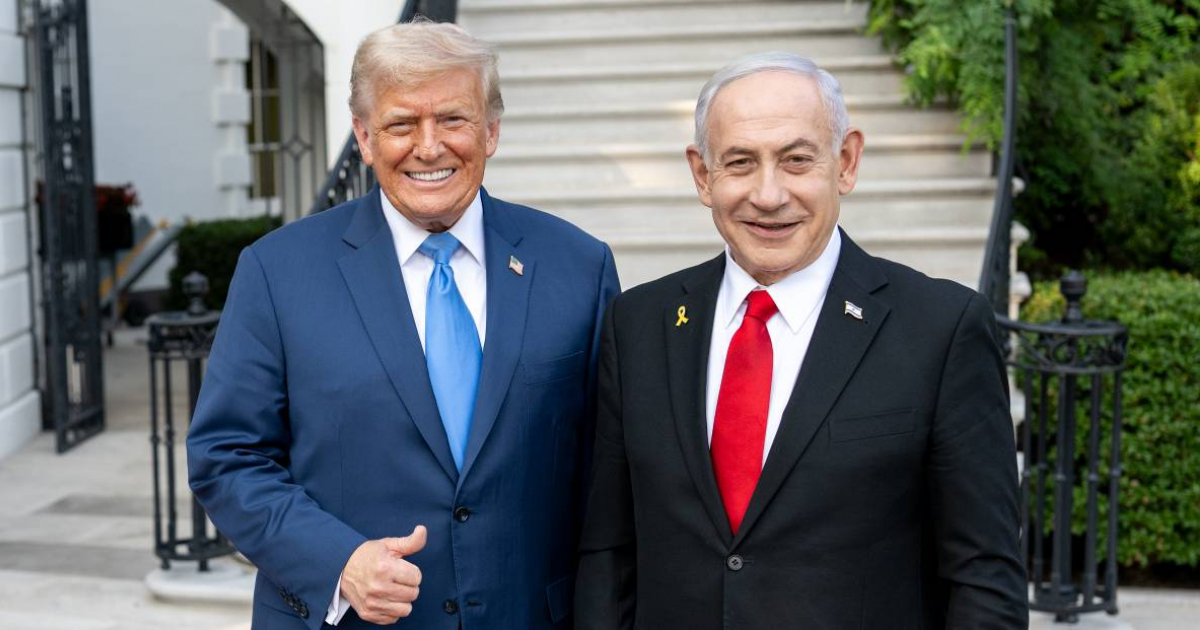
The Office of the Prime Minister of Israel announced this Wednesday its support for President Donald Trump's decision to Israel supports President Trump's decision to suspend attacks against Iran for two weeks, provided that Tehran immediately opens the Strait of Hormuz and halts all attacks against the United States, Israel, and regional countries.
The statement was published on the official account @IsraeliPM on X hours after Trump announced on Truth Social on Tuesday the suspension of the bombings, describing the agreement as a "BILATERAL ceasefire" and making it conditional on the "FULL, IMMEDIATE, and SAFE" opening of the strait.
"Israel supports President Trump's decision to suspend attacks against Iran for two weeks, provided that Iran immediately opens the straits and halts all attacks against the U.S., Israel, and countries in the region," stated the Office of the Israeli Prime Minister in its official statement.
The Israeli government has clearly stated that the two-week ceasefire does not include Lebanon, indicating its intention to continue military operations against Hezbollah during the truce period.
This position contradicts the statement made by Pakistani Prime Minister Shehbaz Sharif, who had stated that the ceasefire should be applied "everywhere," including Lebanon.
United States communicated to Israel its commitment to achieving the shared objectives during the upcoming negotiations with Iran, which includes ensuring that the Iranian regime does not pose nuclear, missile, or terrorist threats to the U.S., Israel, and its Arab neighbors.
The intervention of Pakistani Prime Minister Shehbaz Sharif and Field Marshal Asim Munir was crucial for Trump to grant the diplomatic extension. Trump explained on Truth Social: "Based on conversations with Prime Minister Shehbaz Sharif and Field Marshal Asim Munir from Pakistan, who asked me to stop the destructive force that was to be sent to Iran tonight, I agree to suspend the bombing and attack on Iran for a period of two weeks."
Trump also received a ten-point plan from Iran, which he described as "a viable basis for negotiation." However, the Farsi version of the document included the phrase "acceptance of nuclear enrichment," which was absent in the English versions shared by Iranian diplomats, revealing a fundamental unresolved gap.
The Iranian Foreign Minister Abbas Araghchi confirmed the reopening of the Strait of Hormuz and the suspension of Iranian military operations, contingent upon the cessation of attacks against its territory: "If the aggressions stop, our armed forces will suspend their defensive operations."
The ceasefire occurs within the framework of the Epic Fury Operation, a joint military offensive by the U.S. and Israel that began on February 28, 2026, which destroyed 90% of Iran's missile arsenal, 95% of its drones, and eliminated 49 high-ranking military officials, including Supreme Leader Ali Khamenei.
Iran responded to the conflict by closing the Strait of Hormuz on March 4 using mines, drones, and missiles, leaving 2,000 ships and 20,000 sailors stranded, and driving the price of Brent crude oil from 67 to over 126 dollars per barrel, creating a global energy crisis.
Despite the nominal ceasefire, immediate violations were reported by both parties. Formal negotiations between Iran and the U.S. are scheduled to begin on April 10 in Islamabad, with Pakistan, Egypt, and Turkey as mediators.
Filed under: