
Related videos:
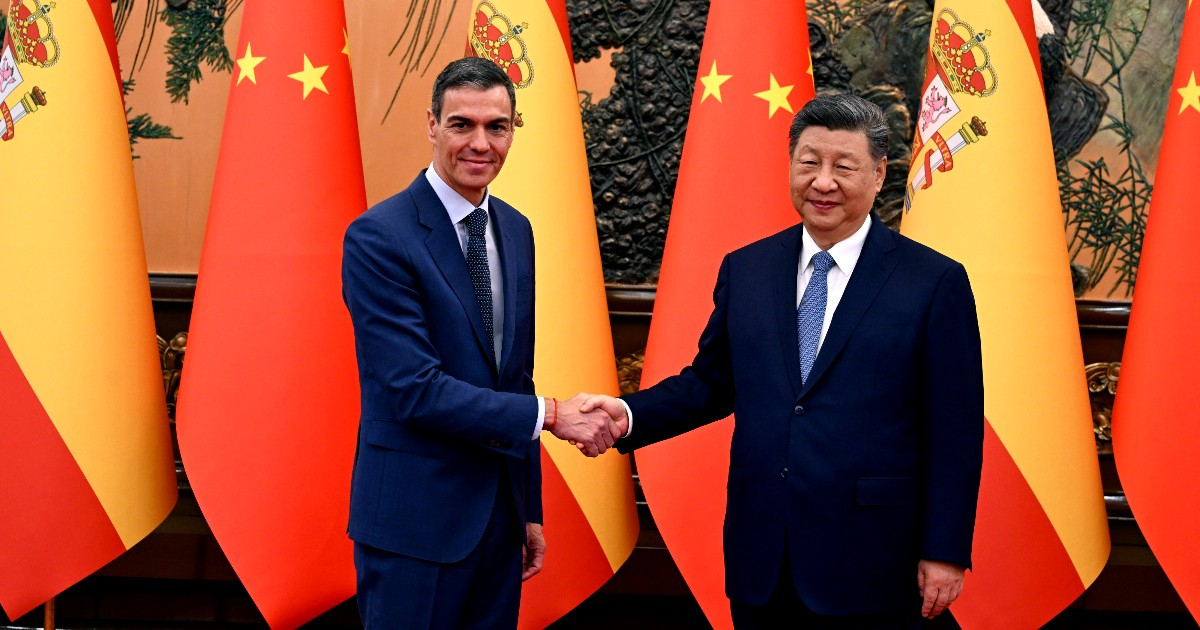
The President of the Spanish Government, Pedro Sánchez, met this Tuesday with the Chinese President Xi Jinping at the Great Hall of the People in Beijing, during his fourth official visit to China in four consecutive years, and stated that the bond between Spain and China is strengthened following this official trip.
After the meeting, Sánchez posted on his X account that "in an increasingly uncertain world, Spain is committed to a relationship between the EU and China based on trust, dialogue, and stability", and added that both countries "must continue to move towards a multipolar order built on respect and pragmatism."
The visit, which runs from April 11 to 15, includes the signing of 19 bilateral agreements—five in agribusiness, four in trade, and others in science, technology, culture, and biodiversity—a business forum with 36 Chinese leaders, and a speech before more than 400 students at Tsinghua University this past Sunday.
Sánchez's rapprochement with Beijing comes at a time of significant tension with Washington. Since February 28, when the U.S. and Israel launched Operation Epic Fury against Iran, Spain has refused to authorize the use of its military bases in Rota and Morón de la Frontera for those operations, invoking the bilateral defense agreement of 1988.
On March 30, Madrid also closed its airspace to U.S. planes linked to the conflict. The Minister of Defense, Margarita Robles, was unequivocal: "From the very first moment, it was made crystal clear to the American military that Spanish bases and airspace were not authorized for actions related to the war in Iran."
Trump responded by threatening to impose trade cuts against Spain and supporting the possibility of withdrawing American military bases from the country. In this context, China publicly aligned itself with Madrid: spokesperson Mao Ning rejected the use of trade as a "political weapon" and criticized the attacks on Iran.
This alignment is neither coincidental nor new. The Spain-China relationship has been marked for decades by a policy of avoiding any friction with Beijing, whose clearest origin dates back to the Tibet case in the National Court.
In 2003, a lawsuit against former Chinese president Jiang Zemin for genocide and torture in Tibet led to direct economic reprisals from China against Spain.
In February 2014, Judge Ismael Moreno issued international warrants for the arrest of Jiang Zemin and former Prime Minister Li Peng. However, in December of that same year, the Supreme Court definitively shelved the case, implementing a legislative reform that restricted universal jurisdiction.
The Chinese government publicly thanked the Spanish government for the reform and the filing. According to El País, Tibetan activists then denounced that Spain trades human rights for money. Since that incident, no Spanish government has directly confronted China in international forums.
In his speech at Tsinghua University, Sánchez pointed out that the trade imbalance — China accounts for 11% of Spanish imports but only receives 2% of its exports — is "unsustainable," and he called on Xi for "understanding and willingness to work" to correct it.
According to Cadena Ser, Xi Jinping stated that both China and Spain are on the right side of history against the "law of the jungle," which, according to both leaders, undermines international law.
Filed under: