
Related videos:
The Government of Spain has decided to take a firmer stance against the military offensive led by the United States and Israel against Iran, closing its airspace to American aircraft involved in the conflict, a measure that further escalates diplomatic tension between Madrid and Washington.
According to the agency EFE, the government has not only rejected the use of the military bases in Rota (Cádiz) and Morón de la Frontera (Sevilla), but has also prohibited the transit of American aircraft involved in the military operation through Spanish airspace, even if they are stationed in other European countries.
The decision, made from the beginning of the offensive, reflects a firm stance by the government of Pedro Sánchez against a war it deems illegitimate.
The Minister of Defense, Margarita Robles, was emphatic in explaining the scope of the measure.
"From the very first moment, we made it absolutely clear to the American military and American forces that no bases were authorized, nor, of course, was the use of Spanish airspace for actions related to the war in Iran authorized," he asserted.
Robles insisted that the Executive's position is "very clear," considering the conflict "deeply illegal and deeply unjust."
In that regard, he emphasized that Spain "will not authorize under any circumstances, nor has it done so, nor does it do, nor will it use the bases of Rota and Morón to go to war, which we are completely against."
Escalation of tension with Washington
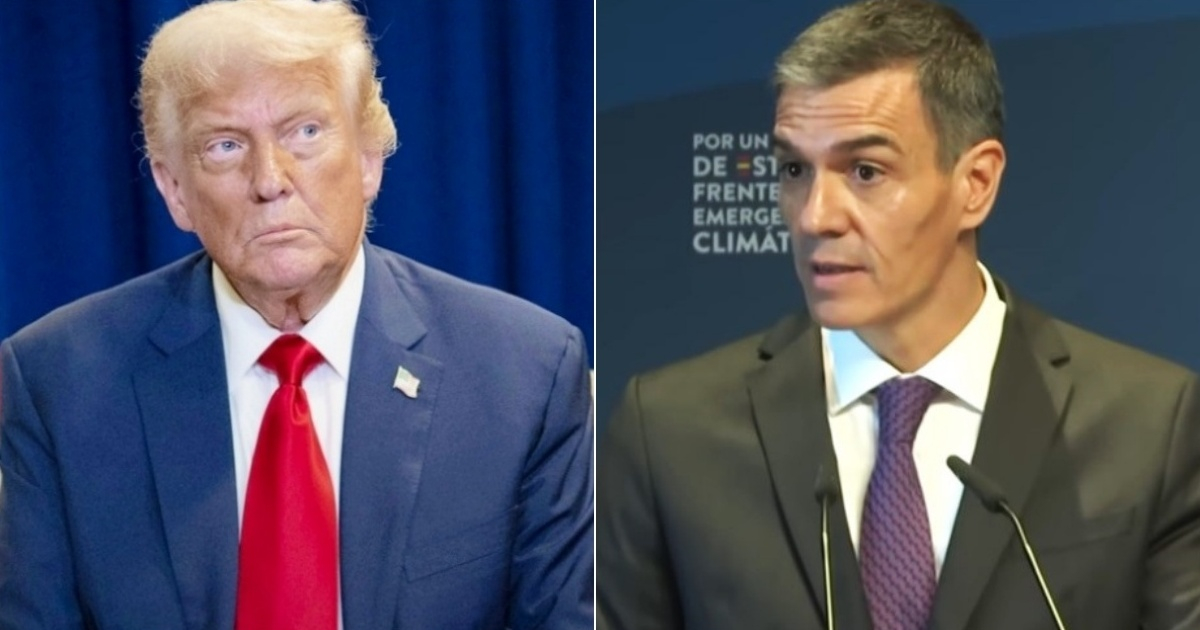
The Spanish refusal has provoked an especially harsh reaction from U.S. President Donald Trump, who has made Spain one of the main targets of his criticisms within NATO.
From the early days of the conflict, Trump threatened with severe economic retaliation.
In an appearance from the White House, he warned that he is willing to "cut all commercial ties with Spain" and stated: "No one will tell me whether I can use those bases or not."
The leader went even further by calling Spain "a fantastic people but a terrible ally," and reiterated that "we do not want to have anything to do with them."
The statements did not remain an isolated incident.
Days later, Trump struck again at the Spanish government, insisting that "they are not cooperating at all" and warning once more: "I may cut off all trade with them."
In that same vein, he added: “The people of Spain are fantastic, but their leadership is terrible.”
The origin of the conflict: Military bases and war in the Middle East
The catalyst for the diplomatic crisis was Spain's refusal to allow the use of the Rota and Morón bases for the so-called military operation launched on February 28 by the United States and Israel against Iran.
Madrid invoked the bilateral defense agreement of 1988, which requires explicit authorization for any use of these facilities outside the framework of NATO.
As a result, Washington repositioned part of its military deployment, relocating tanker aircraft to bases in Germany and other locations in Europe.
The Spanish Government has reiterated that "neither from Morón nor from Rota have they carried out or will they carry out any maintenance or support actions" regarding the attacks against Iran, even denying claims from the White House that suggested alleged cooperation.
Open war and international repercussions
The confrontation between Spain and the United States occurs amid a conflict that has already lasted over a month and has led to increasing instability in the Middle East.
During the early days of the conflict, Israel struck more than 1,700 targets in Iranian territory, including key nuclear facilities. Iran responded with attacks that reached central areas of Israel and targets linked to U.S. interests in the region.
The military escalation has also had an immediate impact on financial markets, with declines of over 3% in the major European stock exchanges in the first days of the conflict.
Meanwhile, the Spanish government has activated operations to evacuate its citizens from the area. Among them is a group of pilgrims who had been stranded in Jerusalem and were transferred to Madrid from Cairo.
A political pulse with economic implications
Beyond the military front, the conflict has opened a significant economic front.
The trade exchange between Spain and the United States amounts to approximately 46 billion dollars annually, with Spanish exports nearing 16 billion, especially in the agri-food and industrial sectors.
Moreover, Spain relies on about 40% of its liquefied natural gas from the United States, which makes any threat of trade disruption a significant risk.
This is compounded by the pressure from Washington for Spain to raise its defense spending to 5% of GDP, a demand that Sánchez's government rejects, arguing that the 2% target to be reached by 2025 fulfills its commitments.
In this context, the decision to close airspace and deny the use of military bases not only reflects a political stance regarding the war but also places Spain at the center of a high-stakes diplomatic crisis with its main ally in NATO.
Filed under: