
Related videos:
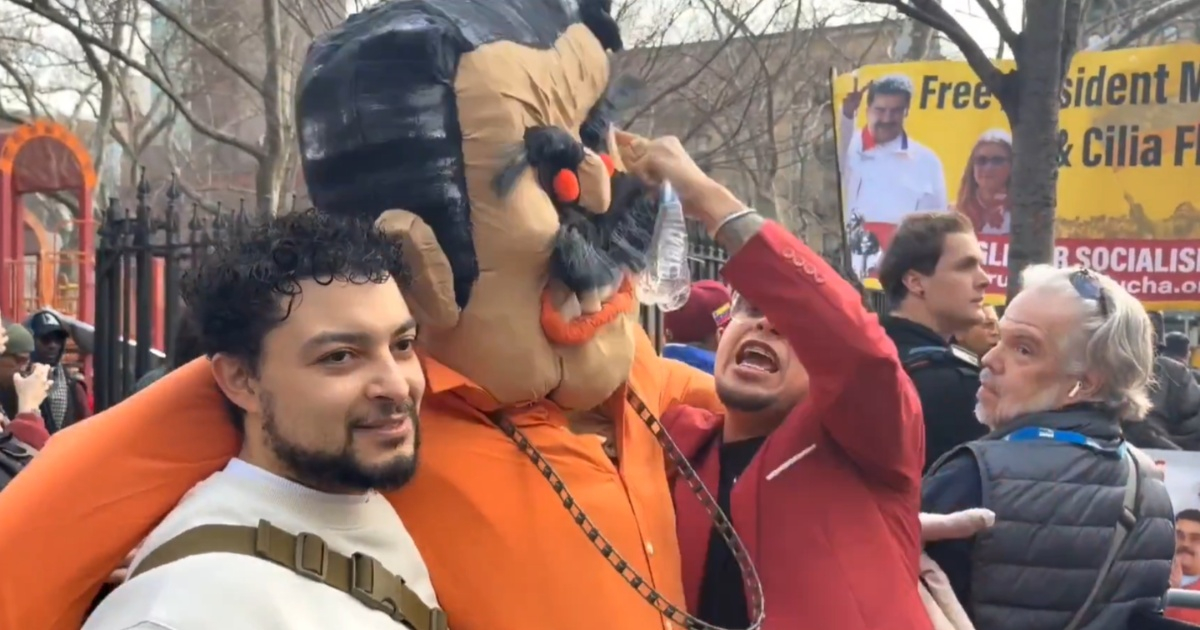
Hundreds of protesters from two opposing sides gathered this Thursday outside the federal court of the Southern District of New York, in Manhattan, during the second court appearance of Nicolás Maduro and his wife Cilia Flores.
The New York Police Department (NYPD) separated both groups with metal barriers to prevent direct confrontations, although moments of tension and clashes among attendees were reported, according to the New York Post and EFE.
The group opposed to Maduro was made up exclusively of Venezuelans, who carried signs with slogans such as "Maduro, rot in prison" and demanded justice.
Some were displaying a doll of the dictator dressed in prison clothes with a chain around its neck. Among them were also three members of the Spanish organization Hazte Oír, holding signs that showed the faces of Maduro, Pedro Sánchez, and José Luis Rodríguez Zapatero under the title "Criminals."
The group supporting Maduro, predominantly made up of Americans, held signs reading "Free President Maduro" and Venezuelan flags, denouncing the arrest as "illegal."
Some protesters danced wrapped in those very flags.
Janette Panzenbeck, a 59-year-old Venezuelan translator who has been living in Manhattan for three decades, summarized the sentiment of the opposition: "Now the Venezuelan people are breathing that air of freedom, and I am very happy here celebrating that this dictator is now in a court in the United States," she stated.
The audience of Maduro
Inside the courtroom, the hearing began nearly an hour late, around 11:45 in the morning.
Judge Alvin Hellerstein outright rejected the defense's request to dismiss all charges: "I am not going to dismiss the case," he stated. The magistrate also noted that the process "transcends the usual."
The defense attorney Barry Pollack submitted a 17-page document arguing that the current sanctions against Venezuela prevent Maduro from accessing state funds to cover his legal representation, which would violate his constitutional rights.
Prosecutor Kyle Wirshba rejected that possibility: "If the purpose of the sanctions is that the accused are looting Venezuela's wealth, allowing them access to those same funds to pay for their defense would undermine the effect of those sanctions." The judge postponed his decision on the financing to a later date.
Cilia Flores' lawyer, Mark Donnelly, raised concerns about the health status of the accused, who suffers from a mitral valve condition, and requested urgent medical attention, including an electrocardiogram.
Maduro, for his part, appeared visibly nervous: according to the journalist from NTN24, "he continually moved his legs, drank water frequently, put on and took off his glasses repeatedly, and had nervous tics. He was a cowed man." In contrast, Flores appeared calmer and with her arms crossed.
Maduro and Flores have been detained at the Metropolitan Detention Center in Brooklyn since January 3, when they were captured in Caracas during Operation Absolute Resolution.
Both pleaded not guilty in their first appearance on January 5. Maduro faces four charges —conspiracy to commit narco-terrorism, conspiracy to import cocaine, possession of assault rifles, and conspiracy to possess weapons of war— all carrying the potential penalty of life imprisonment.
This Thursday, President Donald Trump stated that the current charges are "just a fraction" of Maduro's offenses and hinted that other cases will be presented. Experts estimate that the formal trial will not begin for another one or two years.
Filed under: