
Related videos:
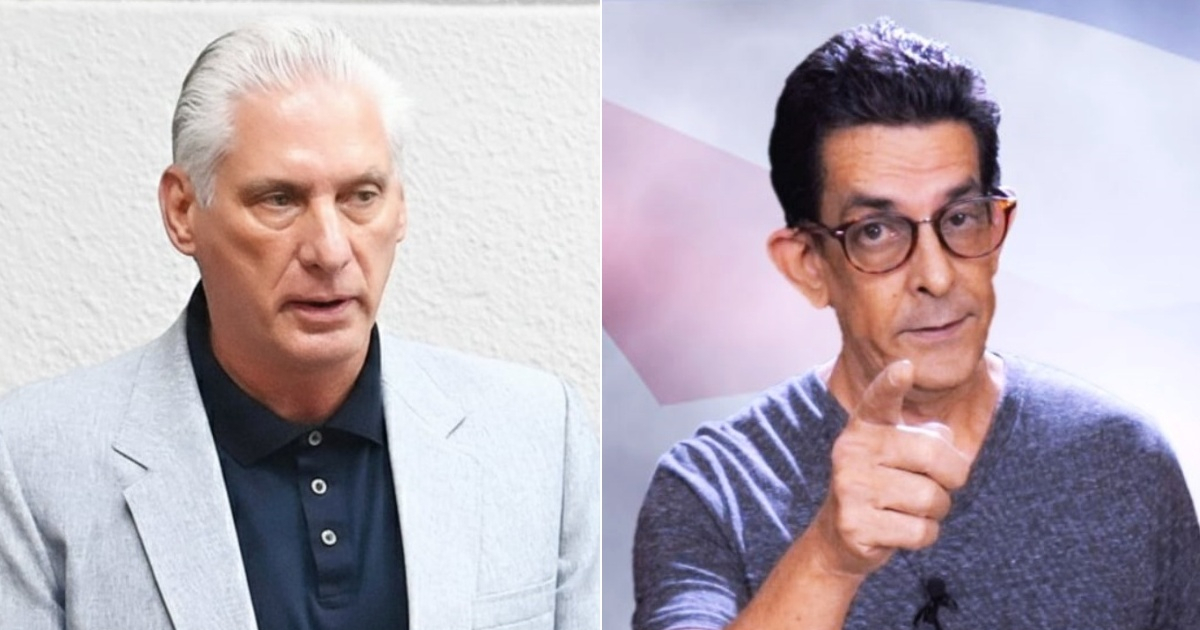
The Cuban comedian and actor Ulises Toirac published a direct critique this Thursday on Facebook regarding the official event held today at the corner of 23 and 12 in Vedado, Havana, labeling it as a "waste of resources at 23 and 12" while millions of Cubans endured blackouts across the country.
The event commemorated the 65th anniversary of the proclamation of the socialist nature of the Cuban Revolution and was presided over by Miguel Díaz-Canel, accompanied by members of the Political Bureau, the Secretariat of the Central Committee of the Communist Party of Cuba, leaders of the Revolutionary Armed Forces, the Ministry of the Interior, the Union of Young Communists, and international delegations, as well as veterans of the Bay of Pigs.
Toirac described with irony how the power outages prevented him from following the event in real time: "And while I miss important events like the waste of resources on 23 and 12 (which cause me more power and data outages, creating an endless loop), I'm cleaning my house and these two come to meet me..."
To illustrate his critique, the actor photographed a 25-cent coin next to a rusty metal washer and asked rhetorically: "Which one solves more? The act or having more curr...? Oh, sorry... Is it the coin or the washer? Damn, how do you erase that?".
The contrast between the official act and the country's energy reality is stark: the Electric Union forecasted a shortfall of up to 1,872 megawatts for peak night hours, with a mere availability of 1,217 megawatts against a recorded demand of 2,110 megawatts in the early morning.
Throughout April, daily deficits have exceeded 1,600 megawatts, with a peak of 1,945 megawatts recorded on the first of April, leaving up to 55% of the national territory without electricity at the same time and more than 200,000 residents of Havana without potable water, as 87% of the supply system depends on electric pumps.
The energy crisis has worsened due to the interruption of Venezuelan crude oil supply since December 2025 and multiple breakdowns in thermal power plants. In March, two total blackouts occurred: on March 16, with 29 hours and 29 minutes without power, and on March 22, when more than 90% of Havana was left in the dark.
In his speech yesterday, Díaz-Canel acknowledged that Cuba absolutely lacks fuel for almost everything, but he attributed the main responsibility to the U.S. embargo, which he described as a "genocidal blockade."
He also rejected labeling Cuba as a "failed state", preferring the term "besieged state," and warned of a possible military aggression from the United States.
Toirac is no stranger to this type of criticism. Last February, he had already poked fun at the "difficult times" acknowledged by Díaz-Canel himself, describing a regime of darkness in Havana and attributing the electrical collapse to 30 years of disarray due to poor investment policies (and not due to a blockade).
In October 2025, there had also been questioned the call for mass events during workdays while the population survives with hunger, blackouts, and shortages.
Toirac's posts follow a pattern that has made him one of the most consistent and popular critics of the Cuban government on social media: a biting irony that contrasts political propaganda spending with the material hardships of daily life, in a country where socialism, according to Díaz-Canel, remains the shield of the present and the guarantee of the future.
Filed under: