
Related videos:
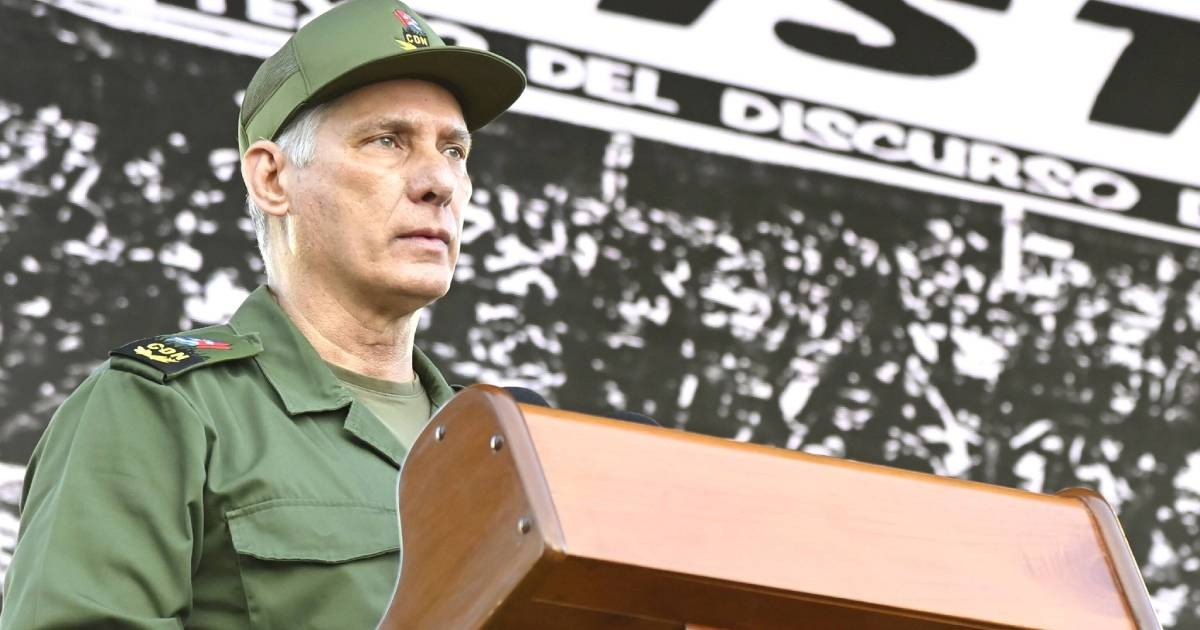
The Cuban leader Miguel Díaz-Canel publicly joined the bellicose rhetoric of Raúl Castro by sharing on his X account the closing of a letter sent by the General to the Eastern Army, in which he calls to confront “any enemy aggression, until victory is achieved.”
It was no small gesture. It was, once again, the confirmation of who sets the tone in power.
The letter from Raúl Castro, published by the Ministry of the Revolutionary Armed Forces (MINFAR) and read on the National News, was issued on the occasion of the 65th anniversary of the Eastern Army, one of the country's main military structures. Although the historic leader did not attend the event held in Holguín, his message was indeed present.
The excerpt chosen by the leader leaves no room for doubt, as it is considered a direct call to confrontation in the name of defending the "socialist homeland."
But beyond the rhetoric, the moment this alignment occurs is crucial.
Cuba is going through one of its worst crises in decades. Power outages of up to 20 hours, food shortages, deteriorating transportation, and a migratory exodus that drains the country are part of the daily lives of millions of Cubans. In this context, the official discourse once again turns toward war.
This is not the first sign. In recent weeks, Díaz-Canel has reiterated a narrative of extreme resistance, even appealing to the idea of dying for the homeland. And now, with this gesture, he reinforces a message that does not originate with him but rather with the historical leadership of power.
Because if this episode makes one thing clear, it is that, even without appearing in public, Raúl Castro continues to set the political and military tone of the country. As has happened on other occasions, his letters serve as a symbolic chain of command, while Díaz-Canel acts more as a spokesperson than as an autonomous leader.
The detail is not insignificant: Raúl himself, at 94 years old and with an increasingly absent profile, continues at the helm of the National Defense Council, the body that would assume total control in the event of a war scenario.
And while the government insists on talking about external threats and military preparedness, within the Island, the concern is different: surviving until the next day.
There lies the true tension. Not between Cuba and an external enemy, but between the official discourse and the reality of an exhausted population.
Filed under: