
Related videos:
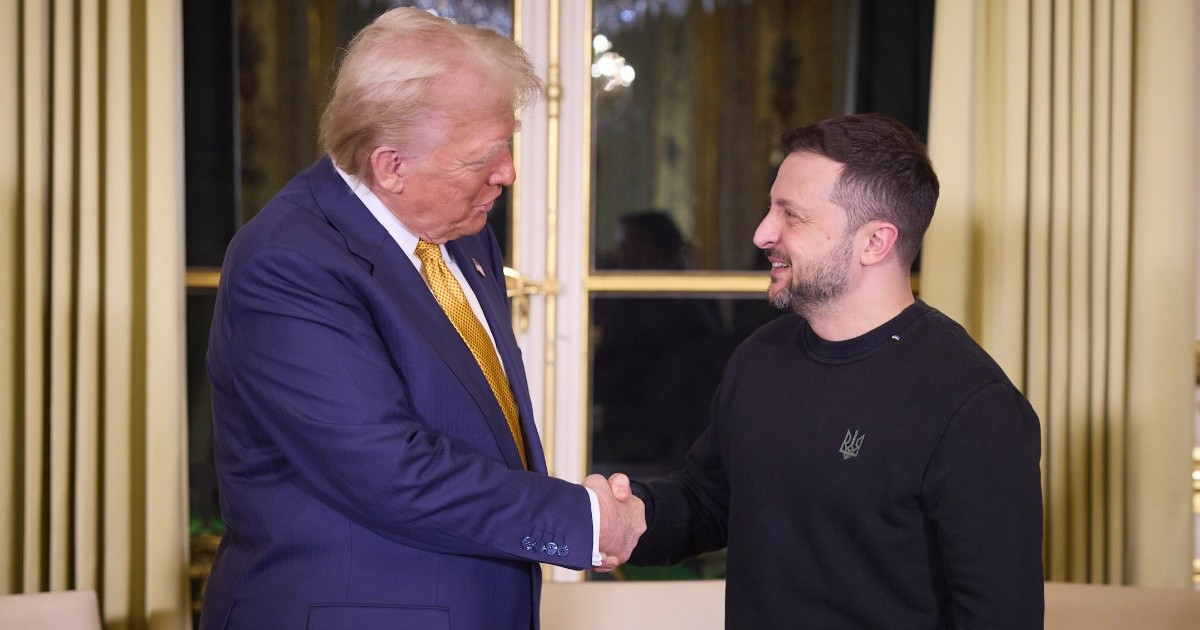
In the midst of stalled peace negotiations and a war that continues to devastate eastern Ukraine, Kiev has proposed an idea that is as unusual as it is revealing: to rename part of the Donbas with a name linked to Donald Trump.
Ukrainian negotiators have suggested naming that area "Donnyland," which translates to "Donnylandia" in Spanish, as reported by The New York Times, which cites several sources close to the negotiations.
The proposal, which began as an informal remark during the conversations, ultimately took on a strategic tone.
According to the American newspaper, the term emerged as a way to influence Washington's position and strengthen the political support of the Trump administration in response to Russia's territorial demands.
A name to tip the scales
The term combines "Donbas" - the disputed industrial region - with "Donny," a diminutive of Donald.
According to four individuals familiar with the discussions, the name was initially mentioned "partly as a joke", but with a clear objective: to pressure the United States into adopting a more favorable stance toward Ukraine.
The initiative comes at a time when Moscow continues to demand greater control over the Donbas, while Kyiv refuses to cede the territory that it still holds.
A key disputed area
The area referred to in this proposal spans approximately 80 kilometers in length and about 60 in width.
According to Ukrainian estimates, approximately 190,000 people live there, although other sources suggest that the actual population may be below 100,000 due to the war and the economic collapse.
It is a territory near the front, deeply affected by the fighting.
Economic activity is almost non-existent, except for an operating coal mine and small businesses catering to soldiers deployed in the area.
Despite this scenario, Ukraine insists that it can defend the area and refuses to surrender it as part of a peace agreement.
More than an eccentricity
Although "Donnylandia" may seem like a striking notion, the background is deeply political.
The proposal illustrates to what extent some governments find it necessary to appeal to Donald Trump's personal style to ensure their support.
The New York Times itself emphasizes that this initiative reflects “a global reality in which governments appeal to Trump's vanity to harness American power to their advantage.”
It's not an isolated case.
In the past, initiatives like "Fort Trump" in Poland and the "Trump Route for International Peace and Prosperity" promoted by Armenia and Azerbaijan have followed a similar logic.
A possible middle ground
Beyond the name, the proposal is part of a broader discussion: the creation of a special zone in the Donbas that is not fully controlled by either Ukraine or Russia.
That area could serve as a demilitarized zone or a free trade area within a potential peace agreement.
In that scenario, Trump could present the initiative as a personal achievement, which -according to Kiev- would increase Washington's pressure on Moscow.
The analyst Samuel Charap from the RAND Corporation explained to the newspaper that "having Trump’s endorsement in a free economic zone" could become "a deterrent" against future Russian aggression.
Between the joke and the strategy
Although the term "Donnylandia" does not appear in official documents, it has continued to be used in conversations.
Other more formal proposals, such as the so-called “Monaco model” – which proposes a semi-autonomous microterritory – have even appeared in drafts of agreements.
The unconventional nature of the idea doesn't end there.
According to the newspaper, “a Ukrainian negotiator created a flag for Donnyland -green and gold- and a national anthem, using ChatGPT”, although it is unclear whether these elements were presented to the US delegation.
A conflict with no clear resolution
Despite these attempts, negotiations remain stalled at the most sensitive point: territorial control.
Russia demands total control of the Donbas, while Ukraine rejects any agreement that involves ceding sovereignty.
President Volodymyr Zelensky has warned that exchanging territory for peace would be a "great mistake."
For its part, the Kremlin only considers solutions that include the presence of its forces in the area, a condition that Kiev finds unacceptable.
Meanwhile, the conversations are progressing slowly and have been partially overshadowed by other international crises.
Trump, who promised during his campaign to resolve the war in 24 hours, recently acknowledged the uncertainty of the process: "We'll see what happens. Things are happening there."
In this context, the proposal becomes more than just a curiosity: it reflects a transforming diplomacy, where political calculation, image, and the ability to charm the counterpart carry as much weight as the actual front lines.
Filed under: