
Related videos:
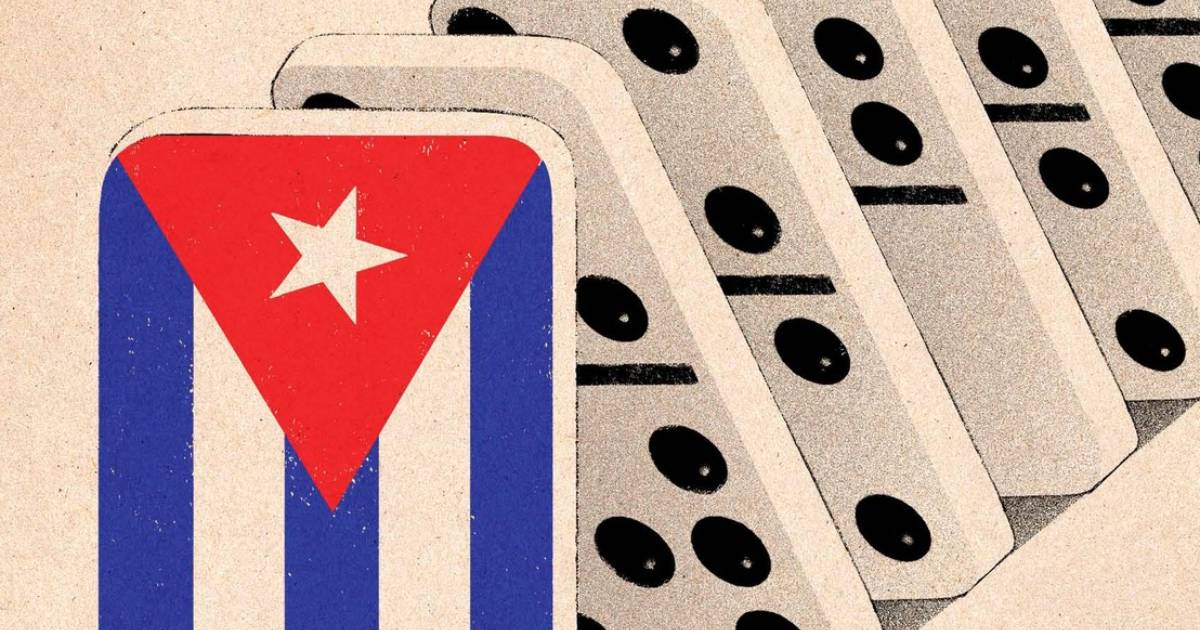
TIME magazine dedicated its cover this Thursday to Cuba with the headline "Before the Fall" and the subtitle "Cuba Awaits Trump's Endgame," representing one of the highest points of geopolitical tension for the island in decades.
The edition of May 11, 2026, published online today, comes one day after President Miguel Díaz-Canel threatened to break off negotiations with Washington if the United States insists on regime change.
The cover is illustrated with dominoes falling in a cascade: the first one displays the Cuban flag, a direct visual metaphor regarding the potential geopolitical effect that a change on the island could trigger following the fall of the Venezuelan regime of Nicolás Maduro.
The report, written by AJ Hess with photographs by Moisés Saman for Magnum Photos, documents the devastating reality faced by the 11 million inhabitants of Cuba: uncollected garbage due to a lack of fuel, nighttime blackouts lasting up to 24 hours, workers in a stranglehold economy, and patients dying from preventable causes.
After the forced removal of Maduro, the United States cut off the Venezuelan oil supply to Cuba —estimated at 25,000 to 30,000 barrels per day— which accounted for two-thirds of the island's energy imports and had kept it afloat for decades.
The president Donald Trump proclaimed the so-called "Donroe Doctrine" —a reworking of the Monroe Doctrine from 1823— and declared: "Cuba is next".
The report brings together three Cuban intellectuals to answer what the people of the island want and what the future holds for them. The novelist Leonardo Padura describes that the official stance of the Cuban government is unequivocal: to resist, indefinitely. He adds that "for some analysts, that 'indefinitely' coincides with the midterm elections in the U.S., which may or may not produce immediate political consequences."
The Cuban-American historian Carlos Eire, for his part, describes the Monroe Doctrine as a nebulous principle, lacking in details.
The economist Ricardo Torres offers the most structural perspective: "What Cuba needs is neither a foreign rescue nor another official myth. It needs the space and institutions to reconstruct itself."
The diplomatic context surrounding the cover is equally tense. On April 10, a delegation sent by Secretary of State Marco Rubio landed in Havana —the first U.S. government plane on Cuban soil since 2016— and met with Raúl Castro's grandson. Washington demanded the release of political prisoners, internet access, and governance reforms.
Díaz-Canel confirmed that the negotiations are at a very preliminary stage and warned that he would terminate them if the pressure from the United States for a political system change on the island continues.
Filed under: