
Related videos:
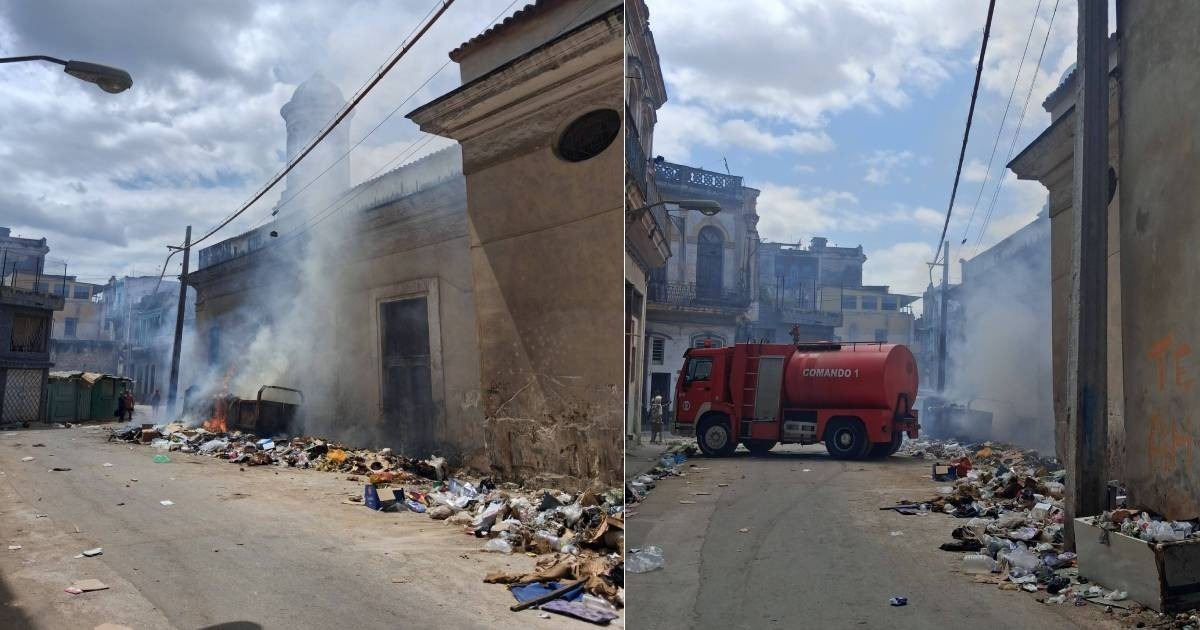
The Escolapian Fathers of the San Judas and San Nicolás Parish in Centro Habana issued a new urgent statement on Thursday, denouncing that the accumulation of garbage on San Nicolás Street has once again posed an imminent danger to their church, which nearly caught fire for the third time in less than two months.
The statement, published on the Facebook page "Escolapios Cuba", describes a situation that is recurring without any action from the authorities, warn the priests, who assert that they have exhausted all available institutional avenues.
The religious community details that it has met and contacted "on countless occasions" with representatives from the three levels of government — municipal, provincial, and national — without achieving concrete results. "They have listened to us. They have made plans. They have promised. But the actions do not follow," they denounce.
The damage from the previous fire, which occurred on April 9, remains unrepaired. The side door of the temple is still damaged by the flames, and the exterior wall and sidewalk continue to be in the same state of neglect. "Nothing has been restored. The danger has not been prevented from returning," the statement emphasizes.
That fire on April 9 was not the first. On March 15, a fire had affected the cloister of the Escolapios church in Guanabacoa —expropriated by the regime in 1961 and abandoned by the Ministry of Education for more than a year— without any explanations from the authorities.
On April 23, a new fire at the makeshift dump near the Centro Habana parish generated toxic smoke that affected residents, the elderly, children, and the faithful. The firefighters were alerted but did not respond urgently to the call.
Brother Ernesto Cuba Schp, in a separate post on Facebook, pointed out that the promises of short-term solutions made by the authorities following the first disaster have faded into bureaucratic silence. He added that the crisis reflects "a broken coexistence, of a citizenry that has stopped caring for the common good, perhaps because they have felt abandoned by so many."
The backdrop of this crisis is the colossal accumulation of garbage that has plagued Havana since at least February 2026. Only 44 of the 106 waste collection trucks in the capital are operational due to a lack of fuel, leaving between 13,000 and 23,814 cubic meters of waste uncollected daily.
The city has only 10,000 containers when it needs between 20,000 and 30,000. In several neighborhoods, including Centro Habana, residents have gone more than ten days without any garbage trucks, and in their desperation, many are burning trash in the street, causing fires that reach nearby buildings.
The Escolapios acknowledge in their statement the shared responsibility of neighbors and parishioners, but they are emphatic regarding the duty of the State: "We have been waiting too long for responses from those who have the obligation to ensure order and the common good. The patience is running out."
To denounce the desecration of the temple, the priests turned to the prophet Jeremiah (7:11): "Have they not turned my house, which bears my name, into a den of robbers? I have seen it myself."
The statement concludes with a direct appeal to authorities, neighbors, and parishioners: "Let us not allow trash and fire to continue desecrating the house of God. Today we ask for action, not more promises."
Filed under: