
Related videos:
The authorities of Matanzas are finalizing logistical details to begin drilling a new well in the Bello supply system, a hydraulic project that, according to the government, will benefit more than 60,000 residents of the Versalles popular council and the industrial area of the city.
Guillermo Cué Lugo, general director of the Water and Sewage Company (EAA) of the province, explained that most of the technical equipment has already been moved to the site. Only the incorporation of the casing is awaited, an iron pipe meant to maintain the structure of the well, conditioned by the clayey characteristics of the soil that require this special lining, the official clarified.
He also confirmed that the specialized brigade of the Empresa Nacional de Perforación UEB Centro Zona Integral Matanzas is ready to begin, and that the well will reach a depth of more than 20 meters and will be equipped with a submersible pump of 100 liters per second.
The work will also include maintenance of the power networks to minimize the effects of blackouts on the operation of the well, an implicit acknowledgment that the electric crisis is an inseparable part of the water collapse faced by the province.
Matanzas is one of the provinces facing the most significant water supply issues in Cuba. Out of the 518,000 inhabitants who receive water through pipelines, more than 29,000 experience ongoing shortages due to breaks in the networks. All 13 municipalities in the province are affected, with over 300,000 people lacking stability in their supply, according to data from the National Institute of Hydraulic Resources (INRH) from early April.
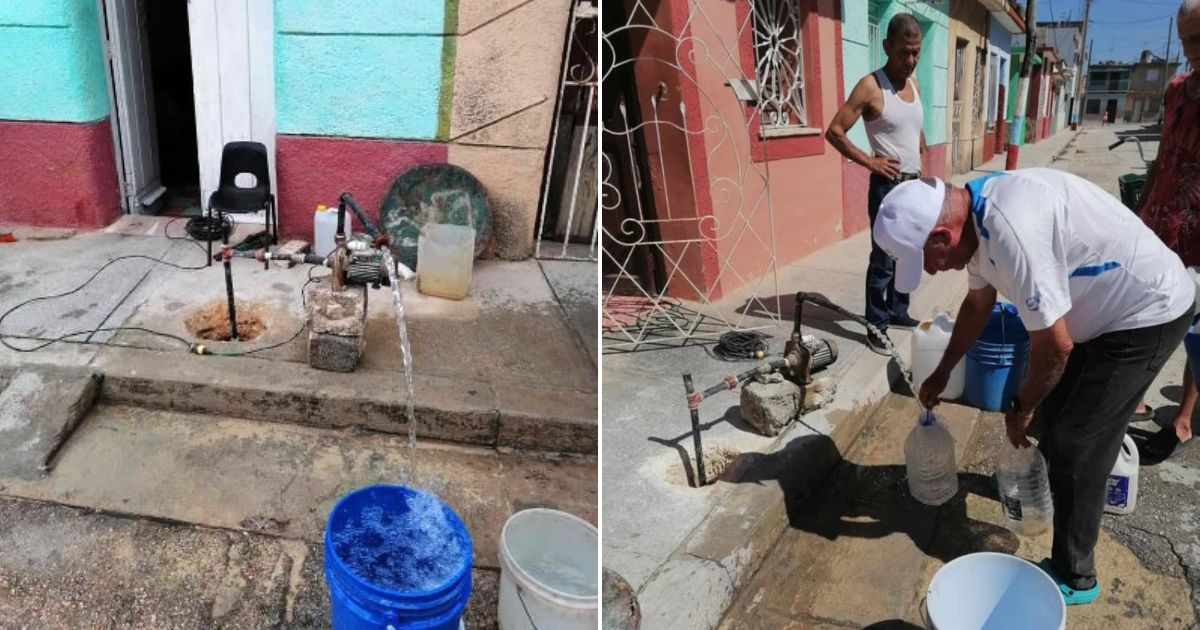
The desperation of the population has led to extreme and risky solutions: more than 40 wells have been illegally drilled in sidewalks and patios, mainly in the Playa neighborhood, which reflects a doubled figure between October 2025 and February 2026. The price of private water tanks skyrocketed from 4,000 to as much as 10,000 pesos for a 4,000-liter cistern. Additionally, water contamination has raised a health alert: in April, 18 cases of hepatitis A were reported in the Versalles neighborhood — precisely the area that the new well intends to benefit — along with additional cases in La Marina, Cidra, and other municipalities, prompting health authorities to order boiling and chlorinating the water.
The crisis in Matanzas is neither new nor merely situational. In February 2025, the water supply source of Bello —the same system where the new well is now projected— was contaminated with fecal coliforms due to a spill from the Boris Luis Santa Coloma Sugar Plant, forcing a temporary suspension of the supply. The accumulated deterioration of decades in hydraulic infrastructure, exacerbated by chronic blackouts —as 87% of the Cuban aqueduct system relies on the national electrical grid— along with the fact that 2025 was the fifth driest year since 1901, creates a scenario of collapse that a single drilling will hardly be able to reverse.
Nationally, around one million people rely on tank trucks to access drinking water, a service limited by the shortage of diesel. The UN developed a $94.1 million action plan to assist two million Cubans in 63 municipalities across eight provinces, although its distribution faces serious obstacles due to the lack of fuel on the Island.
Filed under: