
Related videos:
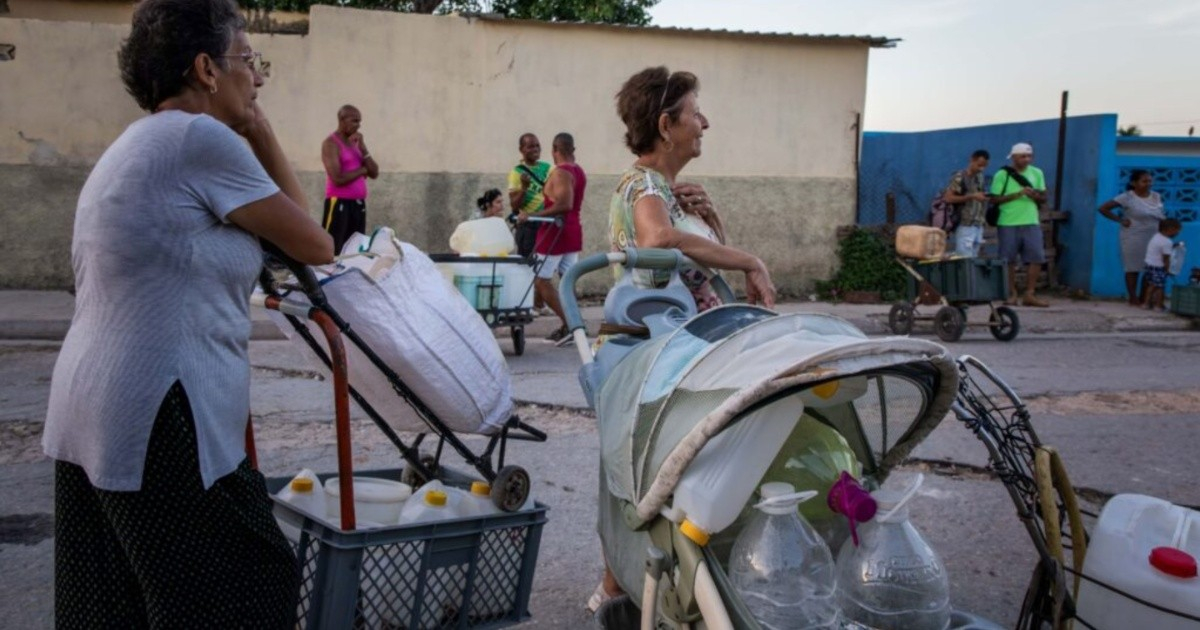
The First Deputy Prime Minister Inés María Chapman met this Wednesday with executives and workers from the main entities responsible for water supply in Matanzas to develop strategies in response to a crisis that leaves over 300 thousand residents of Matanzas without a stable supply of this vital resource.
The meeting included representatives from the Water Supply and Sewerage Company and the National Institute of Hydraulic Resources, highlighting the magnitude of a problem that the community has been reporting for months without a response.
Chapman urged to map out the situation in Matanzas and make decisions based on priorities, aiming to reduce the impact, initially through the repair or construction of new pipelines and subsequently through the available alternatives for energy supply.
In the meeting, it was acknowledged that the continuous power outages cause damages to the motors even with installed safety systems, and it was decided to install greater protection on the pumping equipment and to activate a generator for the higher area of the city.
A call was also made to
While the officials were meeting, the people of Matanzas responded on social media with indignation. "I'm fed up with seeing this kind of news. Everything ends up being just meetings and information about new bomb setups and blah blah blah, and for what? Everything remains the same. América between Milanés and Medio, over a year without water and one of the circuits with the fewest hours of electricity. And then they sit in a meeting with plenty of light and air conditioning to talk about strategies that don't work."
The crisis has deep roots: the well fields that supply the city can only operate for short periods when electricity is available, and 87% of the water supply system in Cuba relies on the National Electric System, which has experienced six nationwide blackouts in a year and a half.
Desperation has led to extreme solutions: in the Playa neighborhood, the number of makeshift wells increased from twenty in October 2025 to over forty in February 2026, while private water trucks skyrocketed their prices from 4,000 to 10,000 pesos for a tank of 4,000 liters.
Health authorities issued alerts urging to boil and chlorinate water due to isolated cases of hepatitis detected in several municipalities, while doctors warned about the risks of cross-contamination due to the proliferation of unregulated wells near septic tanks.
Filed under: