
Related videos:
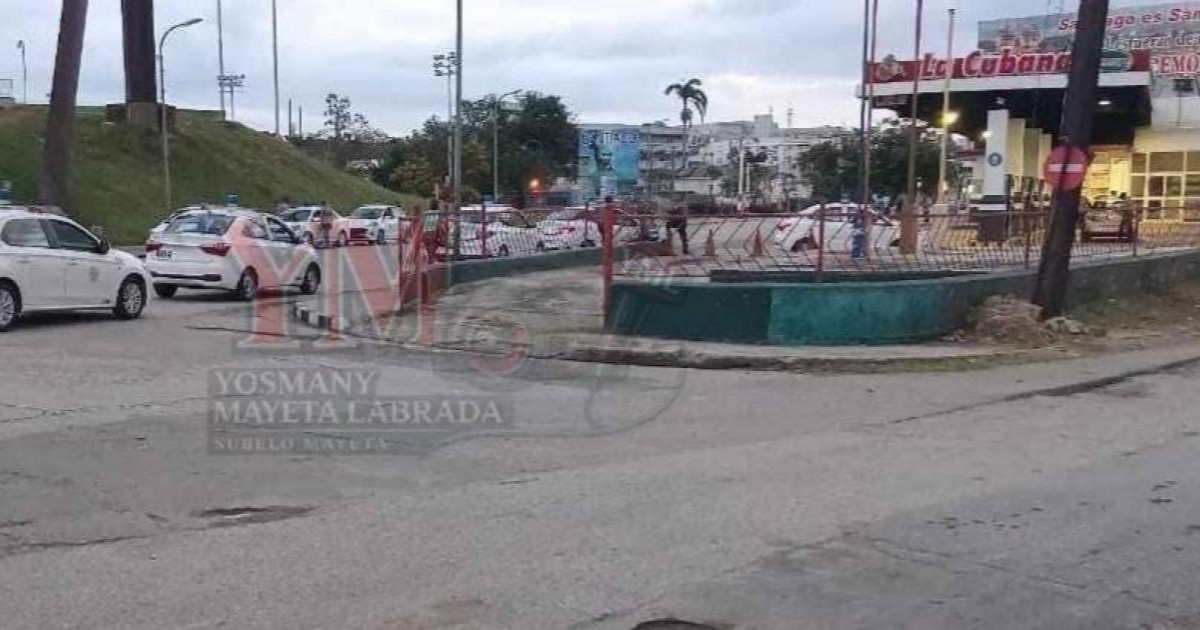
At the service station known as "La Cubana," located near Antonio Maceo Square in Santiago de Cuba, fuel is available this Friday, but only for those in uniform: police vehicles and state entities are refueling without restrictions while ordinary citizens have been waiting in line for days without success.
The complaint, received anonymously by independent journalist Yosmany Mayeta Labrada, is accompanied on Facebook by images showing about seven white patrol cars refueling at the location without apparent restrictions.
"For that, there is fuel; this is repressing the people," stated the anonymous source who sent the information, a phrase that encapsulates the frustration of those who have been waiting in endless lines under the Santiago sun for days.
Mayeta recalled that while this is happening, the population that depends on transportation to work or manage their day continues to be affected by the energy crisis, witnessing how resources are allocated to those with privileges.
"And for the healthcare workers, who are the most self-sacrificing, there is no incentive for them," questioned an emigrant in the post.
The scene stands in stark contrast to the reality faced by ordinary citizens in Santiago de Cuba: queues of up to 15 to 24 hours to obtain a mere 20 liters at state gas stations, black market prices reaching 6,000 pesos per liter of gasoline, and power outages of up to 24 hours a day that have become routine in the province.
The comments from citizens regarding the complaint reflect a growing indignation that can no longer be contained: "For those repressors, there is everything, but for the people who are asked to show resilience, there is nothing," wrote one user. Another pointed out, "That's why the country isn't progressing; resources are wasted on things that produce nothing." A third was more direct: "They don’t sell it, but they give it to their friends to sell."
A woman from Santiago responded to those who believe that the police should have priority in fuel distribution. "Crime is rampant because if you rely on them, you'll rot waiting for them. That’s just about driving around looking for which driver is picking up passengers and behind the little signs they put up," she said.
The pattern reported in Santiago is not an isolated incident. Since January, when the shortage began to worsen critically, it has been systematically documented that military and police receive guaranteed supplies while civilians get nothing.
The fuel crisis that Cuba is experiencing is the most severe in decades.
Venezuela interrupted its shipments of 25,000 to 35,000 barrels per day since December 2025; Mexico suspended its shipments on January 9, when they accounted for 44% of Cuba's imports; and the sanctions from the Trump administration pressured other suppliers. Cuba only produces 40,000 of the 110,000 barrels per day that it needs internally.
The only significant shipment received in months was that of the Russian tanker Anatoly Kolodkin, which arrived in Matanzas on March 30 with 730,000 barrels, barely enough to last until the end of April.
The Minister of Energy and Mines, Vicente de la O Levy, acknowledged last Thursday at the Mesa Redonda that the reserves would run out in a few days. Days earlier, Miguel Díaz-Canel had publicly recognized that Cuba is absolutely lacking fuel for almost everything.
While the regime calls for "resistance" from the population and its officials admit to the energy collapse, the images from the "La Cubana" service station in Santiago de Cuba tell another story: one of a state that prioritizes fuel for its security forces over bread, transportation, or electricity for the people it claims to govern.
Filed under: