
Related videos:
BYD announced in March 2026 a charging technology that promises to take an electric vehicle's battery from 10% to 97% in just nine minutes, redefining the global standards in the industry with its 1,500 kW FLASH Charging system and the new Blade Battery 2.0.
The announcement was made on March fifth by Wang Chuanfu, president and CEO of BYD, who emphasized that "the industry must tackle the ongoing challenges of low charging speeds and reduced charging performance at low temperatures if it wants to convince consumers who are still hesitant to make the shift to electric mobility."
The central figure is striking: from 10% to 70% in five minutes; from 10% to 97% in nine minutes.
Even at -30°C—conditions that typically drastically reduce charging speed—the system charges the battery from 20% to 97% in just 12 minutes, only three minutes more than under normal conditions.
The FLASH Charging delivers up to 1,500 kW through a single connector, more than three times the power of the Tesla Supercharger V4, which reaches a maximum of 350 kW, leaving Western manufacturers far behind in this race.
The technological foundation is the Blade Battery 2.0, developed over six years of intensive research.
Its ionic transport system "FlashPass" combines three innovations: the "Flash-Release" cathode with a multin-level particle architecture, the "Flash-Flow" electrolyte optimized with artificial intelligence, and the "Flash-Intercalate" anode with three-dimensional insertion of lithium ions.
Together, they reduce internal resistance and the heat generated during charging.
The battery also increases energy density by 5% compared to the previous generation, allowing for ranges exceeding 1,000 km in the Chinese CLTC cycle—the Denza Z9GT, the first model with this technology, achieves 1,036 km.
In terms of safety, the Blade Battery 2.0 passed the first global test that combines FLASH charging and penetration testing with a nail, showing no thermal leakage, smoke, or fire, even after 500 rapid charge cycles. It also withstood the simultaneous short-circuiting of four cells at temperatures over 700°C without igniting or exploding.
But technology is only half of the equation: the real challenge is the infrastructure.
At the time of the announcement, BYD had 4,239 FLASH Charging stations installed in China; by early April, it had already surpassed 5,000, with an expansion rate of approximately 1,600 new stations per month.
The goal is to reach 20,000 operational stations in China by the end of 2026, covering 292 cities.
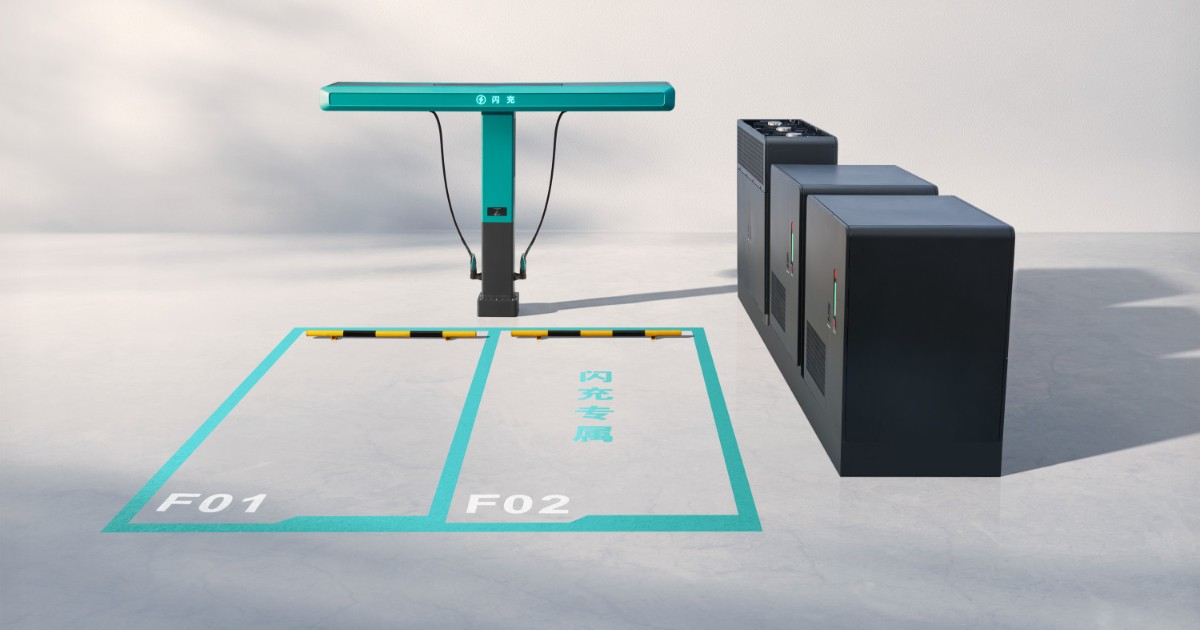
Each station incorporates an ultra-fast discharge energy storage system that serves as a reserve and power amplifier to prevent overloads on the electrical grid.
Outside of China, however, 1,500 kW chargers are virtually nonexistent to date.
In Europe, BYD plans to deploy 3,000 Flash chargers over the next 12 months, starting with Germany, France, Italy, Spain, and the United Kingdom, with expansion planned to 30 countries by the end of 2026.
The first model featuring Blade Battery 2.0 to arrive on the continent will be the Denza Z9GT, which debuted in Paris on April eighth.
The internal competition in China shows no signs of slowing down: Geely/Lynk & Co has already surpassed BYD in charging speed as of April 7, achieving a charge from 10% to 70% in four minutes and 22 seconds. This demonstrates that the battle is no longer fought over range, but rather over time.
Stella Li, Executive Vice President of BYD, summarized the proposal with a straightforward formula when presenting the system in Europe: "Ready in 5, full in 9, cold adds 3."
Filed under: