
Related videos:
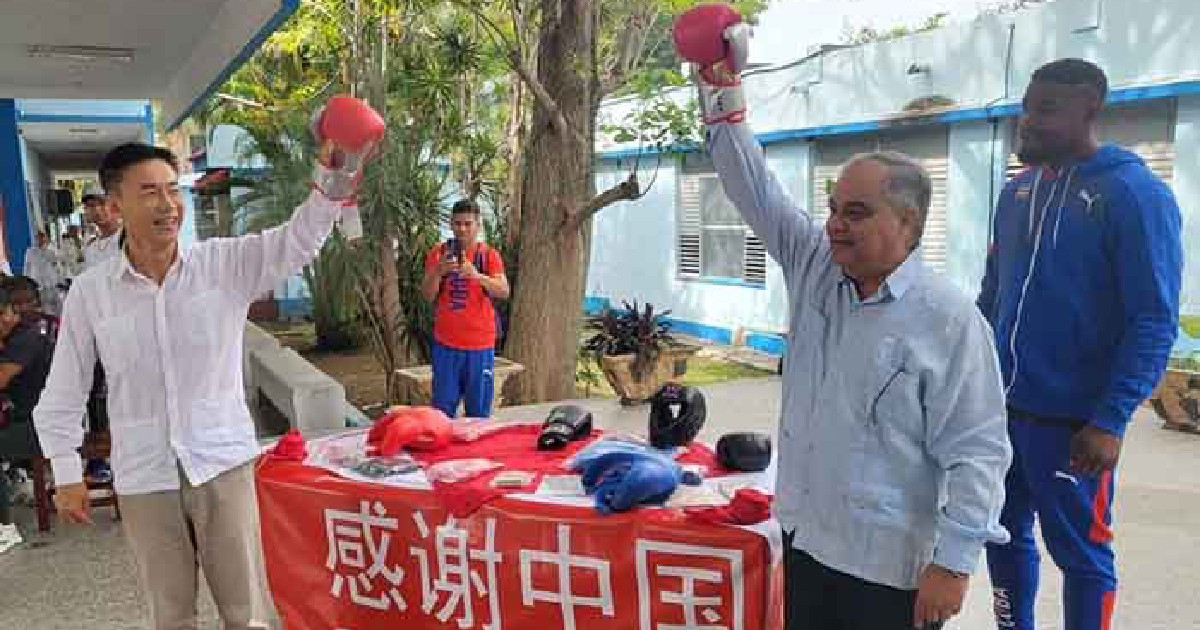
The General Administration of Sports of China donated over 14,000 pieces of sports equipment to the National Institute of Sports, Physical Education, and Recreation (Inder) of Cuba on Friday, during an event held at the Cerro Pelado High Performance Athletes Training School in Havana.
The gesture, which occurs in the context of other aid from the Asian giant amidst the multidimensional crisis affecting the Island, included equipment and protective gear for eight disciplines, including: boxing, table tennis, canoeing, swimming, and gymnastics. The equipment has already been distributed among the various training centers of the national teams, reported ACN.
The event was led by Osvaldo Vento Montiller, president of Inder, and Hua Xin, ambassador of China in Cuba. "I hope these supplies assist Cuban athletes in training and achieving better preparation for future competitions within this Olympic cycle," declared the Chinese diplomat, who added that "this collaboration will continue to increase in a reciprocal manner," the source indicates.
Gisleydi Sosa, director of International Relations at Inder, in typical official propaganda language, described the donation as something that "goes beyond sports equipment and articles: it is a manifestation of solidarity and trust between two brotherly peoples." On behalf of the athletes, junior gymnast Stefani Sulay Cantau described the support as "an injection of love and respect" that arrives "at the most intense moment in the preparation for the 2026 Central American and Caribbean Games in Santo Domingo."
The donation, however, contrasts with the deep structural crisis facing Cuban sports, which needs more than just "an injection"; it requires a long and thorough "medical treatment" for general reconstruction. More than half of the country's sports facilities were in poor structural conditions, as acknowledged by the government itself in 2022. Since that date, the situation has only worsened.
Stadiums with cracked bleachers, empty pools used as dumpsters, and closed dormitories in sports initiation schools are the norm in almost all provinces of the country. Coaches and athletes, under these conditions, make a tremendous effort to continue competing. Or they wait for the best opportunity and emigrate.
To the material ruin is added an unprecedented human exodus. Between 2022 and 2023 alone, 187 athletes left the country, many of them high performers. In baseball, the national sport, 635 players left the country in six years and calmost 40 prospects signed with MLB in 2024-2025.
The impact of this crisis was starkly reflected in the Paris 2024 Olympics, where Cuba finished in 32nd place in the medal table with only nine medals —two golds, one silver, and six bronzes— its worst result since Tokyo 1964, far from the official target of at least five golds and a position among the top 20 countries. Paradoxically, 21 athletes born in Cuba competed under other flags and added eight additional medals. The five-time Olympic champion Mijaín López publicly acknowledged the crisis in Cuban sports due to emigration, the deterioration of facilities, and lack of materials.
As a structural response, the regime approved Law 179 of the Cuban Sports System in January 2026 — the first comprehensive sports law in the country's history — which opens the door to private funding and the participation of non-resident Cubans in national teams. The Chinese donation, welcomed as a "symbol of brotherhood," is merely a drop of relief for a system that requires deep reconstruction, with the Central American and Caribbean Games in Santo Domingo 2026 — scheduled from July 24 to August 8 — as the next test of resilience.
Filed under: