
Related videos:
The Cuban regime is hastening to "cover up" the terrible image left by the successive collapses and the final collapse of the iconic building that housed the Higher Institute of Design of the University of Havana (ISDi), and is accelerating actions and propaganda in favor of the new headquarters being built for the school.
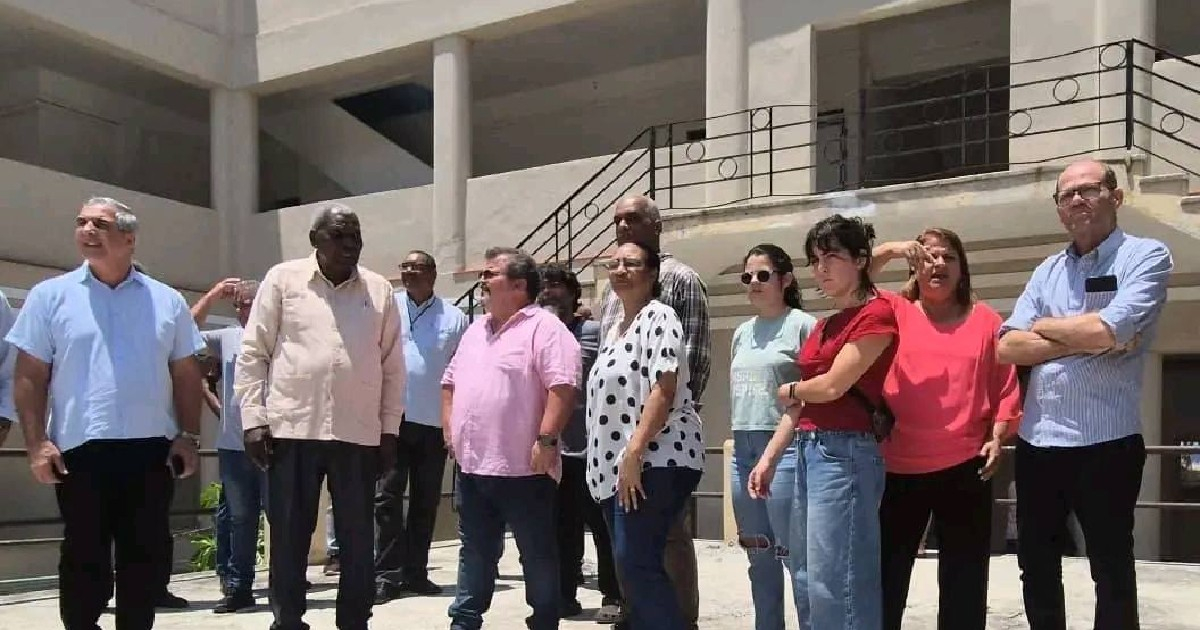
The President of the National Assembly of People's Power and the Councils of State, Esteban Lazo Hernández, visited this Saturday the construction site located on 1st Street between 32 and 34, in the Playa municipality, Miramar, as reported on the ISDi Facebook page.
The visit occurs just six weeks after the state-owned company GEICONS carried out the total demolition of the historic building where the country's designers were trained in Centro Habana, a property from 1860 that housed the institution since its foundation in 1984 and which the regime allowed to fall apart for years.
Lazo was accompanied by Vice Prime Minister Eduardo Martínez Díaz, the Governor of Havana Yanet Hernández Pérez, the First Deputy Minister of the Ministry of Higher Education Modesto Ricardo Gómez, and the Rector of the University of Havana, Dr. Miriam Nicado García, among other officials from the system, the publication noted.
The dean of ISDi, Dr. Sergio Luis Peña Martínez, explained the progress of the rehabilitation process of the building and its surrounding area. Representatives from the construction company affiliated with the Ministry of Construction, which is carrying out the work, reported that the project is expected to be completed by September 2026. That is, unless it follows the pattern of most "revolutionary" construction projects, which are rarely on schedule and, when they are, often leave much to be desired in terms of finish.
The new headquarters is being built in response to the total collapse of the historic location at Belascoaín #710, between Estrella and Maloja, which was closed in March 2022 due to a "complex architectural failure." Since then, the building has suffered a series of collapses: in July 2024, part of its interior facade collapsed, and on January 24, 2025, a 78-year-old woman was hospitalized after a new partial collapse that generated about 800 m³ of debris.
The collapses continued in December 2025 and in February 2026, until in March of this year the Municipal Assembly of People's Power of Centro Habana officially approved the total demolition. The site was reduced to rubble, which caused fear among the surrounding residents.
The abandonment of the building was also marked by systematic looting. Between September and October 2025, theses, historical archives, furniture, and equipment from the closed facility went missing. The art director of ICAIC, Luis Lacosta, documented how some of those ISDi documents were found discarded like trash in the Carlos J. Finlay park in Havana. The authorities did not issue official statements regarding the thefts.
The ISDi's Facebook post announcing Lazo's visit prompted a wave of critical comments. "It’s good for students and teachers to have a new location, but who is accountable for all the loss of material goods from the previous facility? Now the country has to invest again and provide everything that was carelessly stolen," wrote an internet user.
Another user was more direct in their criticism of the regime: "Same old story. They are incapable of maintaining anything. They let buildings fall apart, and then they engage in political maneuvering with the state budget to build a new one."
Nostalgia also surfaced among those who knew the original building. "That place had a magic the moment you walked through the door, a special touch, a story that will never be felt again," lamented one commenter. And a third summed up the collective sentiment: "It’s a shame that we weren’t able to preserve the previous building for its historical value, and today it is nothing more than rubble and trash."
The ISDi, founded in 1984 and part of the University of Havana, offers programs in Industrial Design and Visual Communication Design. Its historic headquarters was restored between 2005 and 2007, but subsequent deterioration became unstoppable under the regime's management, which now showcases the construction of a new facility as an achievement, with no one being held accountable for the loss of heritage or the looted assets.
Filed under: