
Related videos:
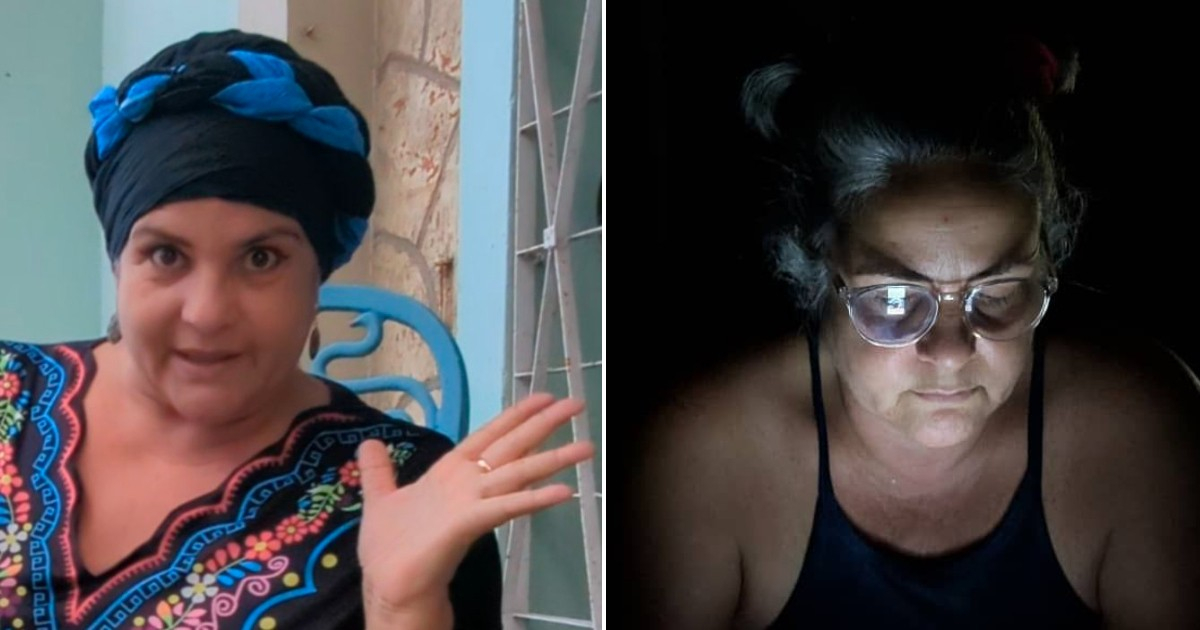
The Cuban broadcaster and presenter Laritza Camacho published a sarcastic critique on Facebook this Sunday directed at the informative segments of the Electric Union, questioning whether the Cuban State truly considers the citizens or merely keeps them informed of problems without solutions.
The daily statements from the Electric Union (UNE) follow a fixed structure that begins with the phrase "Considering that..." and lists the factors that explain the blackouts: the deficit, breakdowns, issues, delays, absences, and difficulties.
Camacho posed the central question of his publication: "The informative note informs you about what they take into account, but do they take us into account?"
The announcer also mocked the response that the regime itself would give to that question: "Yes, (they say) we take them into account so much that we keep them informed."
To illustrate his skepticism, Camacho referred to philosophical and scientific references: “For me, that last piece of information makes me smile with suspicion. I think of Socrates and his famous expression 'I only know that I know nothing'; Newton comes to mind, with his modest genius about knowledge... and suddenly, as if an apple had fallen on my head, I also recall the law of gravity.”
The publication includes a cartoon of Isaac Newton being hit on the head by an apple, ironically alluding to the discovery of the law of universal gravitation, and concludes with the note "P.S. We will continue to keep you informed," parodying the official language of state announcements.
The reactions to Laritza Camacho's post have been marked by humor, irony, and a direct critique of the official discourse. Many users celebrated the way the author deconstructs the usual language of the "informative notes" from the electrical system, which is filled with phrases like "taking into account..." or "will be informed soon." Comments such as "reality takes one path while words take another" or "they know how to inform, but the solution never comes" capture that shared sentiment.
The publication also elicited an immediate identification with the citizens' fatigue over the repetition of explanations without visible results. "What I want is for them to solve at least one problem, they don't even need to inform me," wrote one user, while another added, “don’t inform me about anything else, let me see the reality myself.” In this vein, several comments pointed to the disconnection between institutional discourse and everyday life: “what you see on the streets is the result of how we are taken into account.”
The humorous resource of the "law of gravity" was widely taken up by followers, who reinterpreted it with a critical lens. "Gravity is not just the force of the Earth, it's the gravity in which we live," commented one user, while others added with irony: "the ripe fruit falls by its own weight" or "the law of gravity is going to take them to the center of the Earth." This type of response demonstrates how sarcasm becomes a way to channel frustrations in the face of a prolonged situation.
In general, the predominant tone is not one of direct confrontation, but rather of weariness and clever mockery, where humor serves as a mechanism for social criticism. Amid praise for the author's creativity—"you have a brilliant way of stating the truth"—and jabs at the official discourse, the comments reflect a widespread perception: more than explanations, the population expects concrete solutions to a crisis that has become part of daily life in Cuba.
The criticism comes at a time of blackouts that are once again surging in Cuba: this Sunday, UNE reported an availability of only 1,735 MW against a demand of 3,100 MW, with a projected deficit of 1,365 MW during peak hours.
On Saturday, the electric service was interrupted for 17 hours and 45 minutes, with a maximum impact of 1,461 MW.
On April 16, 62% of the national territory was left without electricity simultaneously, leaving more than 200,000 Cubans without access to drinking water, while provinces such as Holguín, Granma, and Santiago de Cuba reported outages of up to 24 hours daily.
It’s not the first time that Camacho has pointed out the regime with irony regarding the energy crisis and the official management. On April 17, she criticized the waste of resources at the 65th anniversary event of the proclamation of the socialist character of the Revolution, held at 23 and 12 in El Vedado.
In February, following Díaz-Canel's televised appearance, the news anchor summarized her assessment with a powerful phrase: "We're going to squeeze them even more. The lemon is finished!"
In January, in response to the government's attempts to justify the blackouts, Camacho questioned the lack of dialogue from the government with its own people: "Trump claims he is in conversations with Cuba. Díaz-Canel states that there are no discussions with the United States. But when do they talk to the people?"
From December 2025 to April 2026, Cuba received only one shipment of Russian fuel, while the country needs eight fuel ships per month to sustain its electric system, making the energy crisis the most severe the island has faced in decades.
Filed under: