
Related videos:
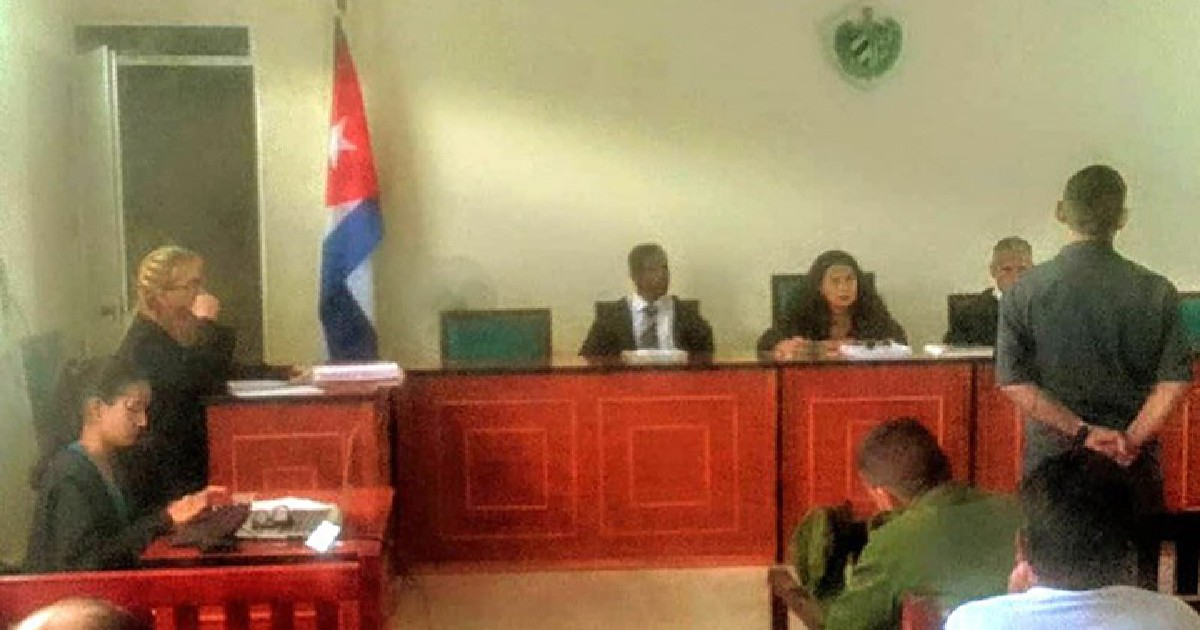
The Popular Provincial Court of Holguín sentenced a man to 14 years in prison for the cultivation and sale of marijuana in the locality of Jagüeyes in Puerto Rico, within the municipality of Banes, in what the Cuban regime authorities presented as an "exemplary" oral trial framed within their "zero tolerance" policy on drugs.
The case, identified as Cause 2 of 2026 of the Third Criminal Chamber, originated from investigations initiated in 2025 by the Criminal Investigation Unit III of Banes, which found that the accused had been involved in criminal activities related to drugs for several years. As a result, the National Anti-Drug Directorate of the municipality began its "monitoring and follow-up" in the file referred to as "Jagüeyes Case."
The police operation that led to his arrest took place on the morning of May 6, 2025, when agents captured the suspect hidden in the underbrush, near a field enclosed by a fence made of wooden poles and wire, according to a post on the PNR's Facebook profile "Heroes in Blue in Cuba".
The detainee had 429 plants of the species Cannabis Sativa L. ssp. Indica, ranging in height from 14 to 77 centimeters, with a total net weight of 2,420 grams, as well as 11,280 Cuban pesos in cash, reported Yeisys González Escalona, Vice President of the Provincial People's Court of Holguín, to the Cuban News Agency.
The man, whose identity has not been revealed, was prosecuted for drug trafficking and sentenced to 14 years in prison, according to the provisions of article 235.1 d). 2 g) of Law 151 of 2022 of the current Penal Code, which has a legal penalty framework of 10 to 30 years of deprivation of liberty. The court also took into account the defendant's recidivism as an aggravating factor, González Escalona stated.
In addition to the deprivation of liberty, additional penalties were imposed, including the removal of civil rights, a prohibition on leaving the national territory for 14 years, and the confiscation of all seized money.
According to the note, the trial was conducted "respecting the accused all the legal and procedural guarantees as established by the current legislation in the country."
The publication reminded that Cannabis Sativa Indica, commonly known as marijuana, belongs to the group of hallucinogenic psychotropics and "can cause motivational syndrome and psychological dependence," which is why it is subject to international regulation according to the Single Convention of 1961, in lists I and IV of narcotic substances, of which Cuba is a signatory member.
In March, the Provincial Court of Holguín sentenced a resident of Cueto to eight years in prison, identified as the main drug dealer in that locality, in the so-called "Phantom Case."
In September 2025, three Cubans were sentenced in Holguín for drug trafficking in another exemplary trial held by the same court.
Nationally, the drug trade shows no signs of retreating. In 2024, the Ministry of the Interior seized over a ton of drugs across the country and sanctioned 1,157 individuals. In 2025, the Cuban Observatory of Citizen Auditing (OCAC), an independent organization, documented 437 incidents of drug production, sale, and consumption, an increase of 115% compared to the previous year.
The authorities have also identified at least 40 variants of synthetic cannabinoids circulating in Cuba, commonly known as "químico" or "papelillo," which shows that the toughening of penalties has not succeeded in curbing the advancement of drug trafficking on the island.
In March, the Provincial Court of Artemisa sentenced two Cubans to 15 years in prison for carrying just 1.74 grams of a synthetic cannabinoid, in another trial conducted under the same punitive logic of the regime.
Filed under: