
Related videos:
A message sent from Bayamo, Granma province, and shared by the Cuban writer and dissident Ángel Santiesteban-Prats on Facebook, denounces that directors of state companies and establishments are being forced to obtain at least 80% of signatures from their employees for the government campaign "My signature for the Homeland."
According to the testimony, members of the Communist Party of Cuba (PCC) must sign up to three times: as party members, as workers, and as members of the Defense Committee of the Revolution (CDR) in their block.
"I was informed that the directors of companies or establishments are required to collect signatures from their workers, at a minimum, 80%; however, those who are party members sign three times: as members, as workers, and for their neighborhood committee (CDR). To achieve this, they apply pressure, threaten, and blackmail," states the message circulated by Santiesteban-Prats.
This report from Granma adds a quantitative and organizational dimension to the pattern of coercion that had already been documented in other provinces and reveals how the regime could be artificially inflating the numbers of support for the campaign.
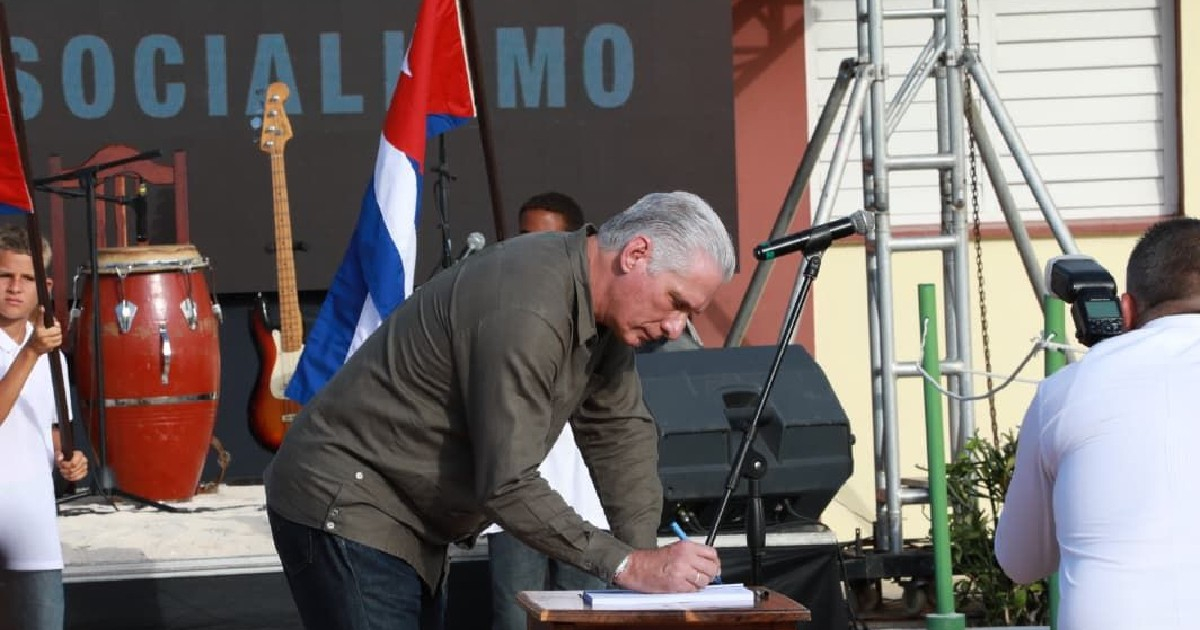
The campaign "My Signature for the Homeland" was launched on April 20 by Miguel Díaz-Canel in Playa Girón, Matanzas, as part of the 65th anniversary of the Battle of Playa Girón, and presented as an initiative of "civil society" in defense of national sovereignty against the U.S. embargo.
However, the reports gathered from multiple provinces reveal a systematic pattern of institutional coercion that contradicts that official narrative.
In Matanzas, workers were threatened with dismissal if they refused to sign, according to testimonies collected on April 22.
In Cárdenas, also in Matanzas, phrases such as "Either you sign or you know what awaits you" were reported, directed specifically at employees.
A Cuban who refused to participate in the campaign summarized her stance with a widely circulated phrase: “My dignity has no price”.
Last Monday, a Cuban stood before the president of his CDR and refused to sign the regime's campaign, arguing state neglect and demanding basic services before supporting any official initiative.
Analysts and opponents point out that the campaign responds to a need for political legitimacy for Díaz-Canel's government in light of the severe economic crisis that Cuba is experiencing, marked by a GDP contraction of 23% since 2019, prolonged power outages, and widespread shortages.
As highlighted in an analysis published on the signing as a stage for power in Cuba, "when a government needs to seek out mass signatures to prove that it still represents the people, what it is admitting, without saying so, is that real legitimacy is no longer sufficient."
The campaign aimed to collect millions of signatures before May 1, 2026, International Workers' Day, a date that is approaching as reports of coercion continue to multiply across the country.
Filed under: