
Related videos:
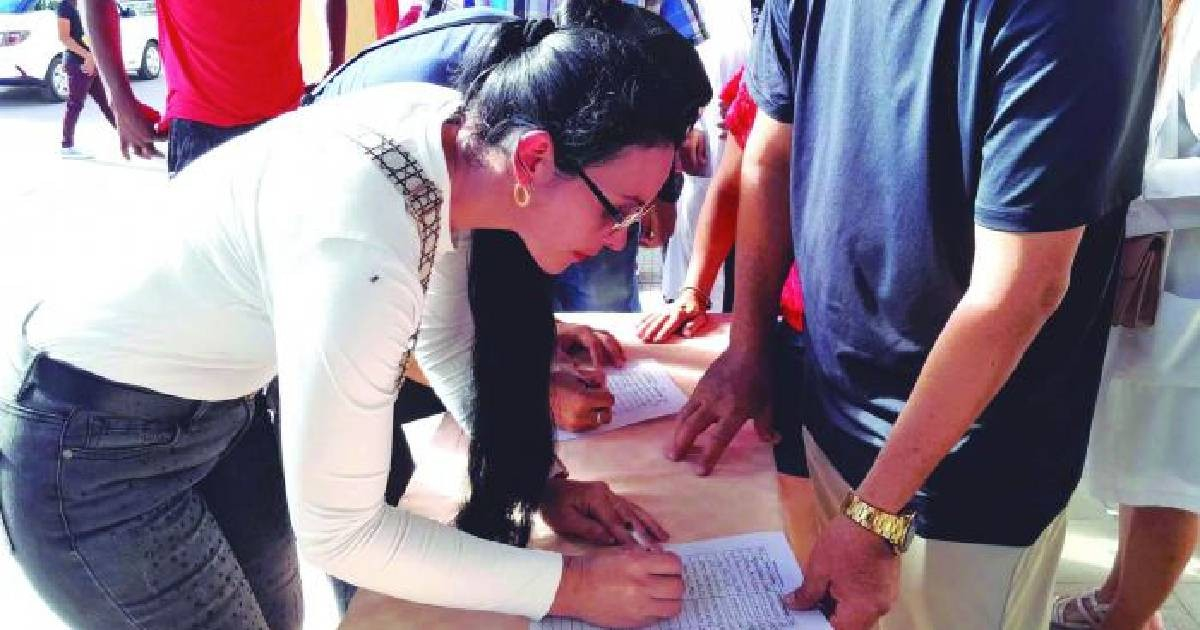
Workers in Matanzas are being forced to sign the lists for the "My Signature for the Homeland" campaign under the threat of dismissal, according to a report received by CiberCuba from a source who is protected for security reasons.
The reporting individual stated that she herself refused to sign the initiative of Miguel Díaz-Canel and was threatened with losing her job.
"My friend is being threatened with losing her job," she stated, pointing out that the pressure is not only on her but also on those around her.
Fear as a mechanism of control is evident in one of the most revealing testimonies of the complaint: "My mom signed because she is afraid."
The complainant believes that the practice extends beyond her province: "This must be happening throughout Cuba."
The pressure is not limited to workplaces. A screenshot of a conversation in a messaging group called "Sign for the Homeland" shows that the same dynamics are replicated in educational institutions.
In that chat, a person recounts being expelled from a meeting at their school for refusing to sign the document: "I was removed because they say my ideas are not in line with revolutionary principles."
Some of the participants in that conversation openly expressed their rejection. "Today I broke down and said everything I wanted," wrote one of them, adding: "Let them take whatever measures they want afterwards. I don't care."
Another participant questioned the very foundation of the official discourse: "I don't know who is going to fight for this here."
These reports arise in a context of sustained ideological escalation by the regime. Since March 2026, the government has intensified warlike rhetoric and the promotion of military service as a supposed patriotic duty, extending this pressure even to children and women.
The Ministry of Revolutionary Armed Forces and the regional armies have amplified the rhetoric of revolutionary defense in public events and study centers.
The practice of forcing employees and students to sign loyalty statements is not new in Cuba.
The regime has historically used these spaces as tools for political control, where refusal to participate in acts of adherence can lead to professional or academic repercussions.
Filed under: