
Related videos:
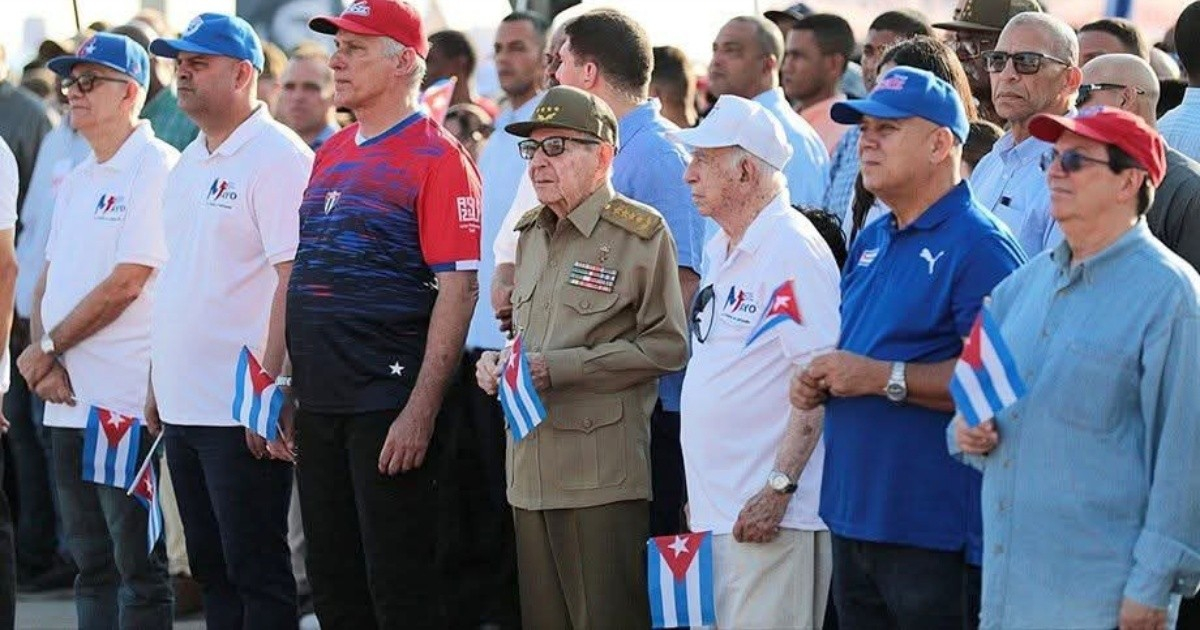
Raúl Castro, 94 years old, presided over the central event for International Workers' Day this Friday at the Anti-imperialist Tribune José Martí, in front of the United States Embassy along the Havana waterfront, in his first public appearance since December 2025.
Alongside the historical leader of the dictatorship was Miguel Díaz-Canel, First Secretary of the Communist Party of Cuba and president of the country, as well as members of the Political Bureau, representatives of the Revolutionary Armed Forces, the Ministry of the Interior, the Union of Young Communists, and various mass organizations.
A notable absence has been that of Ramiro Valdés, who has been out of the public eye for months without any official explanation.
The official account of the Presidency of Cuba on X estimated the concentration at more than half a million people under the slogan "The Homeland is Defended," although the figure comes from sources within the regime itself and cannot be independently verified.
The appearance of Raúl Castro is significant: his last documented presence at an official event was on December 2, 2025, during the final session of the National Assembly, where he was described as "frail and having difficulty walking"."
In March 2026, he was absent from the 9th Congress of the Communist Party, where Díaz-Canel was confirmed as first secretary.
Díaz-Canel himself acknowledged in April, in an interview with Telesur, that Raúl is "alive but retired for health reasons" and is "fragile due to his advanced age."
This year, the central event was moved from the Plaza de la Revolución to the Anti-Imperialist Platform, a smaller venue inaugurated in 2000 during the Elián González case.
The president of the organizing committee of the Cuban Workers' Central, Osnay Miguel Colina Rodríguez, justified the change by appealing to "austerity" and the "cruel energy blockade."
Critics point out that the transfer aims to disguise the low actual participation in light of the economic collapse and social exhaustion.
The workers, organized into 15 unions, marched from dawn from four locations in Havana: 23 and 2, Avenida Salvador Allende and Infanta, Parque Antonio Maceo, and Prado and Malecón.
The event is part of the "Year of Preparation for Defense" declared by the regime for 2026, in direct response to the threats from President Donald Trump, who stated in Miami on March 28 that "sometimes military force must be employed, and Cuba is next."
The National Defense Council approved plans to transition to a State of War and the regime has conducted weekly military exercises.
Raúl Castro published a message in which he stated he is "with one foot in the stirrup and ready to charge with the machete," as "one more fighter, against the enemy and our own mistakes."
The militaristic display contrasts with the reality faced by the Cuban people: blackouts lasting between 10 and 25 hours daily, widespread shortages, and an economy projected to contract by 7.2% in 2026.
The day before the parade, independent journalist Ángel Cuza was arrested in front of his daughter in Havana by State Security agents, and children were taken from their schools in San Miguel del Padrón and Santiago de Cuba to participate in pre-event marches.
Filed under: