
Related videos:
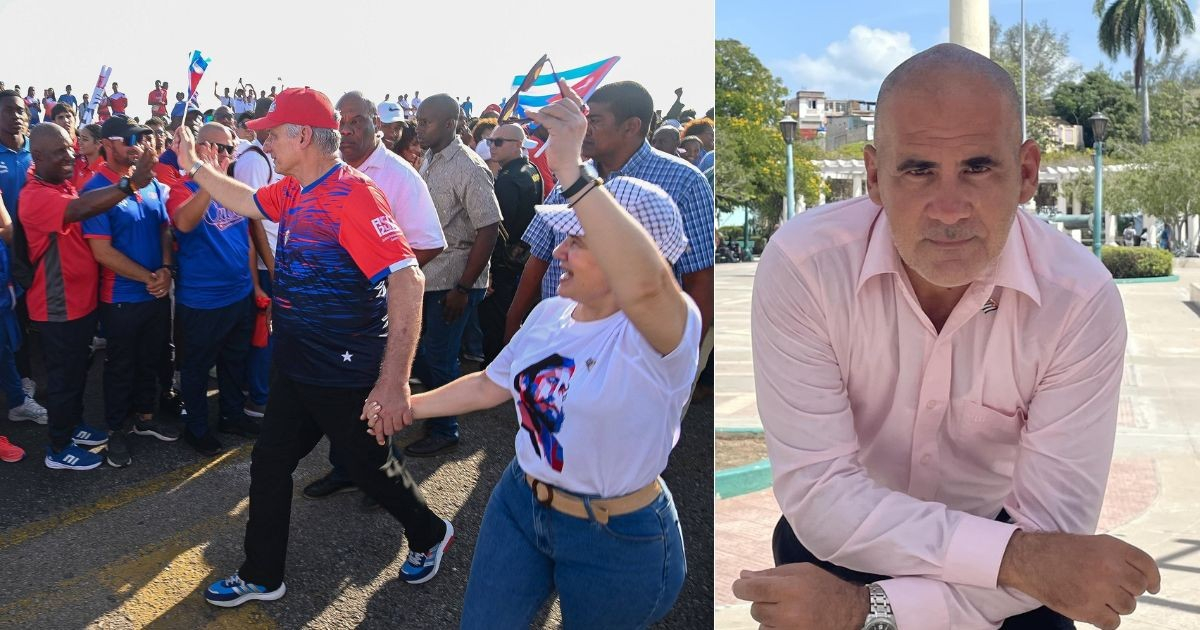
While the Cuban regime organized its usual International Workers' Day parade on Friday under the slogan "The Homeland is Defended," the lawyer and former university professor René Fidel González García published a powerful message on Facebook from Santiago de Cuba, exposing the political hypocrisy of the event: "It's not about the people who are marching, but about the people who cannot express themselves."
González García, Doctor of Legal Sciences and former tenured professor at the University of Oriente, was dismissed and professionally banned in November 2016 due to his critical articles about the regime, in a process fraught with arbitrary actions. Since then, he has continued to express his criticisms through social media.
In his publication, the professor argues that "recognizing and guaranteeing constitutional political rights never involves granting them to some and denying them to others. A privilege is not, and can never be, a right."
For the academic, allowing some to march while repressing those who wish to express themselves freely "means nullifying political equality and excluding a segment of the citizenry from exercising their rights."
This exclusion —the jurist acknowledges— can persist over time, but it cannot be legitimized: "It can be enacted for a period, even concealed for a long time, but it cannot be justified either ethically or legally for what it essentially is: political exclusion."
The repression that accompanied the parade confirms exactly what is being denounced. The day before May 1st, journalist Ángel Cuza Alfonso was detained in front of his young daughter in Havana by State Security agents. At least 18 reporters, activists, and opposition members experienced internet blackouts starting the day before, and dozens were besieged or detained.
This was joined by another institutionalized practice: children taken from their schools in San Miguel del Padrón and Santiago de Cuba to participate in pre-marches, a tradition that the regime has carried on since the 1960s.
The main event was not held in Plaza de la Revolución but at the José Martí Anti-Imperialist Tribune, in front of the United States Embassy along the Havana waterfront. Miguel Díaz-Canel led the march accompanied by his wife Lis Cuesta and Foreign Minister Bruno Rodríguez, surrounded by a significant security detail, while the nonagenarian Raúl Castro presided over the central political event.
The irony of the parade becomes sharper when examining the real situation of the workers who march. The average salary in Cuba was barely 6,930 CUP per month in 2025—about 15 dollars—while a couple needs over 45,000 CUP a month to cover basic necessities. It is these same impoverished workers who are pressured to march in celebration of a system that condemns them to precariousness.
The atmosphere of the parade was openly warlike, framed within the "Year of Preparation for Defense," in response to the climate of escalating tensions with the administration of President Donald Trump. In the midst of the crisis, the regime called for May Day with a warlike tone, mobilizing official unions from dawn.
This is not the first time that González García has issued a warning of this kind: in April, he had already pointed out that the Cuban crisis is worse than in 1953 under Batista, urging a new generation to take action. This Friday, he concluded his message with a vision of the future: “In the territories of the future, what will truly surpass today's exclusion will be effective respect and full guarantee of the right to political equality for all. But even more superior will be our memory and the solid, lucid, and irrefutable reasons that sustain our 'never again' today and at that time.”
Filed under: