
Related videos:
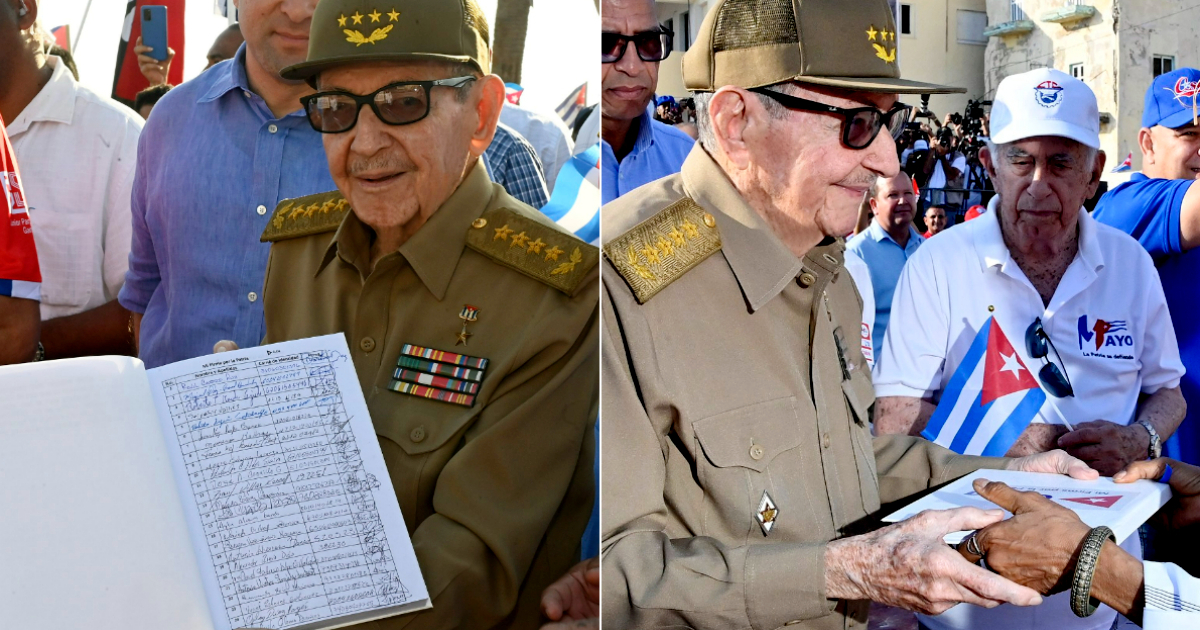
The Army General Raúl Castro reappeared this May Day in Havana holding a book with signatures from the “For the Homeland” campaign, in one of the most symbolic images of the decaying propaganda event organized by the regime.
The scene, shared on the social media of the Presidency, took place during the official parade on the Malecón in Havana, where the ruling elite attempted to portray a supposed unity amid the deep economic and social crisis facing the country, which resulted in images of very low attendance, perhaps the lowest in the entire 67-year history of the dictatorship.
The book is part of a propaganda campaign with which the regime claims to have collected over six million signatures, presented as evidence of popular support.
However, this narrative contrasts with reports of low attendance at some marches, criticisms regarding the lack of freedoms, and questioning the authenticity of citizen participation.
The event was also surrounded by controversy on social media, where many Cubans reacted with mockery to the official speech, while state media attempted to project a festive image through carefully curated images and videos.
It was even reported that there were touch-ups in official photos and a clear effort to control the public perception of the event.
In that context, the image of Raúl Castro — visibly aged according to various analyses — holding the guestbook takes on a strong symbolic weight as a conclusion to the regime that the Castro family established in 1959, and it seems to lack "continuity" amid the current economic debacle.
Beyond the gesture, the page of the book displayed by the general clearly identifies several of the signatories, revealing the internal composition of that supposed "support": a mix of high-ranking political leaders, military commanders, members of the Communist Party, and figures utilized within the regime's propaganda apparatus.
These are the names that appear on the first page of the record:
Raúl Castro Ruz — Army General; central figure of power in Cuba
Miguel Díaz-Canel Bermúdez — President of the Republic
Roberto Morales Ojeda — Secretary of Organization of the Central Committee of the PCC
Salvador Valdés Mesa — Vice President of the Republic
Roberto Legrá Sotolongo — Army Corps General; Chief of the General Staff of the FAR
Yuniasky Crespo Baquero — Head of the Ideological Department of the Central Committee of the PCC
Nemesia Rodríguez Montano (“the coal flower”) — A symbolic figure of the official narrative
Mario Felipe Sabines Lorenzo — Governor of Matanzas and First Secretary of the PCC in the province
Humberto Camilo Hernández Suárez — Head of the Personnel Policy Department of the Central Committee of the PCC
José Antonio Carrillo Gómez — General; head of the Political Directorate of the FAR and member of the Central Committee of the PCC
Raúl Villar Kessel — Division General; Chief of the Central Army
Caridad Meyvis Estévez Echeverría — First Secretary of the UJC
Lis Cuesta Peraza — Official and wife of Miguel Díaz-Canel
Aylín Álvarez García — Rector of the Higher School of the Party "Ñico López"; former First Secretary of the UJC
Marieta Poey Zamora — Official of the political-administrative apparatus
Gerardo Hernández Nordelo — National Coordinator of the CDRs
Antonio Álvarez Blanco — First Colonel; Head of the Political Section of the Central Command of the FAR
Welcome Roig Chirino — First Secretary of the PCC in Ciénaga de Zapata
Yurién Estévez Gutiérrez — President of the Municipal Assembly of People's Power in Ciénaga de Zapata and deputy
Oslay Díaz Pagés — Food Coordinator in Pedro Betancourt
Liudmila Álamo Dueñas — Deputy Head of the Department of Social Sector Attention of the Central Committee of the PCC
Other four names — Not identified due to being illegible in the image
The list reflects a carefully structured composition: political leadership, senior military officials, the ideological apparatus of the Communist Party, territorial cadres, and symbolic figures.
More than just a simple signature register, the document presented by Raúl Castro acts as a visual representation of the power system in Cuba, at a time when the regime is attempting to reaffirm its control and legitimacy in the face of growing social discontent.
Filed under: