
Related videos:
The chancellor of the Cuban regime, Bruno Rodríguez Parrilla, responded this Saturday to the statements made by U.S. President Donald Trump, who the day before claimed that the United States "will take control of Cuba almost immediately," labeling the president's words as a direct threat of military aggression against Cuba.
In a message posted on social media, Rodríguez stated: "The new clear and direct threat of military aggression issued by the President of the United States, after drastically tightening the economic embargo, raises the aggression against Cuba to dangerous levels, with no other pretext than the desire to satisfy tiny elites who promise him electoral and financial loyalty."
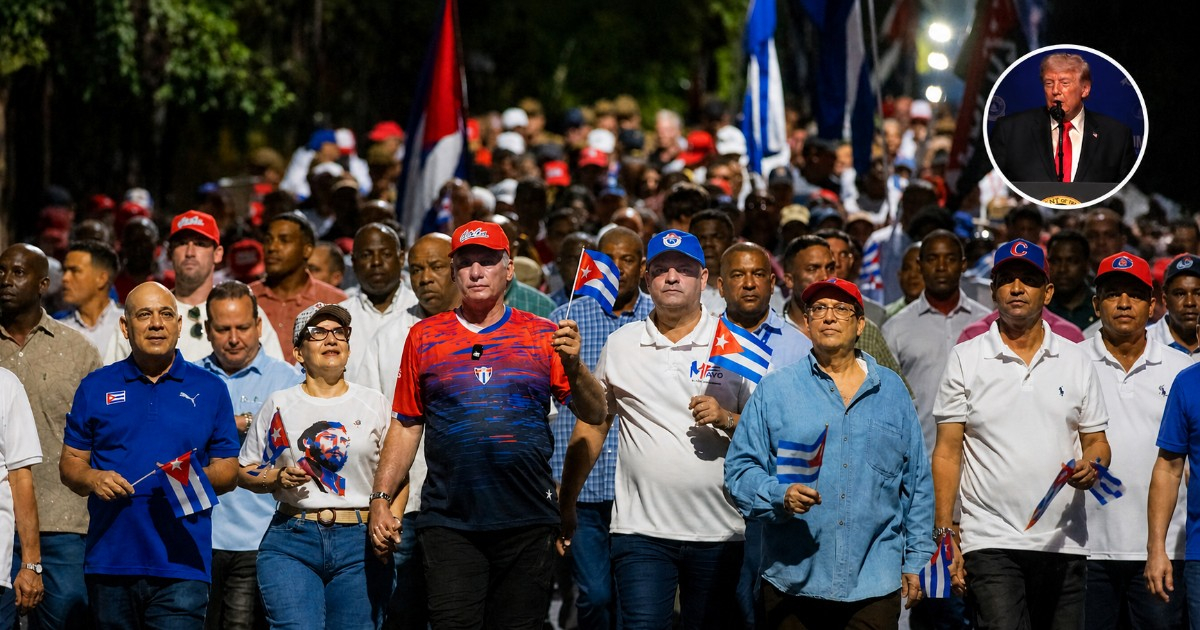
The head of the regime's diplomacy linked the escalation to the demands of the Cuban-American community in South Florida and closed his message with a defiant statement: "Cubans do not allow ourselves to be intimidated. The resolute response of the people and their support for the Revolution was demonstrated massively this May Day."
Trump made his statements on Friday during a private dinner of the Forum Club in West Palm Beach, Florida, where he described a scenario in which the aircraft carrier USS Abraham Lincoln—currently deployed in operations against Iran—would stop "about 100 yards off the Cuban coast," after which the regime would say, "Thank you very much, we surrender." Trump specified that he would act on Cuba once the "work" in Iran was completed.
On the same Friday, the Trump administration signed a new executive order that blocks all assets in the U.S. of individuals or companies operating in the Cuban energy, defense, mining, and financial services sectors, and imposes secondary sanctions on foreign banks that conduct transactions with sanctioned Cuban entities. Díaz-Canel described the new sanctions as a "brutal genocidal blockade" and accused the administration of "moral poverty."
This week, Secretary of State Marco Rubio accused Cuba of hosting intelligence facilities from China and Russia on its territory, warning that "it won't happen under the presidency of Donald Trump." Rubio stated that Cuba hosts Chinese and Russian intelligence just 90 miles from the U.S. coast.
Last Tuesday, the U.S. Senate rejected with 51 votes against and 47 in favor a Democratic resolution that sought to limit Trump's war powers regarding Cuba, paving the way for potential military action without legislative restrictions. The U.S. military deployment in the Caribbean follows a pattern that analysts compare to the one that preceded Nicolás Maduro's capture in Venezuela.
The Cuban regime turned May Day into a show of support in front of the U.S. Embassy in Havana, with the presence of Díaz-Canel, Raúl Castro, and Rodríguez himself. The event was moved from the Plaza de la Revolución to the José Martí Anti-Imperialist Tribuna under the official pretext of "austerity" due to the "energy blockade," while the island suffers from power outages of up to 25 hours daily in more than 55% of the territory.
Since January 2025, the Trump administration has imposed over 240 new sanctions against Cuba, reinstated the island on the list of state sponsors of terrorism in January 2026, and intercepted at least seven oil tankers destined for the island, reducing energy imports by 80-90%.
Filed under: