
Related videos:
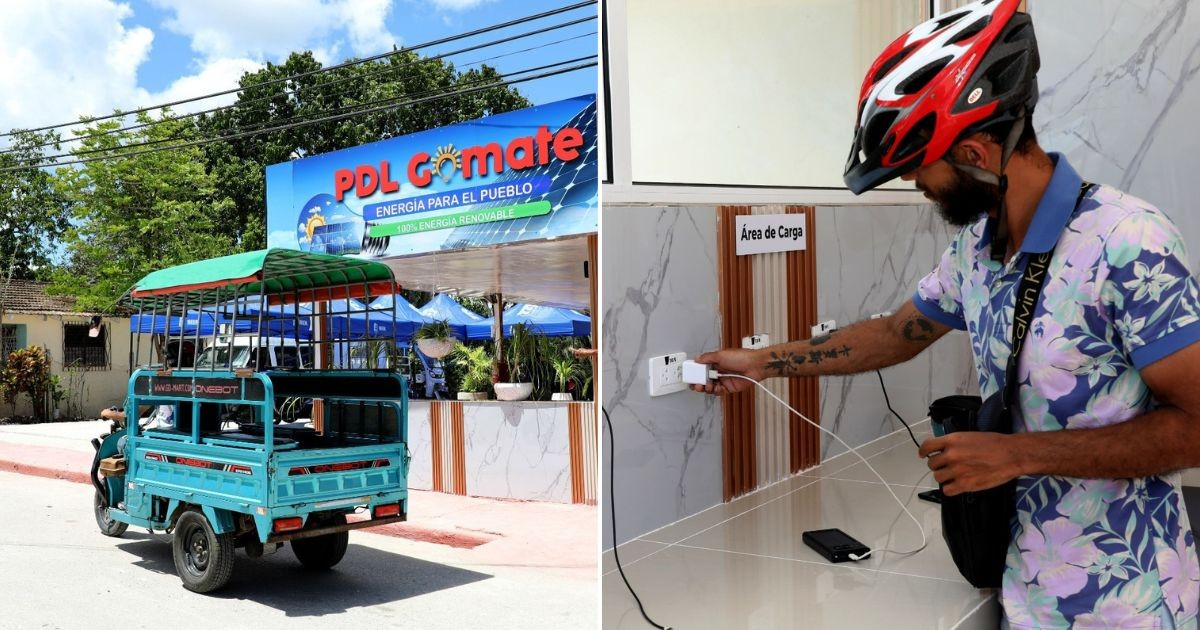
Residents of the Virginia popular council, in Santa Clara, are forced to visit a solar energy station every day to charge their phones, cook food, and recharge their electric vehicles, in what has become one of the most concrete responses—but far from sufficient—to the prolonged blackouts affecting Villa Clara and the rest of Cuba.
The facility, known as "solinera" —a Cuban neologism that combines "solar" and "gas station"—, was inaugurated on April 5 by the Local Development Project (PDL) Gomate Technical and Commercial Services, located on Prolongación de Marta Abreu Street, between Silverio and Circunvalación, and operates daily from eight in the morning to five in the afternoon, entirely independent of the National Electric System.
The solar facility has 56 solar panels, 30 kilowatts of power, and 60 kilowatts of battery storage, providing total autonomy even during hurricanes and extended emergencies.
It has simultaneous capacity for six vehicles and 26 double sockets that allow for the connection of 52 cooking devices, a service that is offered free of charge to the entire population, the regime proudly stated.
The cost of charging motorbikes and electric tricycles is yet to be determined, although those in charge assure that it will remain as low as possible to ensure the sustainability of the project.
Julio Ernesto Gomate Morales, director of the PDL and a 29-year-old who started as a self-employed worker under the name "Partes y Piezas Julito," explained the reason behind the cooking service: "Today, many people are cooking with charcoal, which costs 2,000 pesos a sack and runs out in just a few days. But almost everyone has a rice cooker or a pot at home and can bring it here. The neighbors are happy to have a place to solve this problem."
According to their statements, this is undoubtedly another way of romanticizing the misery endured by Cubans: while the crisis forces them to address basic needs outside their homes, there is an insistence on portraying the neighbors as "happy," when in reality, this is just a makeshift and precarious solution.
The work was completed in just nine days from the ground up, carried out by Eléctrica Total, a private company based in the municipality of Ranchuelo.
Yaneisy Granela Hernández, the administrator of the PDL, described the effort: "We worked from dawn almost until it was dawn again, but we did it."
The same administrator emphasized that this is the first charging station of this magnitude in the province: "There was only one smaller one in another mipyme."
The 30 kW from the community solar installation are added to another 50 kW that ensure the operation of the commercial and service area of the PDL, which since its establishment in mid-2025 has generated 54 direct jobs.
Oscar García Valdés, a resident of the José Martí neighborhood, was one of the first to arrive after seeing the news on Facebook: "I came to charge my phone because I had no power at home. I thought it was a great idea. I believe it should be expanded, especially to the municipalities."
The initiative arises during the worst energy crisis in Cuba in decades. In March 2026, the seventh and eighth total collapses of the electricity system occurred within just 18 months, on the 16th and 22nd of that month, with blackouts exceeding 20 hours a day in several provinces.
The crisis worsened in January 2026, when Venezuela suspended its crude oil shipments and Mexico cut its oil exports under the pressure of sanctions from the Trump administration.
In response to that collapse, decentralized renewable energy solutions have proliferated across the island: tricycles with solar panels in Havana, power outlets installed in a solar park in Isla de la Juventud, and a micro, small, and medium enterprise (mipyme) in Santa Clara that achieved total energy self-sufficiency.
Among the future projects of PDL Gomate is the installation of fast and ultra-fast charging equipment, as well as the construction of another charging station near kilometer 270 of the National Highway. A colleague from Las Tunas has already expressed interest in replicating the experience in that eastern province.
Neighbor Miguel Ángel García Marimón cautiously captured the community's sentiment: “It’s an important step to have a place to charge our phones or cook when there’s no power, but there is still a lot to be done to solve the energy problem in the neighborhood; hopefully, this is just the beginning of more projects like this, because the need is great and power outages continue to be very bothersome.”
Filed under: