
Related videos:
In the midst of one of the worst energy crises in Cuba's history, the announcement by the Ministry of Transportation regarding the "modernization" of the transportation system in Sancti Spíritus with electric vehicles seems, more than a real solution, like a mockery of the Cuban people.
The minister Eduardo Rodríguez Dávila visited the province of Sancti Spíritus to promote electric media projects, as reported by the Ministry of Transport on its social media.
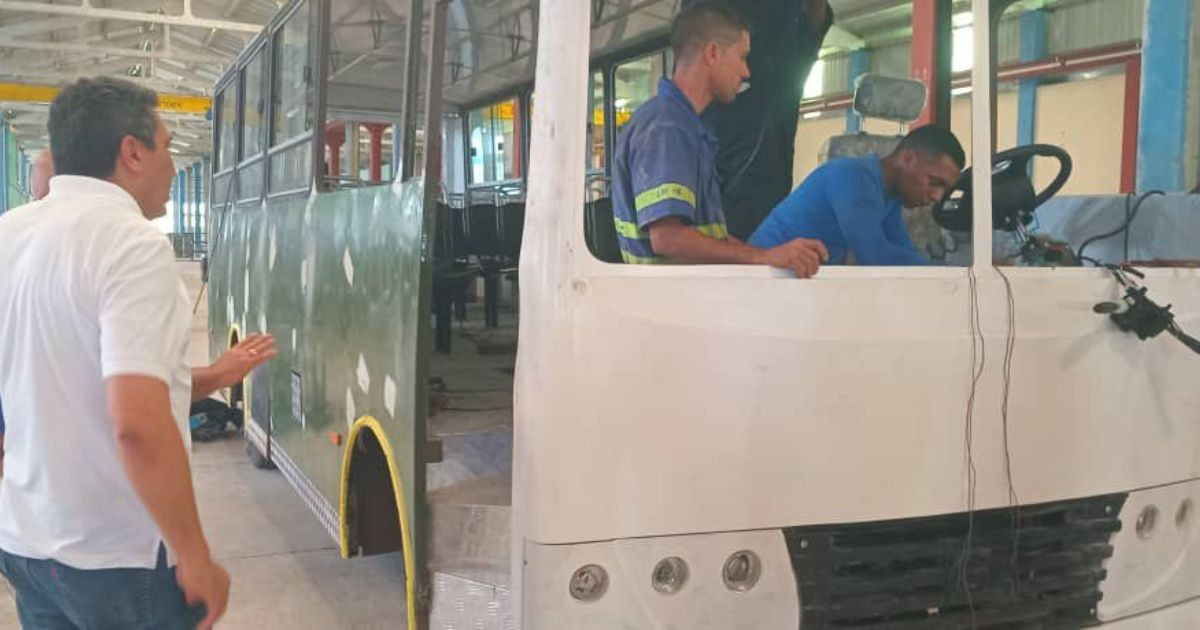
During the visit to the Francisco Aguiar Rodríguez Military Industrial Company (EMI), the official took an interest in the production of a new batch of 40 ecomobiles intended for passenger transportation, funded by the Public Transport Development Fund.
On the production line, assembly is currently underway for 15 of those electric vehicles.
A prototype of a combustion bus is also being manufactured at EMI, based on an imported chassis, with plans to produce 12 units for transportation services.
Rodríguez Dávila also requested to work on the adaptation of 10 electric tricycles for solid waste collection in the capital city and on a prototype of an electrified Diana bus to assess its technical possibilities.
"We need to advance in the installation of solar-powered charging stations and continue modernizing transportation methods," emphasized the minister during the visit.
"With electric cars, we not only have an alternative to fuel limitations but also with the use of lubricants," he added.
The paradox is hard to ignore: on May 2, Cuba recorded an electrical deficit of 1,415 megawatts, with a generation capacity of just 1,735 MW against a demand of 3,150 MW, just two days before the ministerial visit.
Six of the country's 16 thermoelectric units were out of service, and the Russian fuel expected to last until the end of April had already run out, with no immediate prospect of replenishment.
In that context, Cuba needs eight fuel boats per month but has only received one since December 2025, as acknowledged by the Minister of Energy himself.
The crisis of conventional transportation is equally serious: out of 558 interprovincial buses, less than 40% are operational, and the regime admitted in January 2026 that public transportation only meets 42% of the planned targets.
In Ciego de Ávila, out of 135 bus routes, only two are operational, and the seven railway routes in the province are halted due to a lack of fuel.
Sancti Spíritus has been the pioneering province in this program: the first five ecomobiles started circulating in June 2024, and in November 2025, the first electric charging station in Cuba was inaugurated at the EMI as an experimental solar charging infrastructure.
However, that power grid remains minimal and experimental, while outages affect simultaneously 46% of the island and the transportation in Cuba deteriorates every day with official promises failing to translate into real solutions for the population.
Filed under: