
Related videos:
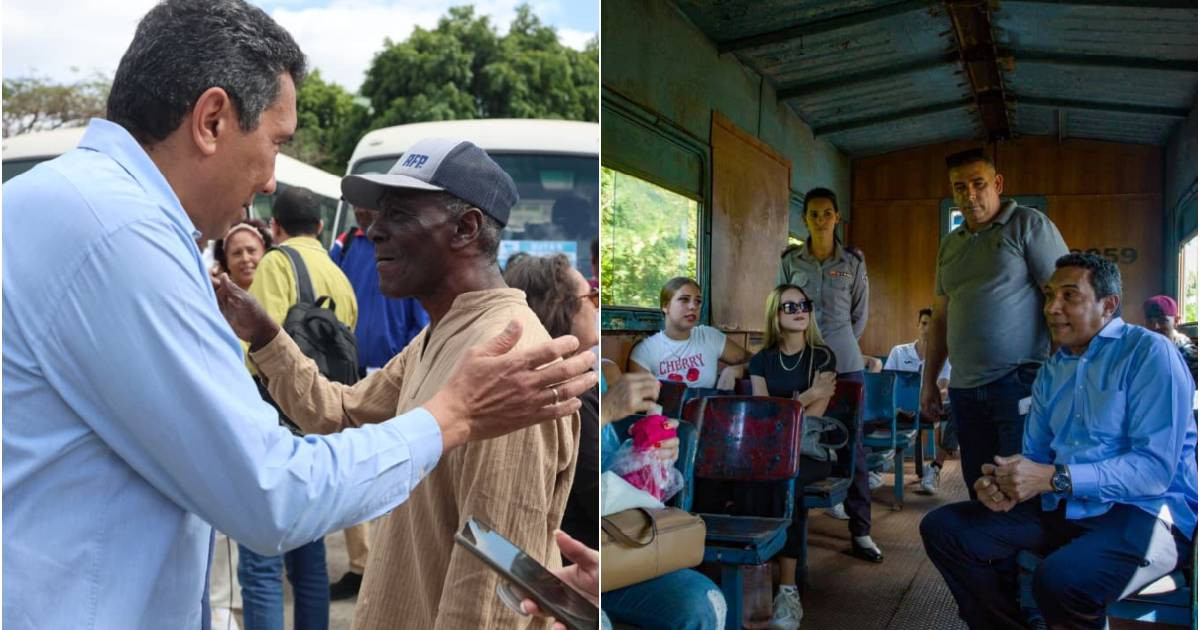
The Minister of Transport of Cuba, Eduardo Rodríguez Dávila, stopped his official vehicle this Thursday at a bus stop on the Vía Monumental, in front of the Pan American Village in Havana, and offered to take five people who were waiting for transportation to go to work or medical appointments, according to witness Geny Andres Bará's account on Facebook.
The incident occurred at 7:45 in the morning when a white van marked with the initials of the Ministry of Transport (Mintrans) came to a sudden stop at the bus stop.
Rodríguez leaned out of the window and asked to advance his route for the passengers, eliciting an immediate reaction from those present.
"That a minister voluntarily stops the car he is traveling in at a bus stop at 7:45 am, filled with people desperate to get to work or a medical appointment, in a country facing an energy crisis and with public transportation nearly nonexistent, is admirable and worth noting," wrote Bará.
The gesture contrasts with the usual behavior that the same witness describes at this stop. "Many times at this very stop, many state vehicles capable of alleviating the crisis refuse to stop, even in the presence of the inspectors' signals, because the director or manager of such-and-such is traveling in them, completely disregarding the needs of the population."
The paradox is evident, with the pickup of passengers at a stop by the head of the ministry responsible for the transport system that leaves them stranded for hours.
The collapse of the sector is structural. Bus production fell from 473 units in 2019 to just 12 projected for 2026, a reduction of 97.5%, and the state passenger transportation collapsed by 93% between January and September 2025.
In March, Rodríguez himself acknowledged on the official program Mesa Redonda that national buses operate with only one departure per day, trains run once every eight days, and the ferry to the Isle of Youth has only two weekly frequencies.
In Ciego de Ávila, only two out of 135 bus routes are operational with minimal and irregular frequencies. In Las Tunas, virtually all bus departures have been suspended, leaving only a nighttime service to Havana.
On February 6, urban transportation in Havana completely collapsed, as no routes operated that day due to a lack of fuel.
Despite overseeing that disaster, Rodríguez has a history of traveling in vintage cars and boarding crowded buses as just another passenger, according to the same witness.
That image of closeness has earned him unusual support among Cubans. A poll led by a number of independent media outlets, open until this May 1, identifies him as the government official with the highest residual support, with 43 favorable mentions in the open-ended question.
In that same survey, 94% of the participants stated that they do not trust anyone in the Cuban government. One of the respondents described it as "the only one who stands out."
At the beginning of 2025, the head of Transport wrote on his Facebook profile that the previous year "was not what we had dreamed of," while acknowledging that "some" indicators in his sector were not met.
The gesture from yesterday at the Monumental, praised on social media, does not change the reality for millions of Cubans who continue to wait at empty bus stops.
Filed under: