
Related videos:
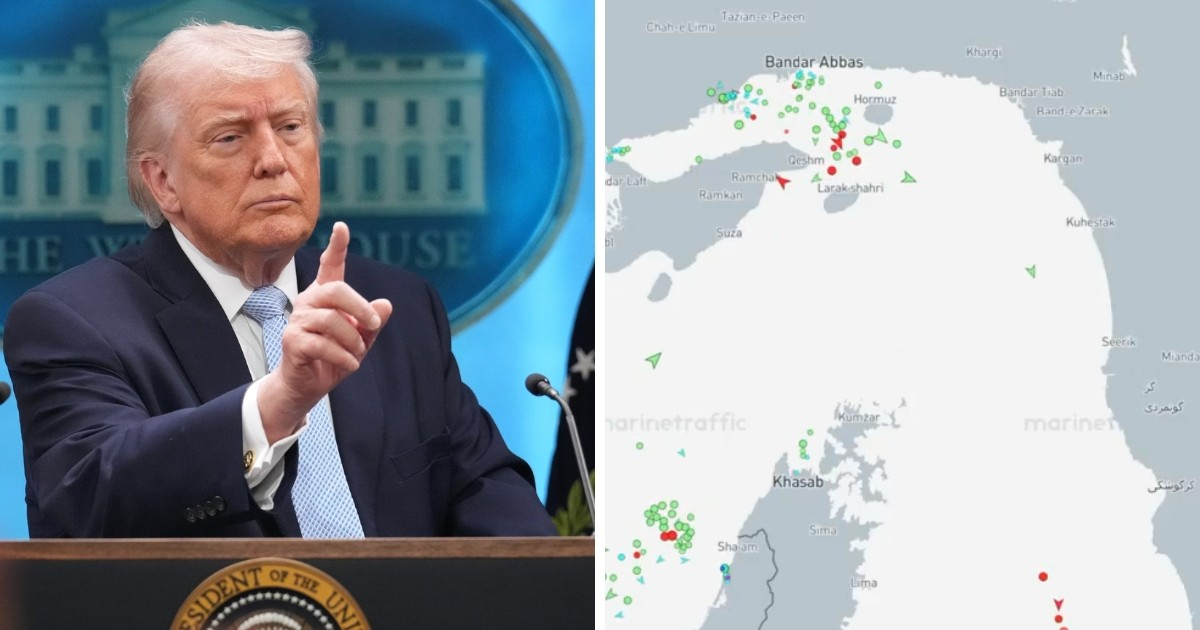
The president Donald Trump activated on Monday the so-called “Freedom Project”, a military operation for humanitarian escort to free third-country vessels trapped in the Strait of Hormuz due to the Iranian blockade, which mobilizes over 100 aircraft, destroyers, drones, and 15,000 military personnel under the command of Central Command (CENTCOM).
Trump announced the operation on Sunday through his Truth Social network, explaining that nations from around the world had requested his help to free their vessels, countries he referred to as "mere neutral and innocent bystanders" with no connection to the conflict with Iran.
As the first concrete result of the mission, CENTCOM reported this Monday that two merchant ships flying the American flag successfully crossed the Strait and continue their journey safely, in what the military command described as "a first step" of the operation.
"For the good of Iran, the Middle East, and the United States, we have assured these countries that we will guide their ships out of these restricted maritime lanes, so they can continue their activities freely," Trump stated.
The leader also warned that any interference with the humanitarian process "will have to be addressed firmly," while urging Iran itself to participate in the operation as a gesture of goodwill.
CENTCOM, for its part, emphasized that "our support for this defensive mission is essential for regional security and the global economy, while we also maintain the naval blockade" on Iranian ports and ships, in effect since April 13.
The commander of CENTCOM, Admiral Brad Cooper, recalled that the Strait of Hormuz is a passage for a quarter of the world's maritime oil trade, as well as significant volumes of fuel and fertilizers.
The Freedom Project is launched in a context of high tension. Iran responded immediately with threats: Ebrahim Azizi, president of the Iranian National Security Commission, warned that "any U.S. interference in the new maritime regime of the Strait of Hormuz will be considered a violation of the ceasefire."
The general Ali Abdollahi, commander of the Unified Command Khatam al-Anbiya, was more direct: “Any foreign armed force, especially the aggressive American army, will be targeted by our attacks if it tries to approach or enter the Strait of Hormuz.”
The tension was further heightened by two attacks recorded in less than 24 hours in the area: a bulk carrier was attacked on Sunday by small boats off the coast of Sirik, in southwestern Iran, and hours later, a tanker flying an unidentified flag was hit by an unknown projectile 78 nautical miles north of Fujairah in the United Arab Emirates, with no injuries reported in either case.
The Iranian blockade of the Strait, imposed on March 4 in retaliation for the Epic Fury Operation launched by the U.S. and Israel, left approximately 2,000 ships stranded with 20,000 sailors and caused the price of Brent crude to rise from $67 to over $126 per barrel.
In parallel with the military operation, peace negotiations remain stalled. Iran is examining Washington's formal response to its 14-point peace plan sent via Pakistan, which proposes a 15-year pause on uranium enrichment, while the U.S. demands the complete dismantling of the nuclear program and a 20-year moratorium.
The definitive opening of the Strait of Hormuz remains a key element in the negotiations, and the Iranian response to the U.S. peace plan could determine whether the Freedom Project becomes a diplomatic bridge or a new point of friction between the two powers.
Filed under: