
Related videos:
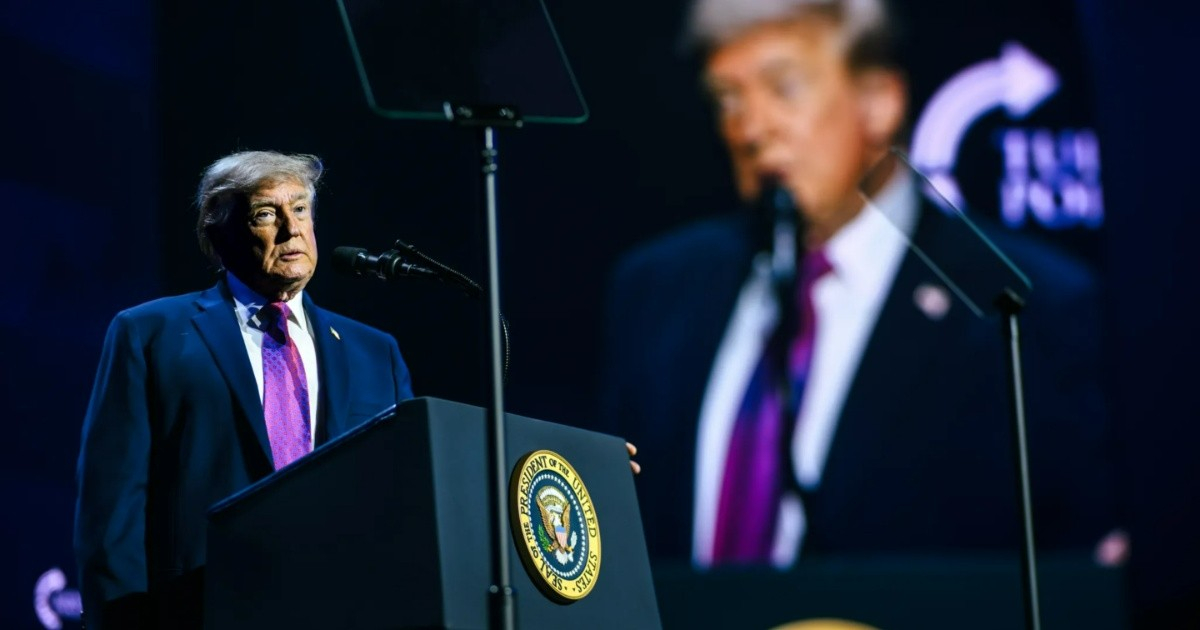
The president Donald Trump urged South Korea on Monday to join the U.S. naval mission in the Strait of Hormuz following the attack on a South Korean cargo ship, in a message posted on his platform Truth Social at 1:16 PM.
"Iran has fired at non-belligerent nations in connection with the movement of ships from the Liberty Project, including a South Korean cargo ship. Perhaps it's time for South Korea to join the mission!" Trump wrote, while simultaneously downplaying the Iranian attacks by stating that "aside from the South Korean vessel, there has been no damage while passing through the strait up to this point."
The incident that prompted Trump's call involves the HMM Namu, a South Korean-flagged freighter that suffered an explosion and fire on Sunday night while anchored near Umm Al Quwain in the United Arab Emirates.
The 24 crew members on board —six South Koreans and 18 foreigners— were unharmed.
The government of Seoul confirmed that it is investigating whether the incident was an Iranian attack, which would make it the first against a South Korean vessel since the closure of the strait, and noted that 26 South Korean-flagged vessels are currently stranded in the region.
The South Korean Ministry of Foreign Affairs stated that it will "closely communicate with relevant countries regarding this matter and take necessary measures to ensure the safety of our vessels and crew within the Strait of Hormuz."
Trump also stated in his message that U.S. forces had destroyed seven small Iranian boats, which he referred to as "fast boats," although Admiral Brad Cooper of Central Command (CENTCOM) had previously confirmed the sinking of six.
Iran, for its part, claimed to have fired missiles at a U.S. frigate near the port of Jask, a claim that Washington strongly denied.
Trump's call comes in the context of the Freedom Project, the naval operation launched by the U.S. to escort commercial ships from neutral countries through the strait, with 15,000 military personnel, over 100 aircraft, and guided destroyers.
This is not the first time that Trump has pressured Seoul in this conflict. Back in March, Trump demanded that South Korea, Japan, and Germany participate in the naval escort, arguing the energy dependence of those countries on the Gulf and the presence of U.S. troops in their territories.
The South Korean Foreign Minister Cho Hyun then described the claim as "a situation that could be called a request or not," while President Lee Jae Myung has avoided speaking directly about the conflict, prioritizing energy-saving measures in light of rising oil prices.
Opposition lawmakers in Seoul argue that joining the conflict would violate the South Korean Constitution.
The Strait of Hormuz has been blocked since February 28, 2026, when Iran closed the maritime route in retaliation for Operation Epic Fury, the joint attack by the U.S. and Israel that decimated Iran's military capacity and eliminated the Supreme Leader Ali Khamenei.
The Iranian blockade paralyzed 97% of global maritime traffic, left 2,000 ships stranded, and caused the price of Brent crude to soar from 67 to over 126 dollars per barrel.
Last Sunday, Iran sent the U.S. a 14-point peace plan in three phases to end the conflict, to which Washington responded by demanding additional conditions.
Trump announced that Secretary of Defense Pete Hegseth and Joint Chiefs of Staff Chairman Dan Caine will hold a press conference this Tuesday regarding the situation in the strait.
Filed under: