
Related videos:
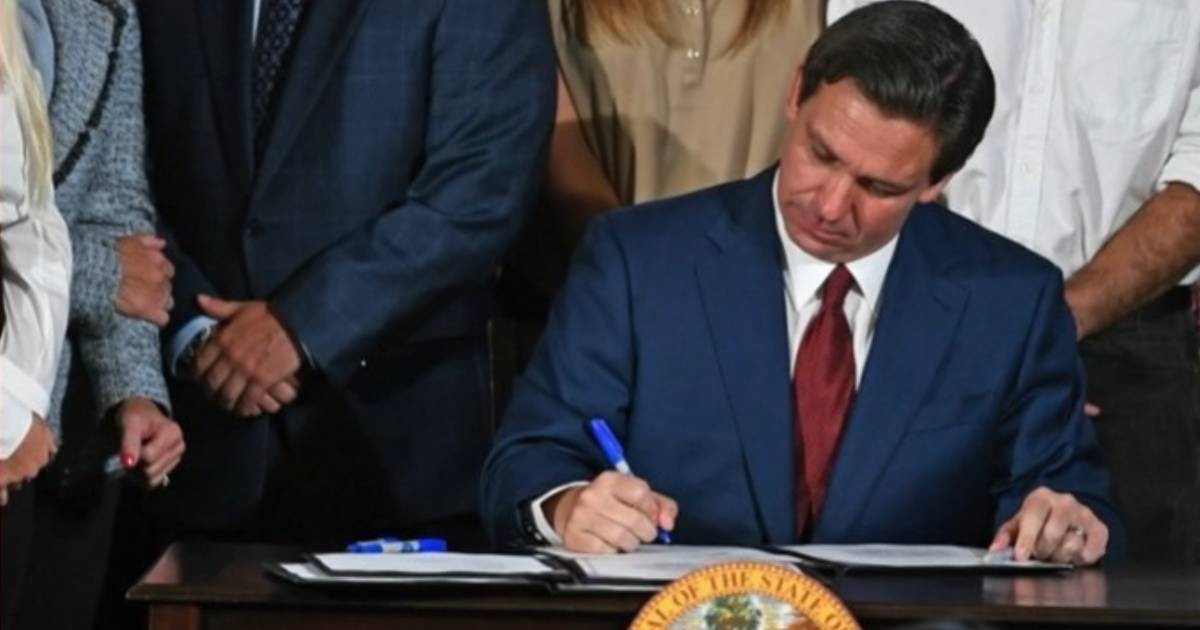
The Governor of Florida, Ron DeSantis, signed the new map for the redistricting of the state's 28 congressional districts this Monday, completing in less than a week a process that could flip four seats from Democrats to Republicans ahead of the November 2026 elections.
"Signed, sealed, and delivered," DeSantis wrote on X, along with a message featuring an image of the Florida map with the new districts highlighted.
The new design, developed by the governor's team, introduces significant changes in 21 of the 28 districts and could expand the Republican advantage in Florida's delegation to the House of Representatives from 20-8 to 24-4.
The timeline of the process was extraordinarily fast-tracked.
DeSantis presented the map on April 27 through an official memorandum. Public hearings were held on the 28th with minimal citizen participation, and both chambers of the state legislature approved it on the 29th: the House by 83 votes in favor and 28 against, and the Senate by 21 to 17.
The legislative approval occurred approximately one hour after the U.S. Supreme Court issued its 6-3 ruling in the case of Louisiana vs. Callais, which weakened Section 2 of the Voting Rights Act of 1965 by requiring proof of intentional discrimination to challenge maps affecting racial minorities.
DeSantis had anticipated this ruling to justify the elimination of the former District 20, which encompassed Broward and Palm Beach counties and which he described as a racial gerrymander. Now the new District 20 is entirely within Broward County.
The governor has justified the measure with a demographic argument: "Florida was underestimated in the 2020 Census, and we have been fighting for fair representation ever since. Our population has grown dramatically since then, and we have shifted from a Democratic majority to a Republican advantage of 1.5 million."
According to the new map, the Democrats would retain only four districts: the 10th (central Florida) and the 20th, 23rd, and 24th (southern Florida), while Tampa Bay would lose all Democratic representation.
The measure is part of a national redistricting war in the middle of the decade driven by President Donald Trump, who publicly urged Florida on April 26 to redraw its maps. Florida is the eighth state to modify its maps before the upcoming elections, following Virginia, Utah, Ohio, North Carolina, Missouri, California, and Texas.
The Republicans currently have a 217-212 advantage in the House, with one Independent and five vacant seats.
The initiative faces strong legal opposition.
Democrats describe it as unconstitutional for violating the Fair Districts Amendment, approved by 63% of Florida voters in 2010, which expressly prohibits designing districts to favor or disadvantage a political party.
The new map also creates rifts within the Republican Party itself: congressmen Mario Díaz-Balart and Carlos Giménez, among others, fear that their safe seats might be at stake, and Republican consultant Alex Alvarado concluded that the redistricting would increase the number of competitive seats from four to seven without providing a net gain for the party.
DeSantis denied political motivation in the new map and argued that Florida was underrepresented in the 2020 Census.
Electoral rights groups have announced legal resources to block it, but time is of the essence: the candidate nomination period for Congress begins at noon on June 8 and closes on June 12.
"We will not go back and allow Ron DeSantis to violate the Florida Constitution," warned Nikki Fried, chair of the Florida Democratic Party. "These maps are unconstitutional and violate the Fair Districts Amendment of 2010. The fight has just begun."
Filed under: