
Related videos:
The architect Abel Tablada warned about the main technical risk of the container housing program promoted by the Cuban regime: the metal boxes "can turn into an oven under tropical conditions."
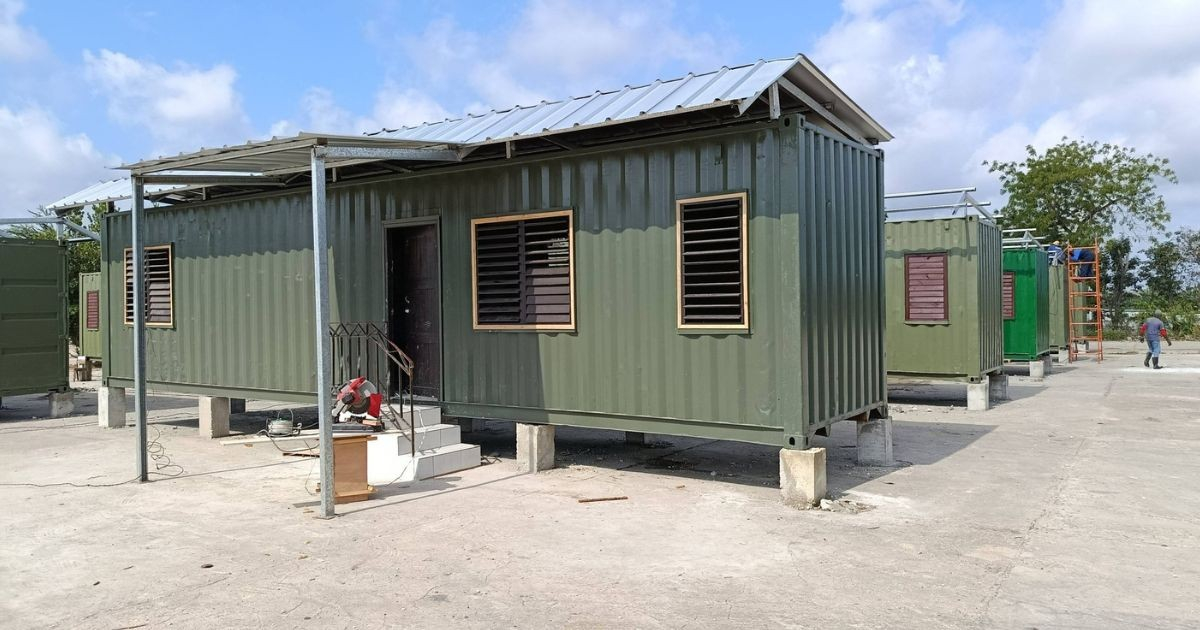
On Monday, Tableda visited the settlement being constructed at the former bus terminal in Toledo, across from CUJAE, in Havana, where the first modules of a project that envisions 300 container houses are being installed, initially intended for young graduates from children's homes without family support and, subsequently, for families affected by hurricanes.
The architect explained that the concern is not limited to solar radiation on the roof, but also extends to the vertical surfaces depending on their orientation, making thermal control a critical challenge for any home of this type in the Cuban climate.
During the visit, Tablada observed that some mitigation measures had been implemented: a second cover with an intermediate space for ventilation and insulation of the metal walls with a layer of air and a sheet of plywood on the inside.
Ventilation is achieved crosswise through louvered windows in each space. The standard home includes a porch, kitchen-dining area, two bedrooms, a bathroom, and a laundry area with a back porch.
CUJAE professors measured the indoor temperatures before the transformation and will need to return once the unit is finished to validate the effectiveness of the thermal insulation, according to the professionals in charge of the construction.
In the table, recently expelled from CUJAE, proposed three specific improvements.
First: install solar panels on the double roof to achieve energy self-sufficiency and turn the community into a solar park with dual land use.
Second: paint the exteriors with light colors — "a lighter green or light beige" — to reduce radiation absorption, since the eaves do not adequately cover the back facade or the sides.
Third: incorporate vegetation among the containers, as "the concrete plaza with high heat absorption raises temperatures and glare."
The architect acknowledged the value of the solution for those who need it most: "For families who have lost everything, or for young people starting their adulthood without having inherited anything, obtaining a container home is a significant improvement in their lives."
However, he emphasized that the program cannot replace a real housing policy: "Despite the real advantages for families in need, this should be viewed as a temporary and emergency solution, as it should not be confused with a long-term housing program."
The project is set against a housing crisis of historic proportions in Cuba, with an official deficit exceeding 929,000 homes and 35% of the housing stock in fair or poor condition. In Havana, around 1,000 buildings collapse each year.
The regime announced the transformation of more than 3,500 containers nationwide, but by April 2026 only 133 units had been delivered throughout the country.
Last Sunday, Díaz-Canel and Marrero delivered the first two modular container houses in Nuevo Vedado, Havana, in an event that generated widespread criticism for being seen as propaganda.
Neighbors from Cerro and Guantánamo have reported leaks, electrical failures, and lack of thermal insulation in units that have already been delivered, reinforcing the technical warnings from the academy.
Tableda concluded her reflection with a call for diverse participation: "We all contribute to the city, with well-considered regulations, with science, financial pragmatism, and oversight, but also with the opinions of citizens, with state and independent architects and engineers, with freedom of creation and a vision for the future."
Filed under: