
Related videos:
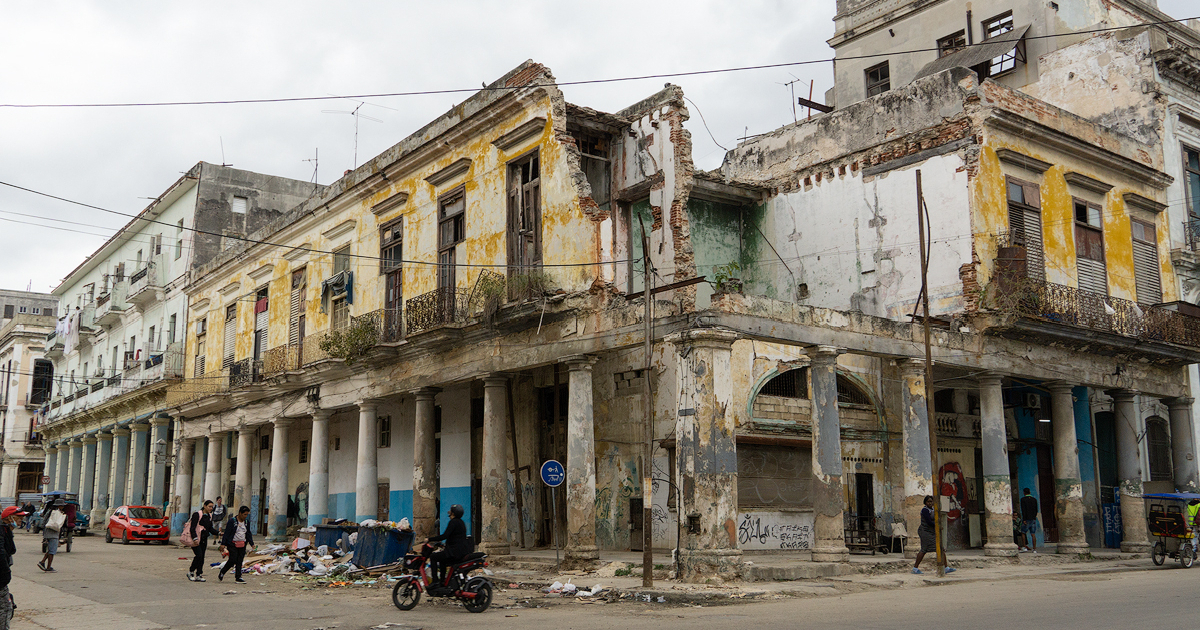
Every time the communist regime in Cuba intervenes in housing matters, it ends up causing a social disaster. The result is evident. The severe deterioration of the nation’s residential heritage is the outcome of decades of wrong decisions that have led to the current chaos from which a new legal framework is supposedly going to rescue, but this framework, inspired by the 2019 communist constitution, will ultimately destroy what little remains standing without addressing the supposed economic and demographic challenges.
When reviewing the available data on the housing sector in Cuba, one cannot help but classify it as a resounding failure. How else can we interpret the housing deficit acknowledged by the authorities, which stands at 900,000 homes? This figure will likely be greater when considering the overcrowding of families in homes that, for the most part, date back to before 1959.
Well, under these circumstances, the communist regime intends to introduce a draft Housing Law that aims to implement a series of structural changes regarding the production, management, and access to the right to housing. If anyone thought that this regulation might bring some fresh air to a sector in structural crisis, they are mistaken.
The regulation has very specific and straightforward objectives, such as updating the legal framework in force since 1988, which has been modified multiple times but has ultimately resulted in a well-known and absolute failure. This framework is encompassed in Law 65 or the General Housing Law and its modifications, which have amounted to a total of nine decrees and 127 supplementary regulations. These have posed numerous problems, the solutions to which aim to align with recent legislative changes and the updating of the Cuban economic and social model. A poor path has been chosen for housing reform.
The authorities justify the new law because, they say, it integrates the production and management of housing and its developments, with an economic, sociocultural, and environmental focus, addressing the country’s demographic dynamics and the emergence of new actors, with a more territorial and local perspective. The statement is perfect and harmonious, yet housing remains a state policy; access to the buying and selling market is restricted, and the construction sector is still regulated and controlled, hindering its development. Failure is inevitable.
This is why the communists fall into the same mistake as always. The Castro regime believes that the economy operates through laws, decrees, and regulations published in the official gazette, but this is not the case. The most obvious example is in front of them: housing, which, despite extensive regulation, is in much worse condition in 2026 than it was in 1988, and far worse than in 1959.
Some of the new features of the draft proposal, such as the controlled diversification of actors in construction, limited and unguaranteed flexibility in property ownership—including the possibility of owning up to two homes—a supposed elimination of administrative barriers, and the recognition, also with scant guarantees, of rights for Cubans living abroad, fall short and do not address the core of the problem.
Viewed from a different angle, these are merely aesthetic changes that do not bravely confront the root of the problem: the communist policies, which are supposedly egalitarian, are an irreparable harm to housing. If there is a sector that needs a 180º shift in the Cuban economy, it is none other than housing in all its facets.
And since that shift in housing is neither present nor expected, the draft proposal under discussion once again relies on the communist state's willingness to continue implementing the same social housing programs that have proven to be a failure, with the aim of reducing the housing deficit and protecting families in vulnerable situations, including young people. Very well, and what about the rest of the Cubans? Is it that this vulnerability is not widely spread throughout society? Is the plan to abandon some to the detriment of others?
It seems that the communists have decided in this draft to recognize the right to property of housing and to diversify management, but let no one have the slightest doubt that, in case of any uncertainty, the Castro courts will apply what is established in the communist constitution of 2019, which clearly outlines the economic model and what must be done regarding private enrichment. In other words, without legal security, the right to property of housing is worthless.
Then they want to authorize multiple actors to participate in the grandiose "National Housing Development Program": the state sector, the self-efforts of the population, housing cooperatives, micro-brigades, small and medium enterprises (mipymes), real estate companies, and other forms of management, all under the same regulatory framework. The reality is that this interventionist approach does not lead anywhere—well, yes, it leads to controlling these entities to prevent their growth—so the construction of housing in Cuba depends on political decisions rather than economic ones, which truly hampers its development.
The draft law establishes that the rights recognized for individuals apply both to Cuban citizens residing in Cuba and those living abroad, as well as to foreigners with permanent residency in the national territory. Once again, the regime is seeking to obtain money from Cubans outside the country so they can exercise their property rights, such as selling, inheriting, or managing their homes, either directly or through a legal representative. It's the same as before; without legal guarantees, all of this may not amount to much.
The possibility of owning up to two homes is presented as something exceptional, justified as a concession of the communist regime to social demands, although there are criticisms from those who believe that allowing two homes should not be permitted while there is a deficit. But one must ask who in Cuba can buy two homes and under what conditions. In any case, the proposal is related to the current demographic situation, where a family may inherit more than one home.
The text of the regulation acknowledges the productive nature of housing in the current economic context, and for this reason, the authorities waste no time in turning housing into a fiscal collection instrument for the communist regime. The acquisition of a second home also entails a tax increase, which contributes to the development of social housing.
A new type of housing emerges, known as a vacation home, which has been designated as such in previous regulations and is listed as such in its title of ownership. Its owners enjoy the same rights as they would over any property: they can sell, donate, or exchange it. It is clarified that this type of housing does not necessarily have to be located in beach or rural areas. However, the status of vacation home is lost if the property is transferred during the owner's lifetime. It is maintained in the case of inheritance, meaning after the owner's death.
Undoubtedly, one of the housing problems in Cuba lies in bureaucracy and administrative hurdles. Therefore, the regulation provides the possibility for the owner of a home declared in a state of ruin by the Municipal Directorate of Territorial Planning and Urbanism to transfer it to a natural or legal person in order to recover its usable value. This decision promotes the rehabilitation of dilapidated homes, depending on their specific condition.
When it comes to buildings of up to two floors or apartments, the transfer can be made in favor of individuals or legal entities, whereas for larger properties, it will be conducted in favor of entities capable of fully managing their recovery. Specifically, this option, associated with a potential productive sector activity, does not exist in the current regulations.
Another significant change is the elimination of the prior administrative authorization from the Directorate of Physical Planning for multiple processes. For instance, in the case of owners of vacant lots, once registered in the Property Registry, their powers are expanded to sell, exchange, donate, lease, divide, consolidate, grant surface rights for construction, and transfer their property through inheritance, always in accordance with current urban regulations.
The regulation also relaxes the relationships between adjacent property owners, allowing those who own contiguous homes, whether horizontally or vertically, to transfer rooms or other built spaces to each other, provided the established requirements are met and the condition of adequate housing is maintained. Similarly, it permits the establishment of loan agreements, introducing the possibility of transferring the use of a home, a scenario that was previously prohibited.
The draft proposal includes solutions for specific vulnerability situations, allowing owners in need of assistance, such as food provision, to establish contracts with individuals or legal entities to ensure their care, an alternative that had not been considered until now.
In terms of inheritance rights, a significant modification has been introduced, establishing that the incapacity to inherit will not apply to individuals who were declared emigrants under previous regulations, thereby opening the possibility to exercise rights that were previously restricted.
Finally, the draft proposal relaxes the notarial processes related to property transfer. Unlike current legislation, which requires these acts to be formalized in the municipality where the property is located, the new proposal allows them to be carried out before any notary within the province, which helps streamline the procedures and reduce bureaucratic burdens.
The regulation will not restore the role of mortgages, which will fall under a specific subsequent regulation. The draft bill establishes the recognition of mortgage loans, which were prohibited by the communist revolution in its early frantic years, but the implementation of this necessary financial mechanism for acquiring housing will depend on supplementary provisions that determine its specific conditions. For now, nothing is known about any of this.
The draft project focuses on protected social housing or housing of social interest, whereby the communist state regains a significant role in the housing sector. However, it now acts specifically for the protected population, those prioritized or in vulnerable situations, unlike previous regulations that addressed the entire society. This change leads to the municipal administrative councils' social housing fund needing to be financed through state investments approved in the Economic Plan, along with housing acquired through various means. These are allocated by the communist authorities according to established priorities determined by the administrative councils, based on the needs of the territory. Once again, political decisions take precedence over economic ones.
The regulation includes a section to address the housing needs of young people, including subsidies for acquiring construction materials, credits, loans, tax benefits, and partial subsidies for housing prices. Similarly, young people in need of housing are prioritized in the allocation of homes built or acquired by agencies, organizations, and economic entities; and temporary rental options are promoted in homes with minimal private space and maximum communal facilities, as well as preferential access to real estate services. They are pushing forward with a failed policy once again.
The draft proposal outlines how to address the legalization of properties, specifically those that have rooms and accommodations predating the Law and lack any legal documentation, or where the room is registered under someone else's name, as well as the legalization of homes built in rural areas. This represents a partial legalization that does not address the issue of expropriations, a topic that the regime seems unwilling to discuss, yet it is closer than ever.
In summary, we are witnessing a draft housing law that will not solve the serious residential issues, because even though the state has withdrawn from the central productive role, it still maintains significant power over the management of the limited funds in the budget. Moreover, the private initiative, which could lead the sector, is subjected to control and regulation, hindering its real development possibilities.
The issue of the limit of two homes, the elimination of confiscation upon leaving the country, the request for the legalization of homes in tourist areas, and in basic facilities related to Public Health, as well as the delays, obstacles, and bureaucratic complexity of the procedures, do not represent the 180-degree shift that housing in Cuba needs. They will ultimately leave a sector where not even aesthetic adjustments can be expected. The new law will not improve the management of social housing production, as resources will remain scarce, and the protection of property rights it introduces lacks sufficient guarantees for investing in something that could end up being expropriated, in accordance with the provisions of the 2019 constitution.
It appears that there is no text provided for translation. Please provide the text you would like to have translated
It is clarified that a second home cannot be obtained through state allocation.
Specifically, Article 29 of the constitution states that private property on land is governed by a special regime. Leasing, sharecropping, and mortgage loans to individuals are prohibited.
Filed under:
Opinion article: Las declaraciones y opiniones expresadas en este artículo son de exclusiva responsabilidad de su autor y no representan necesariamente el punto de vista de CiberCuba.