
Related videos:
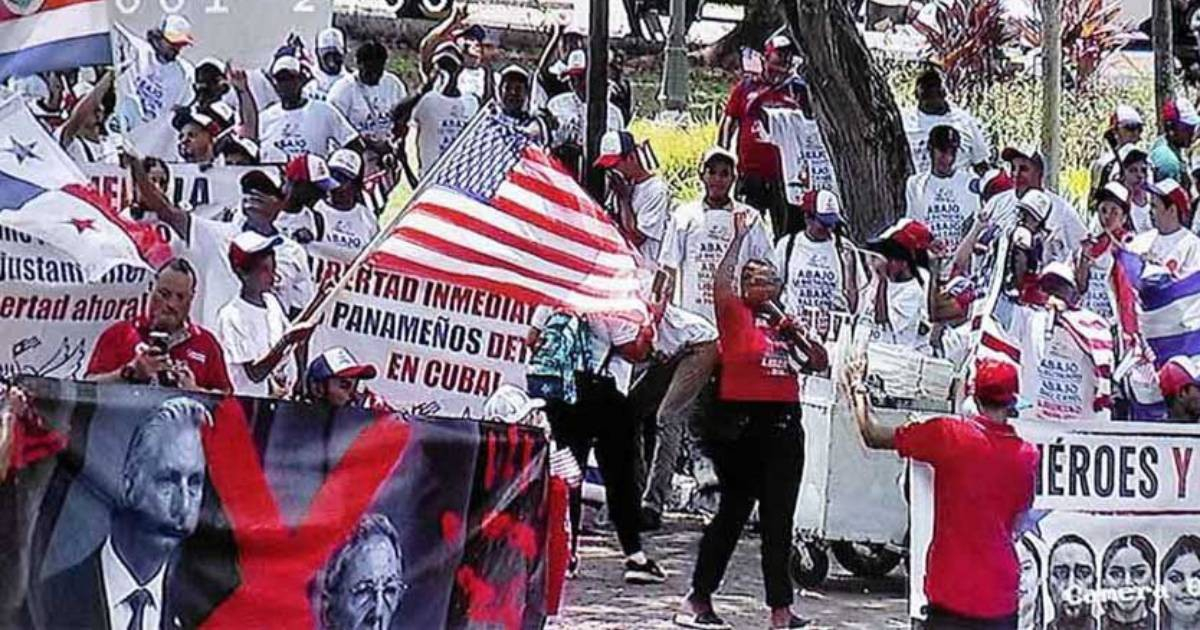
Panamanian, Cuban, and Costa Rican citizens protested on Monday in front of the Cuban embassy in Panama City to demand the release of seven Panamanian detainees on the island, while the Cuban regime described the protests as "provocative acts" orchestrated from Miami.
The demonstration, organized by the Caminos a la Democracia de Cuba, began at the Belisario Porras Park and later moved to the front of the Cuban diplomatic mission, where the protesters carried banners featuring images of Miguel Díaz-Canel and Raúl Castro with the message "we don't want them" and chanted slogans such as "Homeland and Life" and "Free Cuba," reported the local media El Siglo.
"We are here, steadfast and united, demanding immediate release. We cannot remain silent while injustices continue," declared representatives of the organization during the event.
The protesters also urged the Panamanian government to take a stronger stance, including the breaking of diplomatic relations with Cuba until human rights are respected, and demanded the extradition of Boris Betancourt, a Cuban sentenced for drug trafficking who is serving his time in the maximum-security prison La Nueva Joya.
The case originated on February 28, 2026, when the Cuban Ministry of Interior arrested ten Panamanian citizens in Havana, accused of placing anti-government posters in the neighborhoods of Boyeros and Jaimanitas under Article 124 of the Cuban Penal Code, which prescribes penalties of up to ten years for propaganda against the constitutional order.
The ten detainees were held at Villa Marista, the Cuban State Security headquarters.
On April 25, Cuba released three of the detainees —Evelyn Castro, Cinthia Camarena, and Abigail Gudiño— who arrived the same day at Tocumen International Airport following diplomatic efforts by the Panamanian Foreign Minister Javier Martínez-Acha, who traveled to Cuba in March and met with Díaz-Canel.
Seven men remain in custody: Víctor Manuel Pinzón Cedeño, Anthony Williams Jules Pérez, Omar Gilberto Urriola Vergara, Maykol Jesús Pérez Almendra, Adalberto Antonio Navarro Asprilla, Patrochiny Jerodany Joseph Arisarena, and José Luis Aguirre Baruco.
The Panamanian government is continuing negotiations to secure their return, and President José Raúl Mulino instructed the foreign ministry to ensure legal defense, diplomatic protection, and consular assistance for the detainees.
In response to the protests, the official Cuban press —through Prensa Latina— referred to the protesters as "counterrevolutionary cliques arriving on the isthmus from Miami" and described Camino a la Democracia de Cuba as a "front organization."
The regime's media also claimed that the protests constitute "a propaganda and political challenge that aligns with the subversion plans devised in Washington to attempt to isolate the Cuban people."
The chancellor Martínez-Acha, for his part, pointed out that the protesters "should be respectful of the laws and the sovereignty of Cuba" and reiterated his strategy of quiet diplomacy, warning that external pressures could harm the ongoing efforts for the return of the seven citizens who remain detained on the island.
Opposition sources, such as José Daniel Ferrer from the Patriotic Union of Cuba (UNPACU), pointed out at the time that the detained Panamanians were also distributing humanitarian aid — food and medicine — to political prisoners in Matanzas, a detail that the official Cuban version completely omits.
Filed under: