
Related videos:
The government of the United Kingdom sanctioned the Cuban Dayana Echemendia Díaz this week for recruiting compatriots through deception to send them to fight in the war in Russia against Ukraine, according to the official sanctions list published by the British Foreign Office.
Echemendia Díaz, a Cuban citizen born on July 29, 1989, was included under the Global Irregular Migration and Trafficking in Persons Sanctions Regulations 2025 (GIMTiPS), created specifically to combat human trafficking linked to the destabilization of Ukraine and Europe.
Sanctions and accusations
The measures imposed on the Cuban citizen include freezing of assets, travel ban, and disqualification from serving as a company director.
The British Foreign Office determined that there are "reasonable grounds to suspect" that Echemendia Díaz is a "person involved" in irregular migrant smuggling, according to the official sanctions notice.
British authorities accuse her of having used social media and other forms of communication to deceive Cuban citizens by promising them well-paid civilian jobs in Russia, only to then send them to the front under coercion, threats, and imprisonment.
The sanction turns Dayana Echemendia Díaz into one of the first Cuban nationals officially identified by a Western government as part of the networks recruiting foreigners for the war in Ukraine.
Who is Dayana Echemendia Díaz?
A research published in October 2025 by the Russian media Current Time, covered by elTOQUE, revealed new details about Echemendia's role within a structure that operated between 2023 and 2024 recruiting Cubans for the Russian army.
The report, titled “The Soap Flower Cartel”, describes Dayana as a Cuban resident in Ryazan, Russia, who before getting involved in recruitment sold handcrafted products made with soap through a Telegram channel called “Soap Flowers in Ryazan”.
For a long time, her complete identity remained hidden.
According to elTOQUE, in old ads, she appeared using the name “Dayana David Díaz”.
The investigation indicates that Echemendia transitioned from selling handicrafts to becoming one of the main intermediaries in military contracts for Cubans recruited in Russia.
Her name appeared in ads posted on social media, and several Cuban recruits later referred to her as one of the people who facilitated the hiring process with the Russian army.
In Facebook groups like "Cubans in Moscow," some users directly accused her of deceiving fellow countrymen and sending them to fight in Ukraine.
In August 2024, elTOQUE disseminated audios attributed to Dayana in which she assured recruits that they would not be sent to the front lines and that Cubans were not dying in the war, claims that were later contradicted by the facts.
"They're not going to the front lines," he said in one of the messages disseminated by the independent media.
It also stated that the Cubans would perform logistical support roles and would not directly participate in military operations.
However, dozens of testimonies from survivors and their families later revealed that many Cubans were indeed sent to high-intensity combat zones.
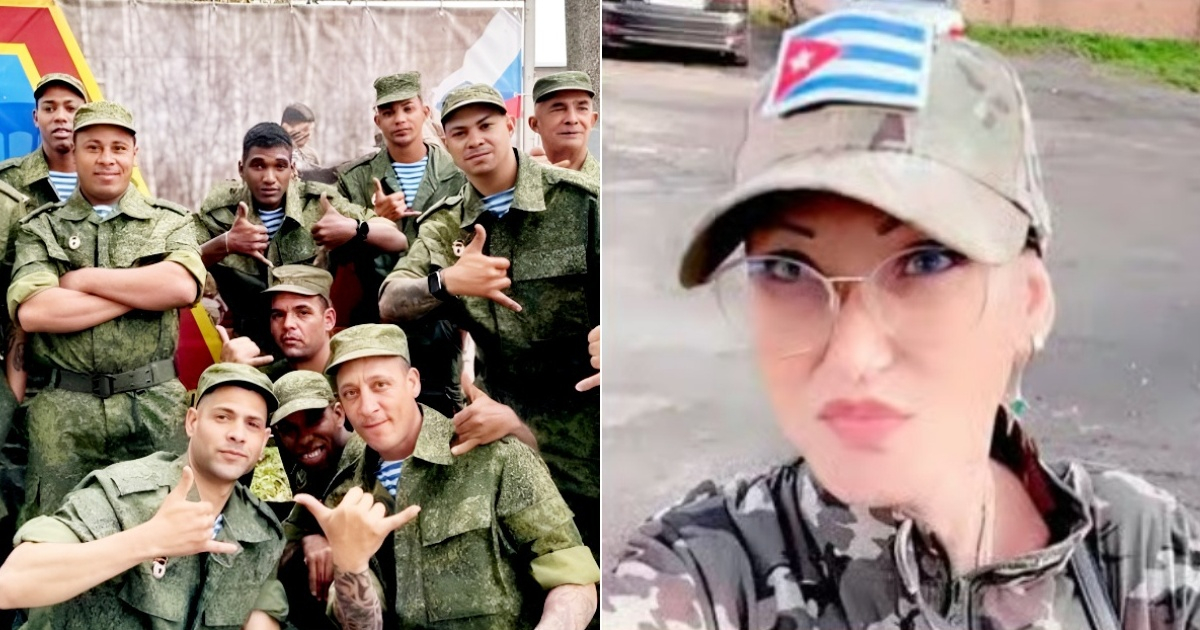
In his VKontakte account, Echemendia was seen wearing a military cap with the letter “V” and the Russian flag, symbols associated with the invasion of Ukraine. In another video released later, he was seen wearing camouflage uniform.
In an interview with journalists from Systema, she denied being involved in recruitment but avoided answering questions about her connections with other members of the network.
The recruitment network
The investigation identified several women connected to the scheme of recruiting Cubans.
The main figure was the Russian Elena Smirnova, a tourism entrepreneur who began posting ads offering supposed jobs in Russia with salaries of up to 2,000 dollars per month and promises of Russian citizenship.
Another member was Olga Shilyaeva, the wife of a Russian military officer, who helped manage documentation and coordinated the arrival of recruits at military offices in Ryazan.
The fourth identified person was the Cuban Indira Noa Martínez, who was performing translation work for Cuban recruits within Russian military facilities.
A close friend of the recruiters stated to Current Time that Dayana Echemendia's entry transformed the operation into a purely economic business.
"When Elena was alone, the idea was to help; when Dayana arrived, everything became a matter of money," stated the source cited in the report.
How did the scheme operate?
The recruitment system operated through Spanish advertisements disseminated on social media and messaging applications.
Recruiters offered supposed civilian jobs in construction, security, or warehouses, with salaries impossible to achieve in Cuba.
The Cuban economic crisis turned those offers into a particularly effective trap: salaries in Cuba average between 15 and 30 euros per month, according to the report from the International Federation for Human Rights (FIDH), Truth Hounds, and the International Office of Kazakhstan.
"With an average salary in Cuba of just 30 euros a month, or even 15 euros, the offers of 'easy work in fraternal Russia' with a monthly salary of 1,700-2,000 euros seem life-changing," the report notes.
Many Cubans claimed that they signed military contracts without understanding the Russian language and believing that they would be working in civilian jobs. Only later did they discover that they would be sent to the front lines.
Several interviewed recruits also reported that intermediaries linked to the network had access to their bank cards and withdrew money from their accounts.
The complaints and the partial collapse of the network
In April 2024, a group of Cubans reported Elena Smirnova to the Russian police, accusing her of theft and fraud. Shortly after, she was arrested and sent to pretrial detention.
According to a letter sent by her lawyer to the Commissioner for Human Rights in Russia, Smirnova allegedly facilitated military contracts for over 3,000 foreigners.
The Ukrainian parliamentarian Marian Zablotsky estimated that more than 1,000 Cubans signed contracts with the Russian Ministry of Defense between July 2023 and February 2024.
One of the whistleblowers mentioned in the investigation was the Cuban René Reyes Fleitas, who was later reported missing in action following a drone attack.
The human cost of war
The Ukrainian project "I Want to Live" confirmed at least 93 Cubans dead fighting for Russia as of January 2026, with an average survival time of just 150 days after deployment.
According to the FIDH report, at least 20,000 Cuban citizens have been sent to fight in Ukraine since 2023, making them one of the largest foreign contingents in the Russian army.
The United States Department of State suggested in April 2026 that the Cuban regime has actively facilitated or tolerated recruitment, while Havana officially denies any involvement.
The European Parliament condemned in July 2025 “the recruitment and deployment of Cuban soldiers” in Russia's war against Ukraine.
Russia plans to recruit 18,000 additional foreigners by the end of 2026, according to Ukrainian intelligence, which anticipates that recruitment networks such as the one attributed to Echemendia Díaz will continue to operate.
Filed under: