
Related videos:
The Cuban-American historian Ada Ferrer published an open letter addressed to the Cuban leader Miguel Díaz-Canel on Wednesday in the opinion section of the New York Times, at a time of heightened tension between Washington and Havana.
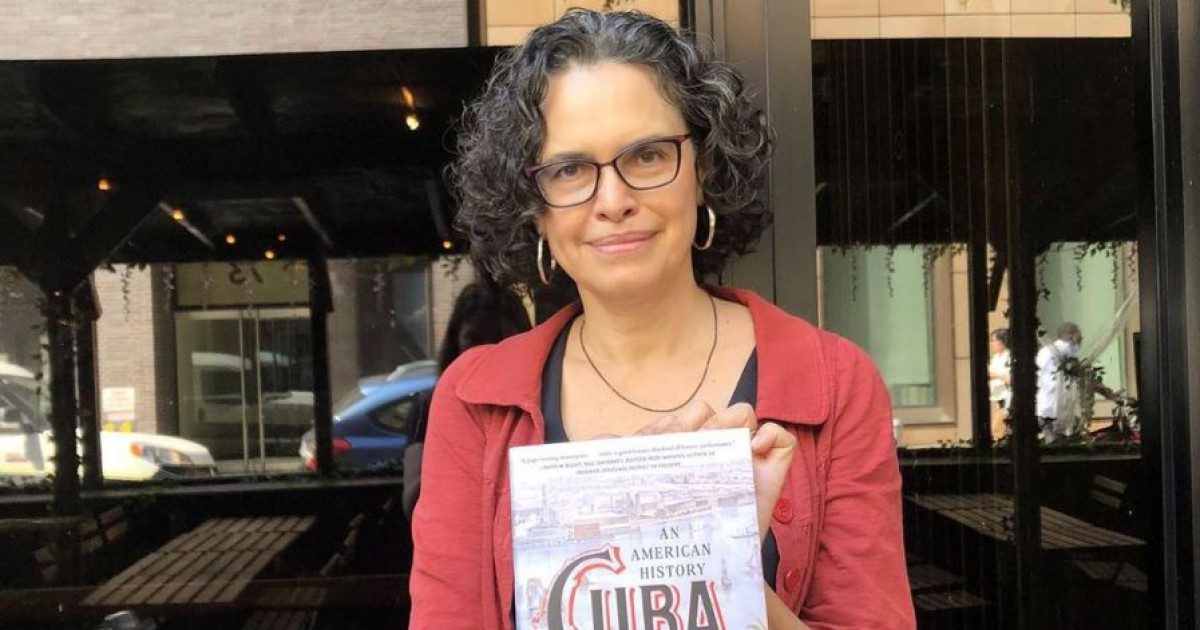
Ferrer, a professor of History and Latin American Studies at New York University, and a 2022 Pulitzer Prize winner for her book "Cuba: An American History", was born in Havana in 1962 and has been researching the shared history of Cuba and the United States for over 30 years.
The author begins her letter with her personal story, shaped by family separation after emigrating as a child in 1963. Her mother left her brother behind with the hope of reuniting soon, which did not happen until many years later. She emphasizes that this kind of family break is a common experience among Cubans.
He then focuses his narrative on his father, who, in his old age, began to write poems, autobiographical texts, and political letters, many of them addressed to Fidel Castro, out of a need to confront those in power.
The core of those letters was clear: "The time has come, Dr. Castro." His father repeated that message over and over, varying its meaning: "time to put an end to the deception, time to leave Cuba's fate in the hands of the youth, time to abandon communism." In summary: "time for change."
Inspired by this example, Ada now decides to write to Díaz-Canel, a defender of "continuity" as a political principle, and questions this stance by arguing that it does not reflect the desires of the majority of Cubans.
The professor details the current crisis in the country: widespread poverty, insufficient wages and pensions against the high cost of food, prolonged blackouts, and serious shortages in the healthcare system. She summarizes the situation by stating that "for many ordinary Cubans, continuity is a death sentence."
Although he points out that the U.S. embargo exacerbates the difficulties, he emphasizes that it is not solely responsible for the crisis and criticizes internal government decisions, such as the halt of economic reforms.
"It was not the embargo that determined how the disastrous monetary restructuring was handled (...) Nor is it a satisfactory answer to the question of why your government has drastically increased government investment in tourism, despite the fact that most hotel rooms are unused and so much arable land remains fallow," he said.
Ferrer also denounces the repression and surveillance of critical citizens, such as historian Alina López Hernández and artists Luis Manuel Otero Alcántara and Maykel Osorbo, who "waste away in prison as punishment for exercising their art, their voice, their example."
The author also questions the lack of a concrete plan from the government to address the crisis. She directly poses the question: "What is your plan to address the fact that the embargo exists? What is your plan to attempt to negotiate its easing?" insisting that placing blame does not replace the need for effective governance.
Ada clarifies that her criticism does not imply support for the United States' policy towards Cuba or for potential interventions. However, she lashes out at the government for using national sovereignty as a political argument while the population faces unmet basic needs.
"You and your government have devalued that word to the point that many young people hear it only as another one of your nonsense. You have wielded that word as a weapon to avoid dealing with more difficult issues. You have acted as if it were your personal achievement when it has never been. You (the governments of the last 67 years) replaced dependence on the United States with dependence on the Soviet Union and, later, on Venezuela," he recalled.
"Without an external sponsor, Cuba collapses and sovereignty begins to seem like an abstraction. You can't eat sovereignty. And to survive, people must eat. To live, they need to do more," he emphasized.
Finally, the writer directly asks Díaz-Canel what he will do to bring justice to the everyday Cubans, urging him to seek real answers.
"If it offers nothing but a ruinous and hopeless continuity, then, as my father would have said, the time has come. The time, at the very least, for a true national dialogue," he declared.
This is not the first time Ferrer has directly questioned the Cuban president. In July 2021, following the historic protests of July 11, he publicly demanded: "Stop the repression. Free the political prisoners. Stop beating your people."
The letter arrives at a time when Cuba is experiencing its worst economic crisis in decades: daily blackouts lasting up to 20 hours, an accumulated inflation rate of 77%, and a projected GDP contraction of 6.5% by CEPAL for 2026, which would place the Island as the worst economy in Latin America that year.
That reality is compounded by political repression: Justicia 11J reported 775 political prisoners in April 2026, of which 338 were sentenced for participating in the protests on July 11.
Filed under: