
Related videos:
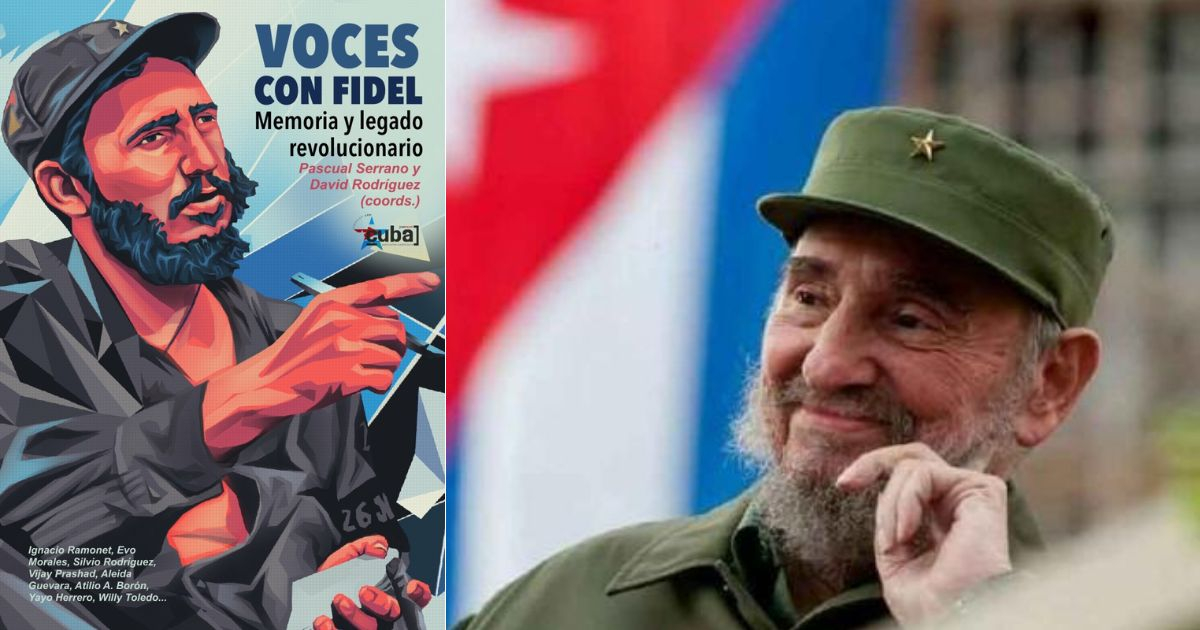
While more than 80% of Cubans live in extreme poverty and there are provinces experiencing blackouts of over 20 hours a day, the propaganda machinery of the regime and its international allies continues to operate at full capacity: a new book praising Fidel Castro has just been published, titled Voces con Fidel. Memoria y legado revolucionario, edited with the institutional support of the Cuban Institute of Friendship with the Peoples (ICAP) and the Fidel Castro Ruz Center in Havana.
The volume, which brings together texts from 44 Cuban and international authors, was edited by Spanish journalist Pascual Serrano and activist David Rodríguez Fernández, and published by the Valencian publisher L'Encobert, according to the website cubainformacion. Its own promoters do not hesitate to reveal the aim: they call it "an arsenal of ideas for the cultural battle" and "a political tool to preserve revolutionary memory."
The book is set in the “Year of the Centennial of Commander-in-Chief Fidel Castro Ruz”, declared after the official approval of the regime at the X Plenary of the Central Committee of the Communist Party of Cuba in July 2025 to commemorate the centenary of the dictator's birth on August 13, 2026.
The book's synopsis, quoted by its own authors, boldly declares that "the 20th century has produced several leaders who will go down in history, but none like Fidel Castro," and that 44 individuals write about him so that "his legacy is never forgotten." This statement, judging by the number of books, murals, colloquia, and campaigns the regime dedicates to the dictator, seems to be a terrifying threat that is gradually coming to fruition.
Among the signatories of the volume are familiar names from the official realm: Silvio Rodríguez, Aleida Guevara, René González, Abel Prieto, Rosa Miriam Elizalde, and Enrique Ubieta for the Cuban side; and internationally, Evo Morales, Atilio Borón, Vijay Prashad, actor Willy Toledo, and journalist Ignacio Ramonet, the official biographer of Castro and author of Cien horas con Fidel, which was the most read book in Cuba in 2018 according to official media. Ramonet, a regular propagandist of the regime, was appointed an honorary member of the National Union of Writers and Artists of Cuba, and will present the book in Valencia on May 13 and in Alicante on May 14.
The volume is complemented by intimate photographs of Álex Castro, the dictator's son, and a cover designed by Javier Parra, the creator of the mural "El Gigante" in tribute to Fidel. Its authors assert that "visual art is also part of this cultural trench against neoliberalism." It costs 20 euros.
The proceeds from the sale, they have declared, will be allocated to the solar electrification of the William Soler Hospital in Havana, which indirectly acknowledges the energy collapse on the Island: the same regime that fills libraries with hagiographies cannot keep the lights on in its hospitals. The energy deficit reached 1,885 MW in March 2026, with blackouts lasting up to 25 hours or more in some areas.
This contradiction is not new. When Cubadebate invited people to download books about Fidel Castro at the end of 2025, users on social media responded by asking for food and medicine. One comment accurately captured the public sentiment: "1926–2026, 100 years of slavery."
Meanwhile, the humanitarian crisis devouring Cuba shows no signs of abating: five provinces—Havana, Matanzas, Cienfuegos, Guantánamo, and Santiago de Cuba—are experiencing extreme levels of food insecurity, and 33.9% of households reported hunger in 2025, nine points higher than the previous year. The regime, true to its tradition, responds with more printed material about the Commander.
The book will also be presented in Havana during the I International Colloquium "Fidel: Legacy and Future," scheduled from August 10 to 13, 2026, at the Palace of Conventions, as part of the activities of the solidarity brigade being organized by the Asociación Valenciana de Amistad con Cuba José Martí. By then, the regime will have accumulated decades of experience in the art of describing Fidel with revolutionary hagiography while the Cuban people continue to wait for light, food, and freedom.
Filed under: