
Related videos:
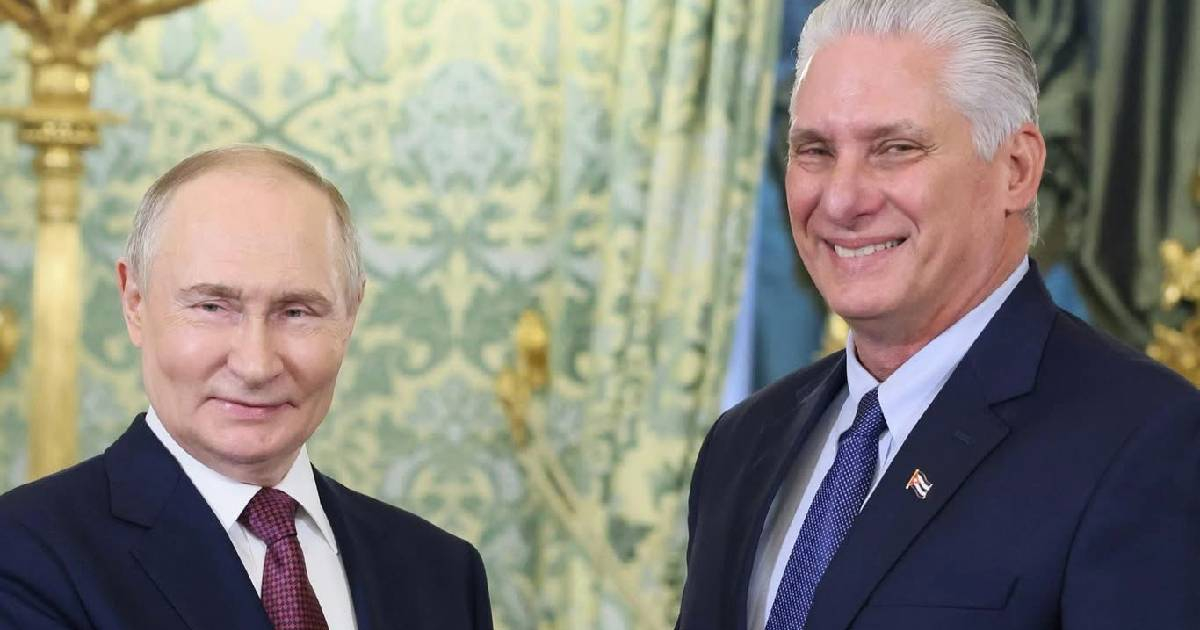
Miguel Díaz-Canel published a message on his X account this Saturday congratulating Vladimir Putin on Victory Day, in which he extended "a warm and grateful hug" to the Russian president, his government, and the "heroic people of the Russian Federation," on the 81st anniversary of the defeat of Nazi Germany in World War II.
The Cuban leader referred to the Russian people as "those who sacrificed the most lives in the fight against fascism" and warned that this "terrible scourge is reemerging today with threatening force in the world," faithfully echoing the official narrative from Moscow to justify its invasion of Ukraine.
The tweet was accompanied by the iconic photograph of a Soviet soldier raising the flag of the USSR over the destroyed Reichstag in Berlin, taken on May 2, 1945, by the Soviet photographer Yevgeny Khaldei.
Unlike in 2024 and 2025, when Díaz-Canel physically traveled to Moscow to participate in the Red Square parade alongside Putin, this time the Cuban leader limited himself to a message on social media, in a year when the parade was notably scaled back due to the war in Ukraine.
It was the first parade since 2007 without tanks, nuclear missiles, or heavy military vehicles, due to the "operational situation" at the Ukrainian front and threats of drone attacks.
The only foreign leaders present in Moscow were Alexander Lukashenko (Belarus), the presidents of Kazakhstan and Uzbekistan, the leader of Laos, and the king of Malaysia.
Putin delivered a speech in Red Square in which he declared, "our cause is just" and equated the war in Ukraine to the fight against Nazism, the same rhetoric that Díaz-Canel echoed in his message.
The gesture of the Cuban leader comes a day after Cuba and Russia celebrated the 66th anniversary of the restoration of diplomatic relations, with Moscow reaffirming its "strong commitment" to continue supporting the Cuban regime.
In this context, the Russian ambassador Víktor Koronelli announced that Moscow is exploring projects to exploit nickel, cobalt, and other precious metals on the island, taking advantage of the exit of Canadian companies like Sherritt.
The diplomatic enthusiasm of Díaz-Canel contrasts with the energy reality in Cuba: the ruler himself admitted on May 2 that the Russian oil received "is running out these days" without knowing when a new shipment will arrive.
The last shipment, the tanker Anatoli Kolodkin, arrived in Matanzas on March 31 with 730,000 barrels, barely 10% of the island's energy needs.
The electrical crisis in Cuba in 2026 includes outages of more than 12 hours in Havana and up to 40 consecutive hours in the interior of the country, while Russian Foreign Minister Sergei Lavrov acknowledged in April that the oil assistance to Cuba "will likely last a couple of months."
Filed under: