
Related videos:
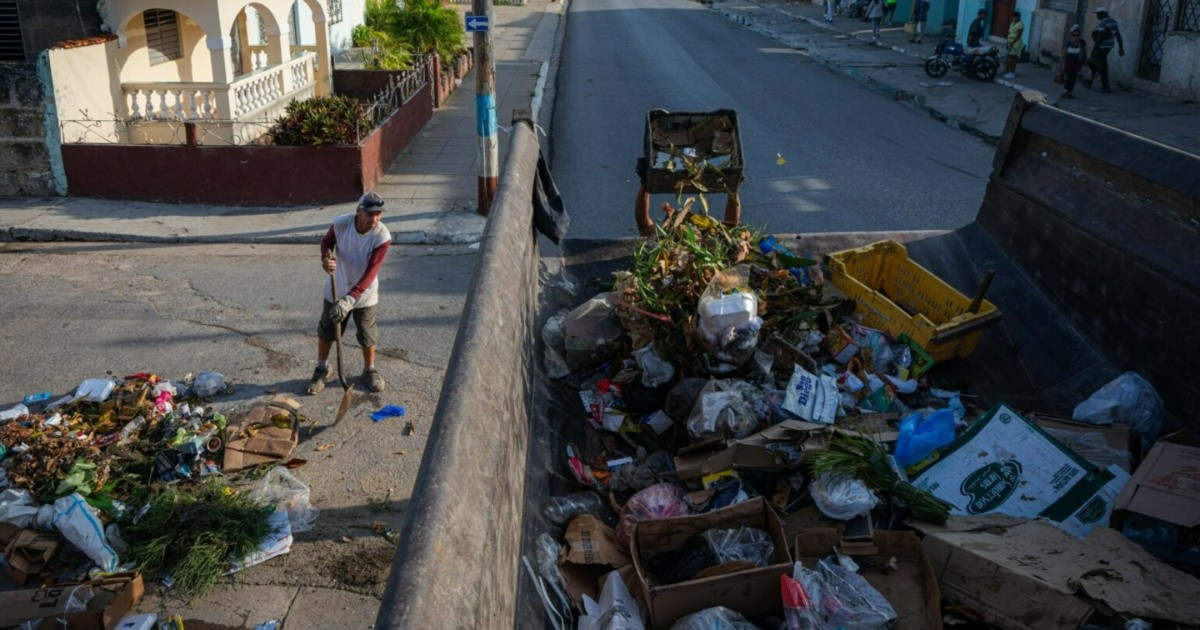
The landfills in Matanzas are overflowing, arsonists are setting them on fire, and toxic smoke seeps into homes while the Municipal Company of Communals lacks the fuel to collect the garbage with the minimum necessary frequency. This is documented in an investigative report from the Periódico Girón published this Saturday, which describes the situation with unusual starkness for an official media outlet of the regime: "Like a rotting tumor that has emerged on the sidewalk, the garbage pile overflows and invades the street. Waste, bacteria, and stench roam freely. The vultures peck at their carrion buffet at ground level, seemingly in no hurry."
The cause acknowledged by the authorities themselves is the scarcity of fuel, a direct symptom of the economic collapse that the Cuban dictatorship is experiencing after decades of mismanagement.
Michel León Rodríguez, mayor of the Yumurino municipality and the highest authority on waste collection, acknowledged that the allocation of diesel "varies between 300 and 550 liters daily, since the beginning of this year," when the ideal would be to have 112 liters per vehicle to complete two daily routes.
Reynol Valdés García, director of the Municipal Communal Company, confirmed that at this moment he only has about 11 operational trucks, compared to the 24 or 25 that can be mobilized when working alongside the Ministry of Construction.
The staff shortage exacerbates the situation: out of a workforce of approximately 1,400 employees, only about 930 are currently active, and more than 50% of the street sweepers are missing.
The neighborhood of Versalles is identified by the authorities as the most affected, with garbage piling up at every corner and sewage blockages worsening with the rain. The irony is that the initiative to incorporate animal traction is unfeasible right there, due to its steep hills.
Neighbors have been reporting the situation on social media for weeks. "On Salamanca and Dos de Mayo, next to the small square, the garbage mound is so large that trucks delivering goods have no way to park, and let’s not even mention that inside the establishment, flies cover the products,” Jorge Jiménez wrote on Facebook.
Liset Silverio pointed out a particularly shocking inequality: "There are places where it hasn't been collected for over a month — military distribution behind the terminal — while others are serviced daily or every three or four days."
Barbara Marilyn Rodríguez Castañeda summed up the feelings of many with a striking comparison: "During the Special Period, they picked them up in horse-drawn carts, and the streets were never like this."
The accumulation of waste exacerbates a multiple health emergency: more than 300,000 residents of the province lack a stable water supply, there are active alerts for hepatitis A in several municipalities, and overflowing trash creates breeding grounds for Aedes aegypti that fuel outbreaks of dengue and chikungunya just as the rains arrive.
This situation is neither new nor exclusive to Matanzas. The lack of fuel had already sunk Havana under mountains of garbage in January, with only 44 out of 106 garbage collection trucks operational. In March, Prime Minister Manuel Marrero Cruz acknowledged that "we lost the fight" against the accumulation of waste in the capital, after having asked Cubans to go out and collect garbage as if the solution depended on citizens' willingness rather than the state's incapacity.
In Matanzas, the outrage over the dumps had already erupted in April when a photograph revealed an improvised garbage dump occupying nearly the entire intersection of Levante and Solís streets. A resident described it bluntly: "It's disgusting and terrifying. There hasn't been any garbage collection for almost a month. It's a place where rodents and flies thrive. No one is providing a solution."
The Matanzas journalist Yirmara Torres Hernández summarized it this Saturday with a phrase that captures the magnitude of the collapse: "In Cuba there have been tough periods, but none have seen as much chaos, as much neglect... as much garbage."
Filed under: