
Related videos:
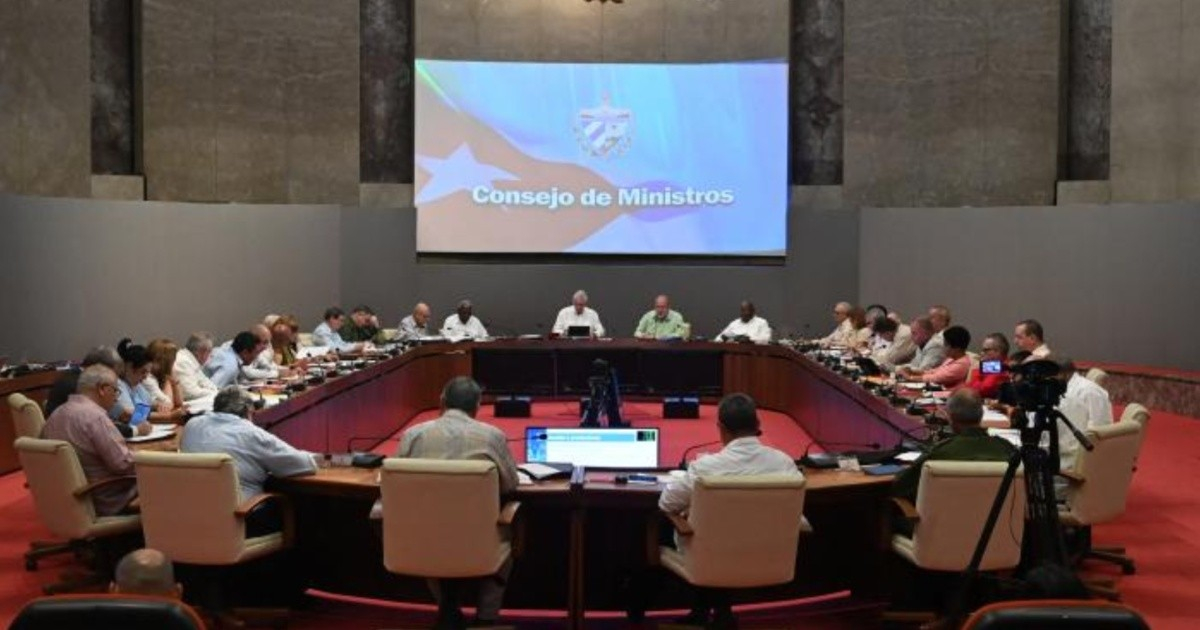
The Cuban Council of Ministers approved this month to initiate legislative action on a draft Law on the Organization of the Central State Administration, which reduces the number of agencies within that structure from 27 to 21, as reported by the official organ of the Communist Party of Cuba, Granma, in its edition this Saturday.
The regular session for the month of April was presided over by Miguel Díaz-Canel and directed by Prime Minister Manuel Marrero Cruz.
The proposal was presented by Andry Matilla Correa, Dean of the Faculty of Law at the University of Havana, who emphasized that it is «not just a mere structural movement, but the redesign of each of the Central State Administration Organizations».
The draft bill will regulate the general bases of organization, number, name, mission, and functions of the ministries and other entities that make up the state structure, and it is expected to be presented to the National Assembly of People's Power in July 2026.
Marrero Cruz justified the measure with an argument that implicitly acknowledges decades of bureaucratic hypertrophy: "A small country, a country with such a complex situation, cannot have such a large structure, so much bureaucracy, which makes processes inefficient, thus requiring a different design."
This reform is not an isolated event. Díaz-Canel announced in April that there would be fewer ministries, the elimination of intermediate structures, a reduction in the size of large state-owned enterprises, and greater municipal autonomy, all before mid-2026.
The process is part of the Economic and Social Program of the Government 2026, which at the end of the first quarter reports 81 specific objectives approved: 32 implemented and 49 in progress, out of a total of 158 planned actions.
Additionally, Decree 127 "On Budgeted Institutions" came into effect on May 8, 2026 and establishes the regulatory framework for resizing the budgeted sector, which accounts for over 50% of the active workforce in the country and encompasses approximately 2,443 units nationwide.
In the same session of the Council of Ministers, the Vice Prime Minister and Minister of Foreign Trade and Foreign Investment, Oscar Pérez-Oliva Fraga, warned that "traditional methods are not yielding results; therefore, we need to act with greater initiative, with different proposals, seeking mechanisms that adapt to current conditions."
The Council of Ministers also approved to take legislative initiative on the Labor Code and the Housing Law, both scheduled to be presented to the National Assembly in July 2026.
In economic terms, the Minister of Economy and Planning, Joaquín Alonso Vázquez, reported that the year-on-year inflation at the end of March 2026 stood at 13.42%, slightly above February, with pressures concentrated on agricultural prices in the non-state market, which rose by 31.9% in Havana.
The draft law that merges and eliminates six agencies within the central state apparatus will be presented to the National Assembly in July, although the recent history of structural reforms in Cuba—often announced and implemented slowly—suggests that we should withhold judgment on its actual impact.
Filed under: