
Related videos:
The U.S. Department of Energy announced on Friday that it has completed, together with Venezuela and international partners, the withdrawal of all remaining enriched uranium from the RV-1 research reactor, in an operation described as a milestone for nuclear non-proliferation in South America.
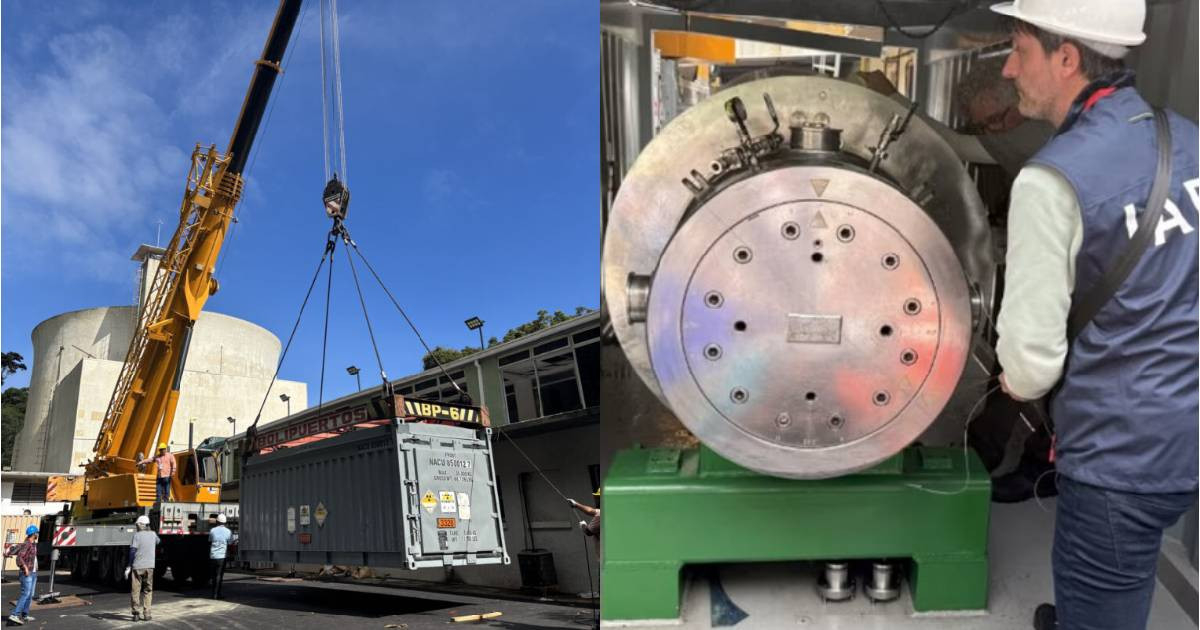
The team from the Defense Nuclear Nonproliferation Office (DNN) of the National Nuclear Security Administration (NNSA), in coordination with the Venezuelan Institute for Scientific Research, the International Atomic Energy Agency (IAEA), and experts from the United Kingdom, removed 13.5 kilograms (approximately 30 pounds) of uranium enriched above the critical threshold of 20%, reported the U.S. embassy in Caracas.
The RV-1 reactor supported research in physics and nuclear energy for decades, but it ceased operations in 1991, at which point its uranium remained as surplus unused material.
The operation was completed in less than six weeks following the initial site visit, a pace that the NNSA administrator, Brandon Williams, directly attributed to the White House.
"The safe removal of all enriched uranium from Venezuela sends another signal to the world of a restored and renewed Venezuela. Thanks to the decisive leadership of President Trump, the teams accomplished in months what would normally have taken years," the diplomatic statement highlighted.
The direct trigger was the visit of Energy Secretary Chris Wright to Venezuela in February, after which the NNSA worked with the State Department, Venezuelan authorities, and the IAEA to plan the extraction.
Once removed, the material was escorted 160 kilometers overland to a Venezuelan port, where it was transferred to specialized transport from the British company Nuclear Transport Solutions.
The vessel arrived at U.S. shores in early May, and the containers were transported to the Savannah River Site in South Carolina, where they will be processed to obtain high assay low-enriched uranium, intended for the United States' civilian nuclear program.
The doctor Matt Napoli, deputy administrator of the DNN, traveled personally to Venezuela to oversee the operation. "I could not be prouder of the men and women who carried out this vital mission. I also want to express my gratitude to our Venezuelan partners for carrying out this withdrawal of materials and laying the groundwork for future cooperation," he pointed out.
The Department of Energy framed the operation within the three-phase plan by Trump and Rubio for Venezuela, expedited following the capture of former president Nicolás Maduro on January 3 during Operation Absolute Resolution.
The normalization of relations between Washington and Caracas has progressed rapidly. The United States removed Delcy Rodríguez from the sanctions list in April, and by the end of that same month American Airlines resumed direct flights from Miami to Caracas for the first time in nearly seven years.
Since 1996, the NNSA has removed or confirmed the final disposition of more than 7,350 kilograms of highly enriched uranium and plutonium from dozens of countries, a track record that the Department of Energy presented as a testament to the technical capabilities deployed in Venezuela.
Filed under: