
Related videos:
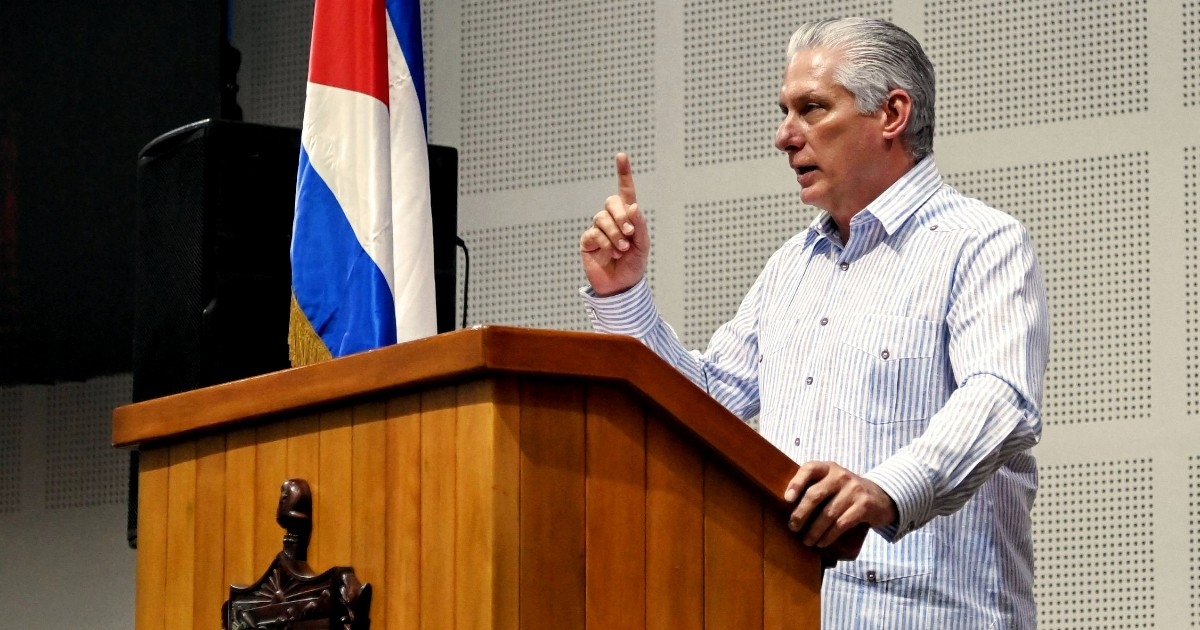
Miguel Díaz-Canel published a statement on Facebook in which he claims that “in more than six decades of socialist Revolution, just ninety miles from the U.S., not a single offensive action against the national security of that country has ever come out of Cuba.”
In his message, titled "Cuba does not threaten, Cuba is constantly threatened," the leader characterized the U.S. government as "cynical" for labeling Cuba as a "threat to U.S. national security."
His words are an immediate reaction to the statements made this Tuesday by U.S. Secretary of Defense Pete Hegseth, who confirmed before Congress that the Cuban regime poses a threat to the U.S., reiterating the warnings outlined in Executive Order 14380 dated January 29, 2026, signed by Donald Trump.
Historical elements that dismantle Díaz-Canel's discourse
For decades, the Cuban government has maintained a hostile discourse towards its northern neighbor, marked by periods of extreme tension.
The most difficult episode to overlook is the Cuban Missile Crisis of October 1962, when the USSR deployed nuclear missiles on Cuban soil capable of reaching all of the continental United States, with the knowledge and agreement of Fidel Castro.
For 13 days—from October 16 to 28, 1962—the world was on the brink of nuclear war, and the U.S. raised its DEFCON alert to level two, the highest position before an atomic confrontation.
It was from Cuban territory that those missiles pointed directly at American cities, a fact that no official narrative can erase.
Decades later, in the 1990s, the Red Avispa —Cuban espionage network dismantled by the FBI in September 1998— operated actively in Miami with specific military objectives.
Among those objectives were to infiltrate the Southern Command, the Boca Chica base in Key West, and to identify locations along the southern coast of the U.S. to introduce weapons and explosives, according to declassified FBI documents.
Its leader, Gerardo Hernández Nordelo, was commended by the Cuban Intelligence Directorate on April 1, 1996, for planning the downing of aircraft from Brothers to the Rescue, which resulted in the loss of four lives.
Between the 1960s and 1980s, Cuba trained guerrillas and sent military advisors to Latin America and Africa, and deployed over 377,000 troops in Angola from 1975 to 1991 in the so-called Operation Carlota, with more than 2,000 confirmed Cuban casualties.
Washington considered that export of the Cuban revolution a direct threat to its hemispheric influence throughout the Cold War.
In addition, Cuba has granted asylum since 1984 to Assata Shakur, convicted in 1977 for the murder of a police officer in New Jersey and sought by the FBI, whose extradition the regime has categorically ruled out.
In the current context, Secretary of State Marco Rubio noted on April 28, 2026, that Cuba allows adversaries to operate against U.S. interests, citing the presence of Russian and Chinese military bases on Cuban territory.
Díaz-Canel, on the other hand, insists that "to label Cuba as a threat while imposing additional coercive measures and accusing its government of being incapable of minimally sustaining its economy is so inconsistent and fantastical that even those who promote this thesis are unable to support it with solid arguments."
This is not the first time the Cuban leader has sent such messages to the U.S. and the world. In April, he had already issued warnings about a possible conflict with Washington, and on May 2nd, he responded to Trump, insisting that Cuba is not an aggressor.
Cuba is on the list of state sponsors of terrorism. The Trump administration has imposed over 240 sanctions against the island since January 2025.
Filed under: